CAPITVLVM TRICEDIMVM TERTIVMTHIRTY-THIRD CHAPTER
EXERCITVS ROMANVSTHE ROMAN ARMY
I
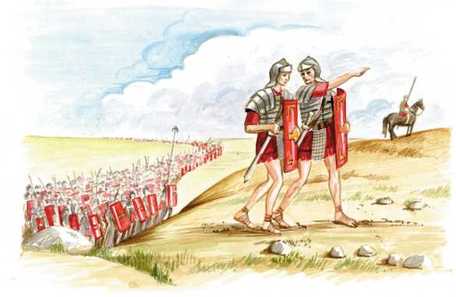
Exercitus Romanus universus constat ex legionibus duodetriginta, quae in denas cohortes dividuntur. In singulis legionibus sunt sena vel quina vel quaterna milia militum, qui omnes cives Romani sunt. Praeterea magna auxilia exercitui adiunguntur. Auxilia sunt pedites equitesque ex provinciis, qui arma leviora, sicut arcus sagittasque, ferunt. Legionarii sunt pedites scutis, gladiis pilisque armati.
Signum legionis est aquila argentea, quae in itinere ante agmen fertur. In itinere cohortes alia post aliam in longo ordine progrediuntur. Talis ordo militum progredientium dicitur agmen. Cum agmen ad hostes pervenit, si tempus et locus idoneus est ad pugnandum, cohortes in tres ordines instruuntur. Exercitus ita instructus acies appellatur. Ante proelium dux exercitus milites suos hortatur ut fortiter pugnent. Tum pedites procurrunt et primum pila in hostes mittunt, deinde eos gladiis caedunt. Hostibus proelio victis, dux a militibus 'imperator' salutatur. Vesperi exercitus loco ad defendendum idoneo castra ponit, quae vallo et fossa circumdantur. Ita muniuntur castra Romana.
Aemilius, frater Aemiliae minor, quem supra commemoravimus, a prima aetate studiosus fuit rei militaris. Iam puer septem annos natus gladios ligneos et arcus sagittasque sibi faciebat, ut cum aliis pueris eiusdem aetatis proelia luderet. Septendecim annos natus a patre interrogatus 'quid tum discere vellet?' filius statim respondit 'se nihil nisi rem militarem discere velle.' Voluntas filii patri haud placebat, cum ipse litteris studeret neque ullum aliud studium filio suo dignum esse arbitraretur. Cum vero filius nullo modo contra voluntatem ad studium litterarum cogi posset, pater eum una cum Publio Valerio, adulescente eiusdem aetatis, in Germaniam ad exercitum Romanum misit, ut apud ducem quendam egregium stipendia mereret. Ibi Aemilius pro patria pugnans iam magnam gloriam militarem sibi quaesivit. Virtus eius egregia ab omnibus laudatur.
Et pater et soror Aemilii frequentes epistulas ad filium et fratrem suum mitunt. Pater maxime de rebus publicis scribit, sed Aemilia de rebus privatis, ut de liberis suis et de conviviis, scribere solet. Epistulae quas Aemilius ad patrem dat praecipue de gloria et virtute militari sunt, sed ex iis litteris privatis quas Aemilia nuper a fratre suo accepit plane apparet eum iam vita militari fatigatum esse. Ecce litterae novissimae, quas Aemilia pridie kalendas Iunias a fratre accepit et postero die in convivio recitavit:
The entire Roman army consists of twenty eight legions, which are divided into ten cohorts each. In a single legion there are six or five or four thousand soldiers each, who are all Roman citizens. Moreover a large number of auxiliary troops are added to the army. Auxiliary troops are foot soldiers and cavalry from the provinces who carry light arms, such as a bow and arrows. Legionaires are foot soldiers armed with shields, swords and javelins.
The sign of the legion is a silver eagle, which is carried on a journey ahead of the column. On the journey the cohorts advance one after another in a long row. Such a row of advancing soldiers is called a column. When a column arrives at the enemy, if the time and place are suitable for fighting, the cohorts are arranged in three rows. The army lined up thus is called a battle line. Before the battle the leader of the army encourages his soldiers to fight bravely. Then the foot soldiers run forward and first send javelins against the enemy, then they kill them with swords. With the enemy vaquished in battle, the leader is hailed as commander by the soldiers. In the evening the army pitches camp at a place suitable for defense, which is encircled by walls and ditches. Thus the Roman camp is fortified.
Aemilius, younger brother of Emilia, whom we mentioned above, was interested in military matters from an early age. Now the seven year old boy was making wooden swords and a bow and arrows in order to play batlle with other boys his age. When he was seventeen, he was asked by his father what he wanted to learn then ?' Immediately the son replied that he wanted to learn nothing besides military matters. The son's will is not pleasing to the father, since he studied literatue and did not think any other study to be worthy of his son. But since the son could not be forced against his will to study literature, the father sent him together with Publius Valerius, a young man his age, to Germany to the Roman army, to earn wages with a certain excellent man. There Aemilius fighting for his country already sought great military glory for himself. His outstanding courage was praised by all.
Both Aemilius's father and sister often send letters to their son and brother. His father writes much of public affairs, but Emilia is accusomed to write of personal that of her children and dinner parties. The letters that Aemilius gives to his father are of military glory and courage, but from those letters that Emilia has received recently from her brother it is clearly apparent that he is already tired of the military life. Behold the newest letter that Emelia received the day before Kalends of June from her brother and which she recited at the dinner party:
II
“Aemilius sorori suae carissimae s. d.
Hodie demum mihi allata est epistula tua quae a. d. VII kal. Mai. scripta est, id est ante viginti dies. Quam tardus est iste tabellarius! Celsi sane et ardui montes Germaniam ab Italia disiungunt, ac difficillimae sunt viae quae trans Alpes ferunt, sed tamen celer tabellarius idem iter quindecim fere diebus conficere potest, ut tabellarii publici quibus utitur dux noster. Ego vero istum tabellarium properare docebo, cum meas litteras ad te referet.
Sed quamquam tarde advenit, gratissima mihi fuit tua epistula magnoque cum gaudio ex ea cognovi te et Iulium et liberos vestros, quos valde diligo, bona valetudine frui. Cum epistulas tuas lego, apud vos in Albano esse mihi videor, neque in hac terra frigida inter homines barbaros. Tum, nescio quomodo, ita permoveor ut lacrimas vix teneam - ita patriam et amicos meos desidero.
O, quam longe absum ab Italia et ab iis omnibus quos praecipue diligo! Utinam ego Romae essem aut tu apud me esses! Cum Danuvium flumen aspicio, quod praeter castra nostra fluit, de Tiberi cogito atque de Roma. Quando te aspiciam, urbs pulcherrima? Utinam hic amnis Tiberis esset et haec castra essent Roma!
Sed frustra haec opto, cum nemo nisi deus ita subito in alium locum transferri possit. Si Mercurius essem alasque haberem, vento celerius trans montes amnesque in Italiam volarem, ubi Venus, soror mea pulcherrima, fratrem ridens reciperet.
Ridebis certe, mea soror, nec sine causa, nam ridiculum est tales res optare, nec lacrimas effundere militem decet, cuius officium est sanguinem effundere pro patria. Ego vero, etsi cupidus sum patriae videndae, officium meum praestabo sicut ceteri milites Romani, quorum magnus numerus in Germania est. Nisi nos hic essemus finesque imperii defenderemus, hostes celeriter Danuvium et Alpes transirent atque usque in Italiam pervenirent, nec vos in Latio tuti essetis. Ne hoc fiat, legiones Romanae hic sunt ac tamdiu remanebunt quamdiu hostis armatus seu citra seu ultra Danuvium flumen reliquus erit.
Quoniam igitur ipse ad te properare non possum, litteras ad te scriberre propero. Quaeris a me cur tibi unas tantum litteras scripserim, cum interim trinas quaternasve litteras a te acceperim. Haud difficile est me excusare, quod neglegens fuerim in scribendo. Si mihi tantum esset otii quantum est tibi, in epistulis scribendis non minus diligens essem quam tu. Sed cum per complures menses vix tempus habuerim ad dormiendum, facile intelleges nullum mihi otium fuisse ad epistulam scribendam. Prope cotidie aut Germani castra nostra oppugnaverunt aut nos impetus fecimus in illos.
Hodie vero nullum hostem armatum citra flumen videmus. Magnus numerus eorum aut caesus aut captus est a nostris, reliqui ultra flumen in magnis silvis latent. Heri enim exercitum Germanorum proelio vicimus. Quod sic factum est:
"Aemilius sends greetings to his very dear sister
Today at last I received your letter that has been writted seven days before Kalends of May, that is twenty days ago. How late that postman is! Certainly the mountains that separate Gemany and Italy are tall and difficult, and the roads are very difficult that lead across the Alps, but nevertheless a faster postman can make the same journey is about fifteen days, as the public postman used by our leader. But I will teach that postman to hurry when he brings my letters to you.
But even though it arrived late, your letter was very pleasing to me and with great joy I learned that you, Julius and your children, whom I love greatly, enjoy good health. When I read your letters, I seem to be with you in Alban, and not in this frigid land among barbarians. Then, I don't know how, I was thus moved that I could harldy hold back tears - thus I miss my country and friends.
O, how long I have been away from Italy and especially from all of those whom I love! Would that I had been in Rome or you had been with me! When I see the Danube river, which flows beside our camp, I think of the Tiber and of Rome. When will I see you, beautiful city? Would that this river had been the Tiber and this camp had been in Rome!
But I hope this in vain, since no one besides a god can transport immediately into another place. If I was Mercury and had wings, I would fly with a swift wind across the mountains and rivers into Italy, where Venus, my most beautiful sister, would receive her brother with a laugh.
You will certainly laugh my sister, but without reason, for it is not fitting to hope for such a ridiculous thing nor to shed tears for soldier whose duty is to shed blood for his country. But even though I am eager to see my country, I will fulfill my duty just as other Roman soldiers, of which there is a large number in Germany. Unless we were here and defending the empire, the enemy might quickly cross the Danube and Alps and come into Italy, and you would not be safe in Latinum. To prevent that from happening, the Roman legions are here and will remain as long as an armed enemy is left on this side of the Danube river or beyond.
Therefore since I cannot hurry to you myself, I will hurry to write letters to you. You asked me why I wrote only one letter to you, when I received three or four letters from you. It is not difficult to excuse me because I have been negligent in writing. If only I had as much leisure as you, I am not as diligent as you in writing letters. But since I've barely had to sleep for several months, you will easily understand that I had no leisure time to write a letter. Almost everyday the Germans have attacked our camp or we made an attack against them.
But today we saw no armed enemy on that side of the river. A large number of them were either killed or captured by our men, the remaining are hiding beyond the river in the great forest. For yesterday we overcame the German army in battle. This is what happened:
III
Media nocte in castra nuntiatum est 'magnum hostium numerum naviculis ratibusque copulatis flumen transiisse celeriterque secundum flumen adversus castra nostra progredi.' Hoc nuntio allato, milites statim convocati sunt. Qui cum arma cepissent et vallum ascendissent, primo mirabantur quamobrem media nocte e somno excitati essent, cum extra vallum omnia tranquilla esse viderentur. Ego quoque dubitare coeperam nun nuntius verum dixisset, cum subito paulo ante lucem magnus numerus Germanorum e silvis proximis excurrens castra nostra oppugnavit. Nostri, cum parati essent ad castra defendenda, illum primum impetum facile sustinuerunt. Nec tamen hostes castra oppugnare destiterunt, sed alii ex aliis partibus etiam atque etiam sub vallum procurrerunt. Cum complures horas ita fortissime a nostris, ab hostibus constanter ac non timide pugnatum esset, equitatus noster repente porta dextra erumpens impetum in latus hostium apertum fecit. Paulo post, cum plerique hostes se ad equites convertissent, pedites nostri porta sinistra eruperunt. Hostes hac re perturbati, cum iam longa pugna fatigati essent, impetum Romanorum ab utraque parte venientium diutius sustinere non potuerunt, ac post brevem pugnam terga verterunt. Cum ad ripam fluminis fugientes pervenissent, alii naviculis ratibusque se servaverunt, alii armis abiectis in flumen se proiecerunt, ut natando ad ripam ulteriorem pervenirent, reliqui omnes ab equitibus, qui ad eos persequendos missi erant, in ripa citeriore caesi aut capti sunt. Tanta ibi caedes hostium facta est ut meminisse horream.
Duo fere milia hominum magnamque armorum copiam hostes eo proelio amiserunt. E nostris haud multi desiderantur. Ipse sagitta in bracchio laevo vulneratus sum, sed vulnus meum leve est, multi graviora vulnera acceperunt. Nec vero ullus miles legionarius a tergo vulneratus est. Plerique autem milites nostri ex tanto proelio incolumes sunt.
Hoc proelio facto, dux victor, cum a militibus imperator salutatus esset, virtutem nostram laudavit 'quod contra hostes numero superiores fortissime pugnavissemus'; 'tot hominibus uno proelio amissis, hostes brevi arma posituros esse' dixit. His verbis maximo gaudio affecti sumus, nam post longum bellum omnes pacem desideramus. Hodie legati a Germanis missi ad castra venerunt, ut cum imperatore colloquerentur. Nescio an legati pacem petitum venerint, sed certo scio imperatorem nostrum cum hoste armato colloqui nolle.
Ego cum ceteris hac victoria gloriosa gaudeo quidem, sed multo magis gauderem si amicus meus Publius Valerius, quocum primum stupendium merui, incolumis esset et mecum gaudere posset. Qui cum mihi in hostes progresso auxilium ferre vellet, ipse ex acie excurrens pilo percussus cecidit. Graviter vulneratus in castra portatus est, ubi in manibus meis ex vulnere mortuus est, postquam me oravit ut per litteras parentes suos de morte filii consolarer. Sed quomodo alios consoler, cum ipse me consolari non possim? Fateor me lacrimas effudisse cum oculos eius clausissem, sed illae lacrimae et militem et amicum decebant, etenim malus amicus fuissem, nisi lacrimas effudissem super corpus amici mortui, cum ille sanguinem suum pro me effudisset.
Utinam patrem audivissem, cum me ad studium litterarum hortaretur! Sed tum litteras et studiosos litterarum despiciebam. Poetas ut homines otiosos oderam, praecipue Tibullum, qui vitam rusticam atque otiosam laudabat, vitam militarem despiciebat. Mirabar cur ille poeta mortem gloriosam pro patria 'diram' vocaret et enses quibus patria defenditur 'horrendos', ut in his versibus, quos senex magister etiam atque etiam nobis recitabat:
Quis fuit horrendos primus qui protulit enses?
Quam ferus et vere ferreus ille fuit!
Tum caedes hominum generi, tum proelia nata,
tum brevior dirae mortis aperta via est!
Ridiculi mihi puero videbantur ii versus, cum nondum caedem vidissem. At hodie Tibullum verum dixisse intellego. Si iam tum hoc intellexissem, certe patrem audivissem nec ad bellum profectus essem, ut tot caedes et tot vulnera viderem.
At iam satis de caede scripsi. Nolo te fatigare narrando te bello cruento, cum brevi pacem fore speremus. Nisi ea spes me fallit, posthac plures epistulas a me exspectato, atque plures etiam ipsa scribito! Etiam alios moneto ut ad me litteras dent. Et de re publica et de re privata narratore mihi! Scitote me omnia quae apud vos fiunt cognoscere velle.
Valetudinem tuam cura diligenter! Datum pridie idus Maias ex castris.
It was reported to the camp in the middle of the night that a large number of enemy boats and rafts had crossed the river and were quickly advancing along the river against our camp. With this report delivered, the soldiers were immediately called together. Those who had taked up arms and climbed the rampart, they first wondered why they had been woken from sleep in the middle of the night, when everything seemed to be peaceful outside the wall. I also began to doubt whether the messenger had spoken the truth, when suddenly shortly before dawn a large number of Germans running out of the nearby forest, attacked our camp. Our men, since they had been prepared to defend the camp, easily withstood that first attack. Nevertheless the enemy did not stop attacking the camp, but others from other parts ran again and again under the rampart. When for several hours thus it was fought by us constantly and not with fear by our enemy, suddenly our cavalry on the right gate made an attack against the open side of the enemy. A little after. when many of the enemy had turned themselves to the cavalry, our foot soldiers broke out from the left gate. The enemy disturbed by this affair, since they they had already been fatigued by a long fight, they were not able to sustain the Roman's attack coming from two directions, and after a short fight they turned to their backs. When they arrived at the bank of the river fleeing, some saved themselves with their boats and rafts, others threw away their weapons threw themselves into the river so that by swimming to the bank they might arive at the other side, all of the rest were either killed or captured on the nearer side of the river bank by our cavalry, who had been sent to pursue them. The slaughter there was so great that I shudder to remember it.
The enemy lost about two thousand men and a large supply of arms in that battle. Not many were missing from our men. I myself was wounded in my left arm by an arrow, but my wound is light, many more serious wounds were received. But no soldier of the legion was wounded in the back. But most of our soldiers are safe from so great a battle.
With this battle done, the winning leader, when he had been hailed commander by the soldiers, praised our courage 'because we fought bravely against an enemy superior in number'; 'having lost so many in the battle, the enemy would soon lay down their arms' he said. With these words we were affected with the greatest joy, for after a long war we all desired peace. Today envoys sent by the Germans came to the camp to speak with the commander. I don't know if the envoys came seeking peace, but I certainly know our commander did not want to speak with an armed enemy.
Of course I rejoice with the others for this glorious victory, but I will rejoice much more if my friend Publius Valerius, with whom I earned my first wage, had been unharmed and could rejoice with me. He who was willing to bring help when I set out against the enemy, himself fell struck by a javelin running from the column. He was carried to camp with serious wounds, where he died in my hands from his wounds, he begged me after that I console his parents through letters of their son's death. But how do I console another when I cannot be consoled myself? I confess that I had shed tears when I closed his eyes, but those tears were fitting for both a soldier and friend, for I would have been a bad friend, unless I had shed tears on my friend's dead body, when his blood had been shed for me.
Would that I had listened to father, when he encouraged me to study literature! But then I hated letters and studying literature. I hate poets as idle men, especially Tibullus, who praising the rural and idle life, despised the soldier's life. I wondered why that poet called a glorious death for the country 'terrible' and the swords with which the country was defended 'horrible,' as in these verses which the old teacher recited to us again and again:
Who was the first to bring forth the horrible swords?
How wild and like iron he was!
Then slaughters for the races of men, then battles were born,
then shorter path of dire death was opened!
Those verses seemed ridiculous to me as a boy, when I had not yet seen death. But today I understand the truth Tibullus had spoken. If I had understood this then, certainly I would have listened to father and not set out to war, so that I would not have seen so many deaths and wounds.
But now I have written enough about death. I don't want to tire you telling you of bloody war, when shortly we are hoping peace will be made. Unless this hope deceives me, expect more letters from me after this, and write more yourself! Even advise others to send letters to me. And tell me of state and personal matters! Know that I want to know all things which are happening with you.
Take diligent care of your health! Given from the camp on the day before the ides of May.
GRAMMATICA LATINA
Coniunctivus
Tempus plusquamperfectum
[A] Activum
Iulius dubitabat num magister Marcum laudavisset.
'Laudavisset' coniunctivus est temporis praeteriti plusquamperfecti. Coniunctivus plusquamperfecti desinit in -isset (pers. III sing.), quod ad infinitivum perfecti sine -isse adicitur.
Exempla: [1] recita|isset; [2] paru|isset; [3] scrips|isset; [4] audiv|isset.
Pater filium interrogavit 'num bonus discipulus fuisset: num magistro paruisset, attente audivisset, recte scripsisset et pulchre recitavisset.' Filius non respondit. Tum pater ab eo quaesivit 'num a magistro laudatus esset.' Cum filius id negavisset, "ergo" inquit pater "malus discipulus fuisti; nam si bonus discipulus fuisses, magister te laudavisset. So magistro paruisses, attente audivisses, recte scripsisses et pulchre recitavisses, a magistro laudatus esses." Filius: "Etiam si industrius fuissem, magister me non laudavisset." Pater: "Quid?" Filius: "Etiam si magistro paruissem, attente audivissem, recte scripsissem et pulchre recitavissem, laudatus non essem ab illo magistro iniusto!"
Pater filios interrogavit 'num boni discipuli fuissent: num magistro paruissent, attente audivissent, recte scripsissent et pulchre recitavissent.' Filii non responderunt. Tum pater ab iis quaesivit 'num a magistro laudati essent.' Cum filii id negavissent, "Ergo" inquit pater "mali discipuli fuistis; nam si boni discipuli fuissetis, magister vos laudavisset. Si magistro paruissetis, attente audivissetis, recte scripsissetis et pulchre recitavissetis, a magistro laudati essetis." Filii: "Etiam si magistro paruissemus, attente audivissemus, recte scripsissemus et pulchre recitavissemus, laudati non essemus ab illo magistro iniusto!"
| Singularis | Pluralis | |
| Persona prima | -issem | -issemus |
| Persona secunda | -isses | -issetis |
| Persona tertia | -isset | -issent |
[B] Passivum
Exempla: vide supra!
| Singularis | Pluralis | |
| Persona prima | laudatus essem | laudati essemus |
| Persona secunda | laudatus esses | laudati essetis |
| Persona tertia | laudatus esset | laudati essent |
Imperativus futuri
Pugnato, miles! Pugnatote, milites!
'Pugnato, pugnatote' imperativus futuri est. Imperativus futuri desinit in -to (sing.) et -tote (plur.); idem fere significat atque imperativus praesentis ('pugna, pugnate').
Exempla:
Magister: "Posthac bonus discipulus esto, puer! Semper mihi pareto! Diligenter audito! Pulchre recitato et recte scribito!"
Magister: "Posthac boni discipuli estote, pueri! Semper mihi paretote! Diligenter auditote! Pulchre recitatote et recte scribitote!"
LATIN GRAMMAR
Subjunctive
Pluperfect Time
[A] Active
Julus doubted whether the teacher had praised Marcus
'Laudavisset' is subjunctive
VOCABVLA
legio, legionis f.
cohors, cohortis f.
agmen, agminis n.
ordo, ordinis m.
acies, aciei f.
proelium, proeli n.
imperator, imperatoris m.
aetas, aetatis f.
studium, studi n.
stipendium, stipendi n.
virtus, virtutis f.
gaudium, gaudi n.
valetudo, valetudinis f.
amnis, amnis m.
ratis, ratis f.
ripa, ripae f.
caedes, caedis
vulnus, vulneris n.
pax, pacis f.
legatus, legati m.
ensis, ensis m.
legionarius, a, um
idoneus, a, um
militaris, militare
publicus, a, um
privatus, a, um
posterus, a, um
arduus, a, um
ridiculus, a, um
ulterior, ulterius
citerior, citerius
incolumis, incolume
otiosus, a, um
dirus, a, um
horrendus, a, um
deni, ae, a
seni, ae, a
quini, ae, a
quaterni, ae, a
uni, ae, a
trini, ae, a
commemoro, -are, -avi, -atum
studeo, studere, studui, -
cogo, cogere, coegi, coactum
fatigo, -are, -avi, fatigatum
propero, -are, -avi, properatum
desidero, -are, -ravi, -atum
transfero, -ferre, -tuli, -latum
effundo, -fundere, -fudi, -
praesto, -are, -avi, praestatum
transeo, -ire, -ivi, transitum
copulo, -are, -avi, copulatum
convoco, -are, -avi, -atum
excurro, -currere, -curri, -
procurro, -ere, -curri,
erumpo, erumpere, erupi,
vulnero, -are, -avi, vulneratum
fore
plerique
pridie
praecipue
tamdiu
quamdiu
diutius
fere
etenim
citra
ultra
secundum
VOCABULARY
legion, army
armed force
marching army, troop
order, rank, series
sharp edge, point
armed encounter, fight
general, commander
lifetime, age, time
devotion, study, zeal
pay, wages, tribute
manliness, courage
gladness, delight, joy
good health, soundness
stream, current, river
raft, ship, boat
bank
slaughter, slain
wound, mental hurt
peace, harmony
ambassador, envoy
sword
legionary, of a legion
suitable, fit, proper
military, of a soldier
public, common
private, personal
following, next
lofty, high, steep
laughable, funny, silly
farthest, last, highest
nearer, urgent, sooner
unharmed, uninjured
unemployed, at leisure
awful, cruel, fearful
horrible, dreadful
by tens
by sixes
by fives
by fours
one at a time
three at a time
to remember, mention
to desire, to strive
to compel, to confine
to tire, to weary
to speed up, to hurry
to long for, to miss
carry across, transport
to pour out, send forth
fulfill, be responsible for
to go over, to cross
to connect, to couple
call together, convene
to run out
advance, run forward
break out, spring forth
to wound, to injure
to be about to
majority, most
day before
especially, chiefly
so long, all this time
as long as, until
by day, all day
almost, about, nearly
and indeed, because
less than, on this side
beyond, on that side
after, according to