CAPITVLVM VICESIMVM QVARTVM TWENTY-FOURTH CHAPTER
PVER AEGROTVSTHE SICK BOY
I
Interim Quintus lecto tenetur. Puer aegrotus iterum iterumque super lectum se convertit nec dormire potest sive in latere dextro cubat sive in latere sinistro. Itaque e lecto surgere conatur, sed pes denuo dolere incipit. Puer territus pedes nudos aspicit et “Quid hoc est?” inquit, “Pes dexter multo maior est quam pes laevus!” Quintus miratur quod pedes, qui heri pares erant, hodie tam impares sunt. Tum puer aegrotus in lecto recumbit. Villa quieta est: nullus sonus auditur ab ulla parte; etiam aves, tempestate subita territae, in horto silent.
At subito silentium clamore et strepitu maximo rumpitur, nam Marcus in cubiculo suo, quod iuxta cubiculum Quinti est, magna voce clamat et forem manibus pedibusque percutit. Quintus, qui tantum strepitum miratur, Syram vocat; quae continuo accurrit.
Syra: “Quid est, Quinte? Putavi te dormire.”
Quintus: “Mene dormire per tantum strepitum? Quid agitur, Syra? Quam ob rem Marcus sic clamat ac forem tam valde percutit?”
Syra: “Noli hoc mirari: Marcus forem frangere conatur, quod aliter exire non potest. Sed tu quid agis? Doletne tibi pes adhuc?”
Puer 'pedem sibi dolere' ait: “Valde mihi dolet pes, ob dolorem e lecto surgere non possum.”
Syra: “Tune e lecto surgere conatus es?”
Quintus: “Certe surgere conatus sum, at necesse fuit me continuo recumbere, ita pes doluit. Intuere pedes meos, Syra! Compara eos! Antequam de arbore cecidi, pares erant, nunc pes dexter maior est pede laevo.”
Syra: “Ego non miror pedum tuum aegrum esse, quod de tam alta arbore cecidisti; at miror te crus non fregisse. Facile os frangere potuisti.”
Quintus: “Quis scit? Fortasse os fractum est, nam pedem vix movere possum sine doloribus.”
Syra: “Ossa tua integra sunt omnia. Noli flere! Puerum Romanum sine lacrimis dolorem pati decet.”
Quintus: “Non fleo, etsi dolorem gravem patior. Tristis sum, quod mihi necesse est intus cubare, dum alii pueri foris ludunt. Consolare me, Syra! Conside hic iuxta lectum et loquere mecum!”
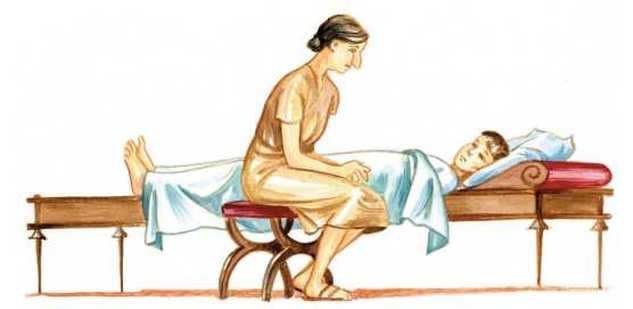
Syra iuxta lectum ad latus pueri laevum considit eumque sic consolatur: “Noli tristis esse quod hic intus cubas: immo laetere te non inclusum esse in cubiculo ut fratrem tuum! Nec Marco licet cum aliis pueris ludere.”
Quintus: “Is non aegrotat nec dolores patitur.”
Syra: “Etsi valet, certe tergi dolores passus est.”
Quintus: “Estne verberatus Marcus? Cur ei non licet exire? Quid factum est postquam frater meus domum rediit? Omnia ignoro. Dum hic solus cubo, nihil noscere possum, etsi omnia scire cupio.”
Meanwhile Quintus is held in bed. The sick boy turns himself over again and again on his bed but cannot sleep either lying on his right side or on his left side. Therefore he tries to get up from bed, but his foot begins to hurt again. The terrified boy looks at his naked feet and says, "What is this? My right foot is much bigger than my left foot!" Quintus is surprised because his feet, which yesterday were equal, today are so unequal. Then the sick boy lies back down into bed. The villa is quiet: no sound is heard from any part; even birds, terrified by the sudden storm, are silent in the garden.
But suddenly the silence is broken by shouting and a very great sound, for Marcus in his room, which is near Quintus's room, shouts with a loud voice and hitting the door with his hands and feet. Quintus, who is surprised by such a great noise, calls Syra; who comes running immediately.
Syra: "What is it Quintus? I thought you were sleeping."
Quintus: "You thought I was sleeping through so much noise? What happened Syra? Why is Marcus shouting and hitting the door so hard?"
Syra: "This is not surprising: Marcus is trying to break the door because he cannot get out another way. But how are you doing? Is your foot still hurting you?"
The boy says 'his foot is hurting': "My foot is hurting a lot, I cannot get up from bed from pain."
Syra: "Are you trying to get up from bed?"
Quintus: "Certainly I am trying to get up, but it was necessary for me to immediately lie back down, my foot hurt in such a way. Look at my feet Syra! Compare them! Before I fell from the tree, they were equal, now the right foot is larger than the left foot."
Syra: "I am not surprised your foot is hurting because you feel from such a tall tree; but surprised your leg is not broken. A bone can be easily broken."
Quintus: "Who noses? Perhaps the bone is broken for I can barely move my foot without pain."
Syra: "All your bones are unbroken. Do not cry! It is fitting for a Roman boy to endure pain without tears."
Quintus: "I am not crying, even though I am suffering serious pain. I am sad because it is necessary for me to lie down inside while other boys are playing outside. Console me Syra! Sit down on the bed next to me and talk with me!"
Syra sits down on the bed next to the boy's side and consoles him: "Do not be sad because you are lying down inside: on the contrary be happy you are not locked in your room like your brother! It is not allowed for Marcus to play with other boys."
Quintus: "He is not sick and does not suffer pain."
Syra: "Even though he is well, his backside is certainly suffering pain."
Quintus: "Was Marcus beaten? Why is he not allowed to go out? What happened after my brother returned home? I am ignorant of everything. While I am lying in this room I can know nothing even though I am eager to know everything."
II
Syra: “Iam narrabo tibi omnia quae facta sunt: Frater tuus hodie sine comite in ludum iit...”
Quintus: “Nonne Medus eum comitatus est?”
Syra: “Medus heri domo fugit - puto quia amicam suam, quae Romae habitat, videre cupivit.”
Quintus: “Quomodo Medus, qui vix umquam Romae fuit, puellam Romanam noscere potuit?”
Syra: “Nescio quomodo, sed certo scio eum aliquam feminam novisse, nam saepe de ea locutus est. NIhil difficile est amanti, ut aiunt.
“Medus igitur hodie Marcum comitari non potuit. Nuper Marcus solus rediit, sed pater filium suum redeuntem vix cognovit neque eum osculatus est ut solet, nam Marcus non modo umidus erat quod per imbrem ambulaverat, sed etiam sordidus atque cruentus quod humi iacueruat et a Sexto pulsatus erat. Pueri enim in via pugnaverant: primum Marcum pulsaverat Sextus, tum Marcus et Titus Sextum pulsaverant. Hoc audito, dominus Marcum severe reprehendit.”
Quintus: “Mater quid dixit?”
Syra: “Mater tua non aderat, sed paulo post intravit. Tunc Marcus iam lautus erat et vestem mutaverat, domina eum sordidum atque cruentum non vidit. Marcus vero 'se bonum discipulum fuisse' dixit, etsi in ludo dormiverat nec magistrum recitantem audiverat - ceterum in hac re is non peior fuerat ceteris, nam omnes dormiverant! Postremo litteras pulchras quas Sextus scripserat matri ostendit atque dixit 'se ipsum eas litteras scripsisse.' Tam turpiter frater tuus mentitus est!”
Quintus: “Quomodo scis Marcum mentitum esse et eas litteras a Sexto scriptas esse?”
Syra: “Quia nomen 'Sexti' in tabella scriptum erat. Et paulo post tabellarius advenit...”
Quintus: “Nuper aliquem ianuam pulsare et canem valde latrare audivi. Tum subito magna voce clamavit aliquis. Quidnam tantus ille tumultus significavit?”
Syra: “Tabellarius clamavit quod canem veritus est, nec sine causa, nam canis eum momordit et vestem eius scidit. Is canis lupo ferocior est!”
Quintus: “Ego canem ianitoris non vereor neque umquam ab eo morsus sum.”
Syra: “Id non miror, nam canis saepissime te vidit. Canis te novit, ignorat illum.”
Quintus: “Canis me non modo novit, sed etiam diligit, nam multa ei ossa dedi et saepe cum eo lusi. Ceterum quid attulit tabellarius?”
Syra: “Epistulam attulit in qua magister scripserat 'Marcum discipulum pigerrimum fuisse atque foede et prave scripsisse.' Tum Marcus, qui primo omnia negaverat, 'se mentitum esse' fassus est.”
Quintus: “Profecto verbera meruit!”
Syra: “Magister eum iam bis verberaverat, nec igitur pater eum denuo verberare voluit, sed in cubiculum inclusit. Ceterum facile tibi est fratrem tuum reprehendere, dum ipse hic in molli lectulo cubas. Tune ipse semper bonus discipulus es?
Quintus: “Melior sum fratre meo! Heri laudatus sum, quia pulchre scripseram et recitaveram.”
Syra: “Tune solus pulchre scripseras et recitaveras?”
Quintus: “Immo omnes praeter Marcum laudati sumus, quod pulchre scripseramus et recitaveramus.”
Syra: “Si vos laudati estis, quod pulchrius scripseratis et recitaveratis quam Marcus, nonne ille tam recte scripserat quam vos? Ego Marcum bene novi, nec puto eum vobis stultiorem esse.”
Quintus: “At certe pigrior est nobis!”
Syra: "Now I will tell you everything which has happened: your brother went to school without a companion today..."
Quintus: "Was Medus not his companion?"
Syra: "Medus fled from the house yesterday - I think because he was eager to see his girlfriend who lives in Rome."
Quintus: "How can Medus who was hardly ever in Rome know a Roman girl?"
Syra: "I don't know how but I certainly know him to know some woman for he often spoke of her. Nothing is difficult for lovers as they say.
"Medus therefore could not accompany Marcus today. Recently Marcus returned alone but your father barely recognized his son nor kiss him as he is accustomed to for Marcus was not only wet because he walked through the rain but also dirty and bloody because he was thrown to the ground and punched by Sextus. For the boys fought in the road: first Sextus punched Marcus then Marcus and Titus punched Sextus. After hearing this, the master reprimanded Marcus severely."
Quintus: "What did mother say?"
Syra: "Your mother was not present but entered a little after. Then Marcus was washed and changed clothes, the mistress did not see him dirty and bloody. But Marcus said 'he had been a good student' even though he slept in school and did not listen to the teacher recite - he was not worse than the others in this matter for everyone slept! After he showed the beautiful letters that Sextus wrote and said 'that he had written the letters himself'. Your brother told such a foul lie!"
Quintus: "How do you know Marcus had told a lie and those letters were written by Sextus?"
Syra: "Because the name 'Sextus' was written on the tablet. And a little after the postman arrived..."
Quintus: "Recently I heard someone knock on the door and the dog barking loudly. Then suddenly someone shouted with a loud voice. What was the meaning of such a disturbance?"
Syra: "The postman shouted because the dog scared him but not without reason for the dog bit him and tore his clothes. The dog is more ferocious than a wolf!"
Quintus: "I am not afraid of the doorkeeper's dog and I am not ever bitten by him."
Syra: "That is not surprising for the dog very often sees you. The dog knows you the does not know him."
Quintus: "The dog not only knows but also loves me, for I give many bones to him and often play with him. However what did the postman bring?"
Syra: "He brought a letter in which the teacher wrote 'Marcus has been a very lazy student and has written ugly and incorrectly'. Then Marcus who first denied everything admitted that 'he lied'."
Quintus: "He certainly deserved beatings!"
Syra: "The teacher had beaten him twice already but therefore your father did not want to beat him again, but locked him in his room. However it is east to reprimand your brother while you are here lying in a soft bed. Are you always a good student?"
Quintus: "I am better than my brother! I was praised yesterday because I wrote and recited beautifully."
Syra: "Did you alone write and recite beautifully?"
Quintus: "On the contrary we were all praised except Marcus because we wrote and recited beautifully."
Syra: "If you were praised because you wrote and recited more beautifully than Marcus did he not write as correctly as you? I know Marcus well and I do not think him to be dumber than you."
Quintus: "But he is certainly more lazy than us!"
GRAMMATICA LATINA
Verbi tempora
Plusquamperfectum
[A] Activum.
Puer umidus est quod per imbrem ambulavit.
Puer umidus erat quod per imbrem ambulaverat
“Ambulavit” praeteritum perfectum est. “Ambulaverat” est tempus praeteritum plusquamperfectum. Plusquamperfectum desinit in -erat (pers. III sing.), quod ad infinitivum perfecti sine -isse additur.
Exempla: [1] recitav|erat, [2] paru|erat; [3] scrips|erat; [4] dormiv|erat.
Heri magister puerum laudavit, quia bonus discipulus fuerat: bene recitaverat et scripserat, magistro paruerat, nec in ludo dormiverat.
Bonus discipulus malo: “Heri magister me laudavit, quia bonus discipulus fueram: bene recitaveram et scripseram, magistro parueram, nec in ludo dormiveram. At te verberavit magister, quia malus discipulus fueras: male recitaveras et seripseras, in ludo dormiveras, nec magistro parueras.”
LATIN GRAMMAR
Time of the verb
More than perfect
[A] Active.
The boy is wet because he walked through the rain.
The boy was wet because he had walked through the rain.
“Ambulavit” is the past perfect. “Ambulaverat” is the past pluperfect tense. The pluperfect ends in -erat (3 pers. sing.), which is added to the perfective infinitive without -isse.
Examples: [1] had recited, [2] had obeyed; [3] had written; [4] had slept.
Yesterday the teacher praised the boy because he had been a good student: he had recited and written well, had obeyed the teacher, and had not slept in school.
The good student to the bad: "Yesterday the teacher praised me because I had been a good student: I had recited and written well, I had obeyed the teacher, I had not slept in school. But the teacher beat you because you had been a bad student: you had recited and written poorly, you had slept in school, you had not obeyed the teacher."
Heri magister pueros laudavit, quia boni discipuli fuerant: bene recitaverant et scripserant, magistro paruerant, nec in ludo dormiverant
Boni discipuli malis: “Heri magister nos laudavit, quia
boni discipuli fueramus: bene recitaveramus et scripseramus,
magistro parueramus, nec in ludo dormiveramus. At vos verberavit magister, quia mali discipuli fueratis: male recitaveratis et scripseratas, in ludo dormiveratis, nec magistro parueratis.”
| Singularius | Pluralis | |
| Persona prima | -eram | -eramus |
| Persona secunda | -eras | -eratis |
| Persona tertia | -erat | -erant |
Yesterday the teacher praised the boys because they had been good students: they had recited and written well, they had obeyed the teacher, and had not slept in school.
The good students to the bad: "Yesterday the teacher praised us because we had been good students: we had recited and written well, we had obeyed the teacher and had not slept in school. But the teacher beat you because you had been bad students: you had recited and written poorly, you had slept in school, and you had not obeyed the teacher."
| Singular | Plural | |
| First person | -eram | -eramus |
| Second person | -eras | -eratis |
| Third person | -erat | -erant |
[B] Passivum.
Magister Marcum verberaverat = Marcus verberatus erat a magistro. Magister pueros verberaverat = pueri verberati erant a magistro.
Filius: “Pater me verberavit, etsi iam a magistro verberatus eram.” Mater: “Cur verberatus eras?”
Filii: “Pater nos verberavit, etsi iam a magistro verberati
eramus.” Mater: “Cur verberati eratis?”
| Singularis | Pluralis | |
| Persona prima | verberatus eram | verberati eramus |
| Persona secunda | verberatus eras | verberati eratis |
| Persona tertia | verberatus erat | verberati erant |
[B] Passive
The teacher had beaten Marcus = Marcus had been beaten by the teacher. The teacher had beaten the boys = the boys had been beaten by the teacher.
Son: "Father beat me even though I had already been beaten by the teacher." Mother: "Why were you beaten?"
Sons: "Father beat us even though we had already been beaten by the teacher." Mother: "Why were you beaten?"
| Singular | Plural | |
| First person | I had been beaten | we had been beaten |
| Second person | you had been beaten | you had been beaten |
| Third person | he had been beaten | they had been beaten |
VOCABVLA
latus, lateris n.
sonus, soni m.
strepitus, strepitus m.
dolor, doloris m.
os, ossis n.
tumultus, tumultus m.
aegrotus, a, um
laevus, a, um
par, paris
impar, imparis
subitus, a, um
cruentus, a, um
converto, -ere, converti, conversum
miror, mirari, miratus sum
recumbo, recumbere, recubui
percutio, -ere, percussi, percussum
frango, frangere, fregi, fractum
fleo, flere, flevi, fletum
patior, pati, passum sum
ignoro, -are, -avi, ignoratum
nosco, noscere, novi, notum
cupio, cupere, cupivi, cupitum
iuxta
denuo
subito
continuo
certo
primo
valde
aliter
intus
etsi
ceterum
plusquamperfectum
VOCABULARY
side, flank
noise, sound
loud noise, din, racket
pain, suffering
bone
commotion, uproar
sick, diseased
left, on the left
equal, like
unequal, uneven
sudden, unexpected
bloody, blood red
to turn over, to shift
to be amazed at
to recline, to lie down
to beat, to strike
to break, to move
to cry for, cry, weep
to suffer, to endure
to not know, to ignore
to get to know, learn
to desire, to long for
near, close to
anew, over again
suddenly, at once
immediately
certainly, definitely
at first, in the first place
strongly, powerfully
otherwise, differently
within, on the inside
although, even if, albeit
but yet, besides
more than perfect