CAPITVLVM ALTERVM TRICESIMVMTHIRTY-SECOND CHAPTER
CLASSIS ROMANAROMAN FLEET
I
Olim cuncta maria tam infesta erant praedonibus ut nemo navigaret sine maximo periculo mortis aut servitutis. Multi nautae et mercatores, mercibus ereptis navibusque submersis, a praedonibus aut interficiebantur aut in servitutem abducebantur. Ii soli qui magnam pecuniam solvere potuerant servitute liberabantur. Ipse Gaius Iulius Caesar, cum adulescens ex Italia Rhodum navigaret, a praedonibus captus est nec prius liberatus quam ingens pretium solvit.
Nec solum nautae, sed etiam incolae orae maritimae insularumque in metu erant. Nonnullae insulae incolis desertae erant, multa oppida maritima a praedonibus capta. Tanta enim erat vis et audacia eorum, ut vim Romanorum contemnentes etiam portus Italiae oppugnarent.
Quoniam igitur propter vim atque multitudinem praedonum ne mare Tuscum quidem tutum erat, parum frumenti ex Sicilia et ex Africa Romam advehebatur. Ita maxima inopia frumenti facta est, quam ob rem pretium frumenti semper crescebat. Postremo, cum iam tam carum esset frumentum ac panis ut multi pauperes inopia cibi necessarii perirent, populos Romanus uno ore postulavit ut universa classis Romana adversus hostes illos audacissimos mitteretur. Ergo Gnaeus Pompeius, dux egregius, classi praepositus est. Qui primum e mari Tusco, quod mare proximum Romae est, et ex Sicilia, insula Italiae proxima, praedones pepulit, tum eos in Africam persecutus est. Denique, aliquot navibus in Hispaniam missis, ipse cum classe in Asiam profectus praedones quos ibi invenit brevi tempore omnes vicit. Hac victoria egregia omnes gentes, ab Hispanis usque ad Aegyptios Iudaeosque, communi periculo libertae sunt. Simul atque gratus nuntius de ea victoria gratissima Romam pervenit, pretium frumenti minui coeptum est; victis enim praedonibus, nautae sine metu per maria, quae omnium gentium communia sunt, navigabant. Romae igitur ex summa inopia repente maxima frumenti copia facta est ac panis tam vilis fuit quam antea fuerat - id quod populo Romano gratissimum fuit. Pompeium victorem cunctus populus Romanus summis laudibus affecit.
Ex eo tempore raro fit ut navis praedonum in mari Interno appareat, nam classes Romanae, quae cuncta maria percurrunt, naves mercatorias atque oram maritimam diligenter tuentur. Mare Internum iterum 'nostrum mare' iure appellatur a Romanis. Neque tamen classis Romana omnes nautas qui ubique navigant tueri potest. Adhuc supersunt aliquot praedones maritimi, qui tanta audacia sunt ut ne armis quidem Romanorum deterreantur.
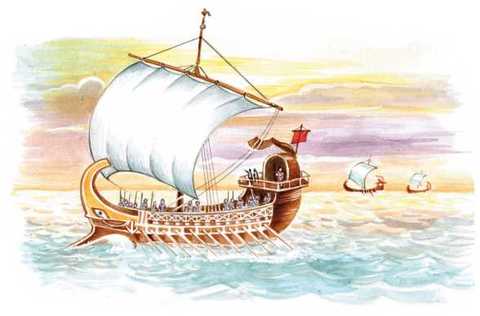
Amici nostri in mari Tusco navigantes tales praedones audacissimos navem suam persequi arbitrantur. Cuncti perturbati sunt. Etsi nautae omnibus viribus remigant, tamen illa navis, vento secundo adiuvante, magis magisque appropinquat.
Caelum nubilum suspiciens gubernator optat ut ventus in adversum vertatur. Is enim nautas suos tam validos esse credit ut nulla alia navis remis solis acta navem suam consequi possit.
Once all the seas were so infested with pirates that no one sailed without the greatest danger of death or enslavement. Many sailors and merchants, having their goods stolen and their ships sunk, were either killed or taken into slavery by pirates. Only those who could pay a large amount of money were freed from servitude. Gaius Julius Caesar himself, when he was a young man sailing from Italy to Rhodes, was seized by pirates and was not freed before paying a great price.
Not only sailors, but even the inhabitants of the coasts and islands were in fear. Some islands were abandoned by the inhabitants, many coastal towns were captured by pirates. For such was their force and daring, that even scorning the power of the Romans, they attacked the ports of Italy.
Therefore because of the strength and number of pirates, not even the Tuscan sea was safe, too little grain was being carried from Sicily and Africa to Rome. Thus a great scarcity of grain occurred, from this matter the price of grain always rose. Finally, when grain and bread was already so costly that many poor were dying from scarcity of necessary food, the Roman people demanded with one voice that the entire Roman fleet be sent against those very daring enemies. Therefore Gnaeus Pompey, an outstanding leader, was put in charge of the fleet. He first drove the pirates from the Tuscan sea, that is the sea nearest to Rome, and from Sicily, the island nearest to Italy, then he pursued them into Africa. Finally, with some ships sent into Spain, he set out himself with his fleet into Asia overcoming all the pirates he found there in short time. With this excellent victory all the people, from Spain to Egypt and Judea, were freed from this common danger. At the same time that the welcome message came to Rome from that very welcome victory, the price of grain began to drop; for with the pirates conquered, sailors sailed without fear through the sea that are common of all peoples. In Rome therefore from the greatest scarcity immediately a large supply of grain was made and bread was as cheap as it was before - which was very pleasing to the Roman people. All the Roman people gave the highest praise to Pompey the victor.
From that time it was rare that a pirate ship appeared in the Mediterranean Sea, for the Roman fleet, that ran through all the seas, carefully protected merchant ships and coasts. The Mediterranean Sea again is rightly called 'our sea' by the Romans. But nevertheless the Roman fleet cannot protect all sailors who sail everywhere. Still there are some sea pirates, who are so daring that they are certainly not deterred by the arms of the Romans.
Our friends sailing in the Tuscan sea think that such daring pirates are following their ship. They are all disturbed. Even if the sailors row with all their strength, nevertheless that ship, aided by a following wind, is approaching more and more.
The steersman looking at the cloudy sky wishes that the wind will turn against them. For he believes his sailors to be so strong that no other ship driven with oars alone can follow his ship.
II
Interea Lydia genua flectit et Deum precatur ut se adiuvet: “Pater noster qui es in caelis! Fiat voluntas tua! Sed libera nos a malo!”
Medus autem gladium brevem, quem adhuc sub veste occultavit, educit et “Equidem” inquit “non inermis occidar. Si praedones me armis petiverint, omnibus viribus repugnabo! Fortes fortuna adiuvat, ut aiunt.”
Tum vero Lydia “Converte gladium tuum” inquit “in locum suum! Omnes enim qui ceperint gladium, gladio peribunt, ut ait Christus.”
“Sed te quoque” inquit Medus “gladio meo defendam. Nolo te a praedonibus occidi spectare inermis. Donec ego vivam, nemo tibi nocebit!”
Sed Lydia, quae Medum ut furem contemnit, “Non a te” inquit, “sed a Deo auxilium peto. Is solus nos tueri potest.”
Item gubernator multis verbis Medo dissuadere conatur ne gladium educat neu praedonibus vi et armis resistat: “Quid opus est armis? Tanta est vis praedonum ut nullo modo iis resistere possimus. Neque praedones nautas inermes occidunt, cum eos magno pretio servos vendere possint.”
Medus: “Iamne oblitus es quid modo dixeris? Dixisti enim 'te mortem servituti praeferre'.”
Gubernator: “Haud scio an ego ita dixerim, sed profecto libertas mihi vita carior est. Nihil libertati praefero. Quam ob rem omnem pecuniam meam praedonibus dabo, si libertatem mihi reddent. Hanc gratiam solam ab iis petam.”
Medus: “Certe praedones pecuniam tibi eripient, sed felix eris si pecuniae gratia vitae tuae parcent.”
Gubernator: “Si necesse erit, decem milia sestertium praedonibus offerre possum. Quod ipse non possideo amici mei pro me solvent.”
Medus: “Ergo nulla spes est mihi, qui nec ipse pecuniam habeo nec amicum tam pecuniosum, ut me e servitute redimere possit aut velit.”
Tum mercator “Mihi quidem” inquit “multi sunt amici pecuniosi, sed valde dubito num pecunia sua me redimere velint. Fortuna adversa amicis fidendum non est! Namque amici, quos in rebus secundis multos habere videmur, temporibus adversis nobis desunt. Duos versus reminiscor e carmine quod de hac re scripsit poeta quidam:
Donec eris felic, multos numerabis amicos.
Tempora si fuerint nubila, solus eris!”
Gubernator: “Nescio qui poeta ista scripserit. Tune nomen eius meministi?”
Mercator: “Illos versus scripsit Ovidius, poeta egregius, nisi memoria me fallit. Qui ipse, cum fortuna adversa premeretur, ab amicis suis desertus erat.”
Gubernator: “Non verum est quod dixit Ovidius. Nam etsi rara est vera amicitia ac fides, non omnes amici sunt falsi seu infidi. Multo melius Ennius poeta:
Amicus certus in re incerta cernitur.
Certus ac verus amicus est qui numquam amico suo deest seu secunda seu adversa fortuna est. Mihi vero multi sunt tales amici, qui semper mihi aderunt in rebus adversis, seu pecunia seu alia re mihi opus erit. Ipse enim saepe amicis meis affui, nemo amicus umquam frustra auxilium a me petivit. Ergo omnes mihi grati sunt pro beneficiis.”
Mercator: “Aliud est gratiam habere, aliud gratiam referre. Non omnes qui tibi pro beneficiis gratias agunt, ipsi postea, si opus fuerit, gratiam tibi referent. Facile est gratias agere pro beneficiis, nec vero quidquam difficilius esse videtur quam beneficiorum meminisse.”
Gubernator: “Sed ego ipse soleo amicis meis gratiam referre. Numquam beneficii oblitus sum, semper pecuniam acceptam reddidi.”
Meanwhile Lydia bends her knees and prays that God may help them: "Our Father who art in Heaven! Thy will be done! But save us from evil!"
But Medus takes out his short sword, that he hid under his clothes and says, "I will certainly not die unarmed. If the pirates attack with weapons, I will resist with all my strength! Fortune aids he brave as they say."
But then Lydia says, "Return your sword to its place! For all who have taken the sword, will perish by the sword, as Christ says."
"But I will also defend you with my sword," says Medus. I do not want to see you killed unarmed by pirates. While I am alive, no one will hurt you!"
But Lydia who despises Medus as a thief says, "I will seek help from God not from you. He alone can protect us."
Likewise the steersman tries to dissuade Medus with many words from raising the sword or resisting the pirates with force and arms: "What is the need for weapons? So great is the strength from the pirates that we cannot resist them in any way. Nor do the pirates killed unarmed sailors, when they can sell them for a great price."
Medus: "Have you already forgotten what you said? For you said you prefer death to slavery."
Steersman: "I don't know if I said that, but certainly freedom is more dear than life. I prefer nothing to freedom. Wherefore I will give all my money to the pirates, if they return my freedom. I seek this favor alone from them."
Medus: "The pirates will certainly take your money, but you will be lucky if they spare your life for the sake of money."
Steersman: "If it will be necessary, I can offer then thousand sesterces to the pirates. What I do not possess myself my friends will pay for me."
Medus: "Therefore there is no hope for me, who does not have money nor a friend so wealthy as to be able or willing to redeem me from slavery."
Then the merchant says, "Certainly many of my friends are wealthy, but I seriously doubt whether they are willing to redeem me with their money. Adversity should not be trusted with friends! For friends, whom we seem to have in many secondary affairs, we lack in adverse times. I remember two lines from a poem that a certain poet wrote on the matter:
As long as you are happy, you will count many as friends.
If times will be cloudy, you will be alone!"
Steersman: "I don't know the poet who wrote that. Do you remember his name?"
Merchant: "Ovid wrote those lines, the excellent poet, unless my memory fails me. Who himself, when oppressed by adversity, was abandoned by his friends."
Steersman: "It is not true what Ovid said. For even if it true friendship and faithfulness is rare, not all friends are false or unfaithful. Much better Ennius the poet (wrote):
A certain friend is discerned in an uncertain matter.
He is a certain and true friend who never is absent from his friend whether fortune is good or bad. But to me there are many such friends, who are always there for me in adverse matters, whether there will be a need for money or another thing. For I myself have often been there for my friends, no friend has ever sought help from me in vain. Therefore there are all thankful to me for my kindness."
Merchant: "It is one thing to have a favor, another to return a favor. Not all of those who are thankful to you for kindness, themselves afterward, is there will be a need, will return thanks to you. It is easy to give thanks for kindness, but there doesn't seem to be anything more difficult than to remember kindness."
Steersman: "But I myself am accustomed to return a favor to my friends. I never forget kindness, I have always returned money I have received."
III
Hic Medus inquit: “Ergo melior es amicus quam ille quem ego aliquando e servitute redemi.”
Gubernator: “Miror unde pecuniam sumpseris ut alios redimeres, cum te ipse redimere non possis.”
Lydia: “Ego miror cur id mihi non narraveris.”
Medus: “Nihil cuiquam narravi de ea re, ne quis me gloriosum existimaret. Sed quoniam omnes me quasi servum scelestum contemnitis, narrabo vobis breviter quomodo amicum e servitute redemerim atque ipse ob eam gratiam servus factum sim:
“Cum homo liber Athenis viverem, a quodam amico epistulam accepi qua ille mihi nuntiavit 'se a piratis captum esse' ac me per amicitiam nostram oravit ut se e servitute redimerem magnum pretium solvendo. Cum autem tantum pecuniae non haberem, necesse fuit pecuniam mutuam sumere. Ergo virum divitem adii, qui mihi omnem pecuniam mutuam dedit hac condicione, ut anno post ad certam diem omnia dibi redderentur. Pecunia soluta, amicus meus a piratis libertatus gratias mihi egit pro beneficio, ac simul mihi promisit 'se intra annum omnem pecuniam redditurum esse'. Sed anno post ne assem quidem ab eo acceperam! Die ad solvendum constituta, cum pecuniam debitam solvere non possem, homo ille dives me in carcerem misit et aliquot diebus post servum vendidit. Sed nescio cur hoc vobis narraverim, nec enim sine maximo dolore eius temporis reminiscor cum patria liber inter cives liberos versarer. Utinam aliquando liber patriam videram! Sed frusta hoc opto, nam iam illi piratae eam spem mihi eripient, idque eodem die quo ab amica mea desertus sum!” Hoc dicens Medum anulum quem Lydia abicere voluit prae se fert.
Gubernator: “Ne desperaveris! Fortasse anulo isto aureo te redimere poteris. Namque avari atque auri cupidi sunt omnes piratae. Magna est vis auri.”
Medus anulum parvum aspiciens “Putasne” inquit “me tam parvi aestimari a piratis?”
Gubernator: “Non omnes homines pari pretio aestimantur. Scisne quantum piratae a Iulio Caesare capto postulaverint? Viginti talenta postulaverunt, id est prope quingenta milia sestertium. At Caesar, vir superbus, cum id parum esse censeret, quinquaginta talenta piratis obtulit, simul vero censeret, quinquaginta talenta piratis obtulit, simul vero supplicium iis minatus est! Tum praedonibus quasi servis suis imperavit ut taverent neu somnum suum turbarent - ita Caesar praedones contemnebat, cum in eorum potestate esset. Ubi primum redemptus est, ipse naves armavit et captos praedones in crucem tolli iussit.”
Medus: “Non sum tam superbus ut me cum Caesare comparandum esse putem. Utinam ne piratae me ut servum fugitivum occidant! Verum hoc anulo si quis servari potest, non ego, sed amica mea servanda est. Ecce anulum reddo tibi, Lydia. Ne eum abieceris! Utinam ille anulus vitam tuam servet!”
Lydia anulum oblatum accipit et “Gratias tibi ago” inquit, “sed quomodo tua vita servabitur?”
“Id non curo” inquit Medus, “nec enim mortem metuo, si te salvam esse scio.”
Tum Lydia “O Mede!” inquit, “Nunc demum intellego me tibi vita cariorem esse. Ignosce mihi quod te accusavi! Omnia mea gratia fecisti. Quomodo tibi gratiam referam?”
Medus: “Nihil rogo, nisi ut me ames ita ut me amabas. Hoc nihil gratius mihi fieri potest.”
Lydia nihil respondet, sed Medum complectitur atque osculatur. Quid verbis opus est?
Interea gubernator in mare prospicit et “Quid hoc?” inquit, “Aliae naves illam sequuntur. Tot naves praedones non habent. Naves longae sunt, quae mare percurrunt, ut nos a piratis tueantur. Ne timueritis, amici!”
Mercator: “Sed cur illae nos persequuntur?”
Gubernator: “Quia tamquam praedones ab iis fugimus. Remos tollite, nautae!”
Nautae statim remigare desistunt ac remis sublatis naves longas salutant. Classis celeriter appropinquat. Iam milites armati in nave proxima cernuntur. Lydia magna cum laetitia classem appropinquantem spectat, sed Medus etiamnunc perterritus esse videtur.
“Nonne laetaris, Mede” inquit Lydia, “quod nos omnes e communi periculo servati sumus?”
Medus: “Laetor sane quod vos servati estis; sed ego milites aeque timeo atque piratas. Ne oblita sis me servum fugitivum esse. Timeo ne milites me captum Romana abducant, ut coram populo ad bestias mittar in amphitheatro. Hoc dominus mihi minari solebat.”
“Ne timueris!” inquit Lydia, “Milites ignorant qui homo sis et quid antea feceris. Iam nemo nos prohibebit simul in patriam nostram communem redire.”
Interea naves longae tam prope venerunt ut milites cognoscant navem mercatoriam esse. Itaque persequi desistunt atque cursum ad orientem flectunt. Brevi cuncta classis e conspectu abit.
- Hic amicos nostros in medio cursu relinquimus. Utinam salvi in Graeciam perveniant! Omnia bona iis optamus.
Here Medus says: "Therefore you are a better friend than he whom I once redeemed from slavery."
Steersman: "I wonder where you got the money to redeem another when you can't redeem yourself."
Lydia: "I wonder why you did not tell that to me."
Medus: "I've told nothing to anyone of that matter lest they think me boastful. But since you all despise me as a wicked servant, I will tell you quickly of how I redeems my friend from slavery and from that favor I myself was made a slave:
When I was living as a free man in Athens, I received a letter from a certain friend who accounced to me that he had been captured by pirates and begged me from friendship that I pay a large price to redeem him from slavery. But since I did not have much money, it was necessary to borrow money. Therefore I went to a wealthy man who gave me all the borrowed money on this condition, that after one year that everything be returned to him on a certain day. With the money paid, my friend freed from the pirates gave me thanks for the kindness, and at the same time promised me that he would return everything within a year. But after a year I did not receive a single penny from him! On the decided day for payment, when I could not pay the money I owed, that rich man sent me to prison and after some days sold me as a slave. But I don't know why I am telling you this, for it is not without great sorrow that I remember those times when I was present in my free country among free citizens. Would that sometime I see my country free! But in vain I hope for this, for now those pirates will take that hope from me, and on the same day that I was deserted by my girlfriend!" Saying this Medus bears the ring before himself which Lydia wanted to throw away.
Steersman: "Don't despair! Perhaps with that gold ring you can redeem yourself. For all pirates are greedy and eager for gold. There is great power in gold."
Medus looking at the little ring says, "You think me so little valued by pirates?"
Steersman: "Not all men are valued equally. Do you know how much the pirates demanded from the captured Julius Caesar? They demanded twenty talents, that is almost five hundred thousand sesterces. But Caesar, a proud man, thinking that to be too little, offered fifty talents to the pirates, but at the same time they were threatened with execution! Then he ordered the pirates as his servants that they be silent nad not disturb his sleep - thus Caesar despised the pirates, when he had been in their power. As soon as he was redeemed, he armed a ship and ordered the captured pirates to be put up on a cross."
Medus: "I am not so proud that I think I can be compared to Caesar. Would that the pirates not kill me as a fugitive slave! But if this ring can save anyone, is should save my girlfriend, not me. Behold I return the ring to you Lydia. Do not throw it away! I hope that ring may save you!"
Lydia taking the offered ring says, "I thank you, but how will your life be saved?"
Medus says, "I don't care, for I don't fear death if I know you will be saved."
Then Lydia says, "O Medus! Now I finally understand that I am dearer to you than life. Forgive me for accusing you! You have done me a favor. How can I return the favor?"
Medus: "I ask for nothing except that you will love me as you were loving me. Nothing but this can be a better favor."
Lydia answers nothing, but gives Medus a hug and kiss. What need for words is there?
Meanwhile the steersman looks out on the sea and says, "What is this? Other ships follow that one. Pirates do not have that many ships. There are long ships that sail through the sea to protect us from pirates. Don't be afraid friends!"
Merchant: "But why are those following us?"
Steersman: "Because we are fleeing from the pirates. Raise the oars sailors!"
The sailors immediately stop rowing and raise the oars to salute the long ships. The fleet quickly approaches. Now the armed soldiers can be discerned on the nearby ship. Lydia looks with great happiness at the approaching fleet, but Medus now seems to be terrified.
Lydia says, "Are you not happy that we are all saved from this common danger?"
Medus: "I am certainly happy that you are saved; but I fear soldiers and pirates equally. Don't forget that I am a fugitive slave. I fear that the soldiers will lead me as a Roman prisoner that in sight of the people I will be sent to the amphitheater to the beasts. The master used to threaten me with this."
Lydia says, "Do not fear. The soldiers don't know who you are and what you did previously. Now no one will stop us from returning together to our common country."
Meanwhile the long ships come so close that the soldiers recognize the merchant ship. Therefore they stop following and change course to the East. Soon the whole fleet goes out from view.
- Here we leave our friends in the middle of the course. May they arrive safe into Greece! We wish them all well.
GRAMMATICA LATINA
Coniunctivus
Tempus perfectum
[A] Activum.
Iulius dubitat num magister Marcum laudaverit.
'Laudaverit' est coniunctivus temporis praeteriti perfecti. Coniunctivus perfecti desinit in -erit (pers. III sing.), quod ad infinitivum perfecti sine -isse adicitur.
Exempla: [1] recitav|erit; [2] paru|erit; [3] scrips|erit; [4] audiv|erit.
Pater filium interrogat 'num bonus discipulus fuerit: num magistro paruerit, attente audiverit, recte scripserit et pulchre recitaverit.'
Pater: "Audisne? Interrogo te 'num bonus discipulus fueris, num magistro parueris, attente audiveris, recte scripseris et pulchre recitaveris'." Filius: "Iam tibi dixi 'me industrium fuisse.' Quare igitur me interrogas 'num bonus discipulus fuerim, num magistro paruerim, attente audiverim, recte scripserim et pulchre recitaverim'? Crede mihi! Ne dubitaveris de verbis meis!"
Parentes filios interrogant 'num boni discupuli fuerint: num magistro paruerint, attente audiverint, recte scripserint et pulchre recitaverint.'
Parentes: "Auditisne? Interrogamus vos 'num boni discipuli fueritis, num magistro parueritis, attente audiveritis, recte scripseritis et pulchre recitaveritis'." Filii: "Iam vobis diximus 'nos industrios fuisse.' Quare igitur nos interrogatis 'num boni discupuli fuerimus, num magistro paruerimus, attente audiverimus, recte scripserimus et pulchre recitaverimus'? Credite nobis! Ne dubitaveritis de verbis nostris!"
| Singularis | Pluralis | |
| Persona prima | -erim | -erimus |
| Persona secunda | -eris | -eritis |
| Persona tertia | -erit | -erint |
[B] Passivum.
Pater dubitat num filius a magistro laudatus sit.
Pater: "Tune a magistro laudatus es?" Filius: "Nescio num laudatus sim!" Pater: "Quomodo nescis num laudatus sis a magistro?" Filius: "Nescio quid ab eo dictum sit, nam in ludo dormivi!"
Pater dubitat num filii a magistro laudati sint.
Pater: "Vosne a magistro laudati estis?" Filii: "Nescimus num laudati simus!" Pater: "Quomodo nescitis num laudati sitis?" Filii: "Nescimus quid magister dixerit, nam in ludo dormivimus!"
| Singularis | Pluralis | |
| Persona prima | laudatus sim | laudati simus |
| Persona secunda | laudatus sis | laudati sitis |
| Persona tertia | laudatus sit | laudati sint |
LATIN GRAMMAR
Subjunctive
The perfect time
[A] Active
Julius doubts whether the teacher praised Marcus.
'Laudaverit' is subjunctive perfect past time. Perfect subjunctive ends in -erit (3rd pers. sing.), that is added to the perfect infinitive without -isse.
Examples: [1] (whether) he recited; [2] obeyed; [3] wrote; [4] heard
A father asks his son whether he was a good student: whether he obeyed the teacher, listened attentively, wrote correctly and recited beatifully.
Father: "Do you hear? I am asking you whether you were a good student, whether you obeyed the teacher, listened attentively, wrote correctly and recited beautifully." Son: "I already said to you that I had been industrious. Why therefore do you ask me whether I was a good student, whether I obeyed the teacher, listened attentively, wrote correctly and recited beautifully? Believe me! Do not doubt my words!"
Parents ask their children whether they were good students: whether they obeyed the teacher, listened attentively, wrote correctly and recited beautifully.
Parents: "Do you hear? We ask you whether you were good students, whether you had obeyed the teacher, listened attentively, wrote correctly and recited beautifully." Sons: "We already told you we had been industrious. Why therefore do you ask us whether we had been good students, whether we had obeyed the teacher, listened attentively, written correctly and recited beautifully? Believe us! Do not doubt our words!"
| Singular | Plural | |
| First person | -erim | -erimus |
| Second person | -eris | -eritis |
| Third person | -erit | -erint |
[B] Passive
A father doubts whether his son was praised by the teacher
Father: "Were you praised by the teacher?" Son: "I don't know if I was praised!" Father: "How do you not know whether you were praised by the teacher?" Son: "I don't know what was said by him, because I slept in school!"
A father doubt where his sons were praised by the teacher
Father: "Were you praised by the teacher?" Sons: "We don't know if we were praised!" Father: "How do you not know if you were praised?" Sons: "We do not know what the teacher said because we slept in school!"
| Singular | Plural | |
| First person | I was praised | we were praised |
| Second person | you were praised | you were praised |
| Third person | he was praised | they were praised |
VOCABVLA
legio, legionis f.
cohors, cohortis f.
agmen, agminis n.
ordo, ordinis m.
acies, aciei f.
proelium, proeli n.
imperator, imperatoris m.
aetas, aetatis f.
studium, studi n.
stipendium, stipendi n.
virtus, virtutis f.
gaudium, gaudi n.
valetudo, valetudinis f.
amnis, amnis m.
ratis, ratis f.
ripa, ripae f.
caedes, caedis
vulnus, vulneris n.
pax, pacis f.
legatus, legati m.
ensis, ensis m.
legionarius, a, um
idoneus, a, um
militaris, militare
publicus, a, um
privatus, a, um
posterus, a, um
arduus, a, um
ridiculus, a, um
ulterior, ulterius
citerior, citerius
incolumis, incolume
otiosus, a, um
dirus, a, um
horrendus, a, um
deni, ae, a
seni, ae, a
quini, ae, a
quaterni, ae, a
uni, ae, a
trini, ae, a
commemoro, -are, -avi, -atum
studeo, studere, studui, -
cogo, cogere, coegi, coactus
fatigo, fatigare, fatigavi, fatigatus
propero, -are, properavi, properatus
desidero, -are, -avi, desideratum
transfero, -re, transtuli, translatus
effundo, effundere, effudi, effusus
praesto, -are, -avi, praestatum
transeo, transire, transivi, transitus
copulo, copulare, copulavi, copulatus
convoco, -are, convocavi, convocatus
excurro, excurrere, excurri, excursus
procurro, -ere, procurri, procursus
erumpo, erumpere, erupi, eruptus
vulnero, -are, -avi, vulneratus
fore
plerique
pridie
praecipue
tamdiu
quamdiu
diutius
fere
etenim
citra
ultra
secundum
VOCABULARY
legion, army
armed force
marching army, troop
order, rank, series
sharp edge, point
armed encounter, fight
general, commander
lifetime, age, time
devotion, study, zeal
pay, wages, tribute
manliness, courage
gladness, delight, joy
good health, soundness
stream, current, river
raft, ship, boat
bank
slaughter, slain
wound, mental hurt
peace, harmony
ambassador, envoy
sword
legionary, of a legion
suitable, fit, proper
military, of a soldier
public, common
private, personal
following, next
lofty, high, steep
laughable, funny, silly
farthest, last, highest
nearer, urgent, sooner
unharmed, uninjured
unemployed, at leisure
awful, cruel, fearful
horrible, dreadful
by tens
by sixes
by fives
by fours
one at a time
three at a time
to remember, mention
to desire, to strive
to compel, to confine
to tire, to weary
to speed up, to hurry
to long for, to miss
carry across, transport
to pour out, send forth
fulfill, be responsible for
to go over, to cross
to connect, to couple
call together, convene
to run out
advance, run forward
break out, spring forth
to wound, to injure
to be about to
majority, most
day before
especially, chiefly
so long, all this time
as long as, until
by day, all day
almost, about, nearly
and indeed, because
less than, on this side
beyond, on that side
after, according to