CAPITVLVM ALTERVM ET VICESIMVMTWENTY-SECOND CHAPTER
CAVE CANEMBEWARE THE DOG
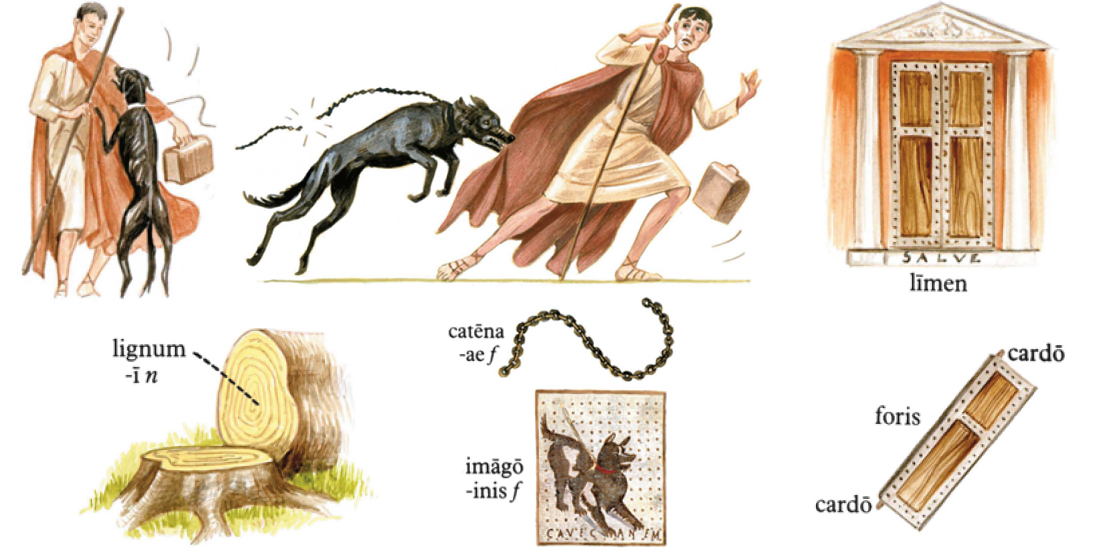
I
Ianua villae e duabus foribus constat. Sub foribus est limen, in quo SALVE scriptum est. Foris duos cardines habet, in quibus verti potest; cum foris in cardinibus vertitur, ianua aperitur aut clauditur. Servus cuius officium est fores aperire et claudere ac villam domini custodire, ostiarius vel ianitor appellatur.
Si quis villam intrare vult, ianuam pulsat et extra ianuam exspectat, dum ianitor fores aperit eumque in villam admittit. Ianitor intra ianuam sedet cum cane suo, qui prope tam ferox est quam lupus; itaque necesse est eum catena vincire. Antea domini severi non solum canes, sed etiam ianitores suos catenis vinciebant.
Catena qua canis vincitur ex ferro facta est. Catena constat e multis anulis ferreis qui inter se coniunguntur. Anuli quibus digiti ornantur non ex ferro, sed ex auro facti sunt. Aurum est magni pretii sicut gemmae. Anulus aureus multo pulchrior est quam anulus ferreus.
Fores e ligno factae sunt sicut tabulae. Lignum est materia dura, sed minus dura quam ferrum. Qui res ferreas vel ligneas facit, faber appellatur. Deus fabrorum est Vulcanus. -
Ianua clausa est. Ianitor, qui fores clausit postquam Marcus intravit, iam rursus dormit! Ianitore dormiente, canis vigilans ianuam custodit. Extra fores stat tabellarius (sic appellatur servus qui epistulas fert, nam antea in tabellis scribebantur epistulae). Is baculo ligneo fores pulsat atque clamat: “Heus! Aperi hanc ianuam! Num quis hic est? Num quis hanc aperit ianuam? Heus tu, ianitor! Quin aperis? Dormisne?”
Cane latrante ianitor e somno excitatur.
Tabellarius iterum fores pulsat magna voce clamans: “Heus, ianitor! Quin me admittis? Putasne me hostem esse? Ego non venio villam oppugnatum sicut hostis, nec pecuniam postulatum venio.”
Tandem surgit ianitor. “Quis fores nostras sic pulsat?” inquit.
Tabellarius (extra ianuam): “Ego pulso.”
Ianitor (intra ianuam): “Quis 'ego'? Quid est tibi nomen? Unde venis? Quid vis aut quem quaeris?”
Tabellarius: “Multa simul rogitas. Admitte me! Postea respondebo ad omnia.
Ianitor: “Responde prius! Postea admitteris.”
Tabellarius: “Nomen meum non est facile dictu: Tlepolemus nominor.”
Ianitor: “Quid dicis? Cleopolimus? Vox tua difficiliis est auditu, quod fores intersunt.”
Tabellarius: “Mihi nomen est Tlepolemus, sicut iam dictum est. Tusculo venio. Erum tuum quaero.”
Ianitor: “Si erum salutatum venis, melius est alio tempore venire, nam hac hora erus meus dormitum ire solet, post brevem somnum ambulatum exibit, deinde lavatum ibit.”
Tlepolemus: “Si quis per hunc imbrem ambulat, non opus est postea lavatum ire! At non venio salutatum. Tabellarius sum.”
The villa's doorway consists of two doors. Beneath the doors is the threshold, in which SALVE is written. The doors have two hinges, on which they can turn; when the doors turn on the hinges, the door opens and closes. The slave whose duty it is to open and close the door and take care of the master's villa, is called the porter or doorkeeper.
If anyone wants to enter the villa, he knocks on the door and waits outside the door while the doorkeeper opens the door and admits him into the villa. The doorkeeper sits inside the door with his dog, who is nearly as wild as a wolf; therefore it is necessary to restrain him with a chain. Formerly strict masters restrained not only dogs but also their doorkeepers with chains.
The chain which restrains the dog is made from iron. A chain consists of many iron rings which are joined together. Rings which decorate the fingers are not made from iron but from gold. Gold is a greatly valuable like gems. A gold ring is much more beautiful than an iron ring.
Doors are made from wood like tablets. Wood is a hard material, but less hard than iron. He who makes things from iron or wood is called a smith. The god of smiths is Vulcan -
The door is closed. The doorkeeper who closed the door after Marcus entered, is now sleeping again! With the doorkeeper sleeping, the dog is awake guarding the door. Outside the door stands the postman (thus the slave is called who carries letters, for in the past letters were written on tablets). He knocks on the door with his staff and shouts: "Hey! Open this door! Surely someone is here? Surely there is someone who will open the door? Hey you doorkeeper! Why aren't you opening? Are you sleeping?"
The barking dog wakes the doorkeeper from his sleep.
The postman again knocking on the door shouts with a loud voice: "Hey doorkeeper! Why won't you let me is? Do you think me to be an enemy? I did not come to the villa to attack like and enemy, but I come to demand money."
Finally the doorkeeper stands up. "Who is knocking thus on our door," he says.
Postman (outside the doorway): "I am knocking."
Doorkeeper (inside the doorway): "Who is 'I'? What is your name? From where are you coming? What do you want or whom are you seeking?
Postman: "You ask many things at once. Let me in! Afterwards I will answer everything."
Doorkeeper: "Answer first! After I will admit you."
Postman: "My name is not easily said: I am named Tlepolemus."
Doorkeeper: "What are you saying? Cleopolimus? Your voice is difficult to hear, because the doors are in between."
Postman: "My name is Tlepolemus as I already said. I come from Tusculum. I seek your master."
Doorkeeper: "If you come greeting the master, it is better to come another time, for his hour my master is accustomed to go, after a short sleep he will go out for a walk, then he will go to a bath."
Tlepolemus: "If he walks through this rain, he will not need to go for a bath afterwards. But I did not come to greet. I am the postman."
II
Tandem ianitor fores aperit et Tlepolemum foris in imbre stantem videt. Canis iratus dentes ostendit ac fremit: “Rrrr...!” nec vero tabellarium mordere potest, quod catena retinetur.
Ianitor: “Cave! Canis te mordebit!” Sic ianitor hominem intrantem de cane feroci monet.
Tlepolemus in limine resistens “Retine canem!” inquit, “Noli eum solvere! Nec vero opus est me monere de cane, ego enim legere scio.” Tabellarius solum intra limen aspicit, ubi CAVE CANEM scriptum est infra imaginem canis ferocis. “Neque haec imago neque canis verus me terret!” inquit, et propius ad canem accedit.
“Mane foris!” inquit ianitor, “Noli ad hunc canem accedere! Iam te monui!”
Tabellarius vero, quamquam sic a ianitore monitus est, alterum gradum ad canem versus facit - sed ecce canis in eum salit catenam rumpens! Homo territus ex ostio cedere conatur, sed canis iratus pallium eius dentibus prehendit et tenet.
“Ei! Canis me mordet!” exclamat tabellarius, qui iam neque recedere neque procedere audet: canis fremens eum loco se movere non sinit.
Ianitor ridens “Quin procedis?” inquit, “Noli resistere! Ego te intrare sino. Ianuam aperui. Procede in villam!” Sic ianitor virum territum deridet.
“Id facilius est dictu quam factu” inquit tabellarius, atque alterum gradum facere audet, sed canis statim in pedes posteriores surgit atque pedes priores in pectore eius ponit! Tabellarius, toto corpore tremens, ex ostio cedit: sic canis eum e villa pellit. “Remove canem!” inquit ille, “Iste canis ferox me intrare non sinit.”
Ianitor eum tremere animadvertit iterumque deridet: “Quid tremis? Hicine canis te terruit?”
Tlepolemus: “Noli putare me ab isto cane territum esse! Si tremo, non propter canem ferocem, sed propter imbrem frigidum tremo. Admitte me sub tecum, ianitor - amabo te! Vinci istum canem ferocem! Cur eum solvisti?” Tabellarius enim canem a ianitore solutum esse arbitratur.
Ianitor catenam manu prehendit canemque paulum a tabellario removet. “Noli arbitrari” inquit “me canem solvisse. Canis ipse catenam suam rupit. Ecce catena rupta.”
Tlepolemus: “Num canis catenam ferream rumpere potest? Id non credo. At certe vestem scindere potuit: videsne pallium meum novum, quod nuper magno pretio emi, scissum esse a cane tuo?”
Ianitor: “Istud pallium non est magni pretii, neque id nuper emptum esse credo. Sed quid tu venisti? Num quid tecum fers?”
Finally the doorkeeper opens the door and sees Tlepolemus standing at the door in the rain. The angry dog shows his teeth and growls: "Rrrr...!" but cannot bite the postman because he is restrained by the chain.
Doorkeeper: "Beware! The dog will bite you!" Thus the doorkeeper warns the man entering of the ferocious dog.
Tlepolemus halting at the threshold says, "Hold back the dog! Do not untie him! But it is not needed to warn me of the dog for I know how to read." The postman looks at the ground in front of the threshold where CAVE CANEM is written below a ferocious dog. "Neither this picture nor the true dog terrifies me!" he says, and he approaches nearer to the dog.
"Remain at the doors!" the doorkeeper says, "Do not approach this dog. I already warned you!"
But the postman even though he was thusly warned by the doorkeeper, makes another step towards the dog - but behold the dog jumps towards him breaking the chain! The terrified man tries to go out of the door but the angry dog seizes his cloak with his teeth and holds him.
"Ah! The dog is biting me!" shouts the postman, who now does not dare to withdraw or proceed: the growling dog will not allow him to move.
Doorkeeper laughing: "Why don't you proceed?" he says, "Don't stop! I will allow you to enter. The door is open. Proceed into the villa!" Thus the doorkeeper mocks the terrified man.
"That is easier said than done" says the postman, and he dares to make another step, but the dog immediately stands up on his back feet and places his front feet on his chest! The mailman, his whole body trembling, falls out of the doorway: thus the dog drives him out of the villa. "Remove the dog!" he says, "that ferocious dog is not allowing me to enter."
The doorkeeper notices him trembling and again mocks him: "Why are you trembling? Did this dog terrify you?"
Tlepolemus: "Do not think me to be terrified by that dog! If I am trembling it is not because of the ferocious dog, but I am trembling because of the cold rain. Admit me under the roof doorkeeper - please! Tie up that ferocious dog! Why did you untie him?" For the postman thinks the dog was untied by the doorkeeper.
The doorkeeper takes the chain with his hand and removes the dog a little from the postman. "Do not think that I had untied the dog," he says, "The dog broke his chain himself. Here is the broken chain."
Tlepolemus: "Surely a dog cannot break an iron chain can it? I do not believe it. But certainly it can tear my clothes: do you see my new cloak, which I recently bought for a great price, which was torn by your dog?"
Doorkeeper: "That cloak is not of great value, nor do I believe you bought it recently. But why did you come? Surely you are not carrying anything with you are you?"
Tlepolemus: “Stulte rogitas, ianitor, nam iam tibi dixi 'tabellarium me esse'. Quid tabellarios ferre arbitraris? aureosne ianitoribus? Profecto nos aurum non ferimus.”
Ianitor: “Vos scilicet epistulas fertis.”
Tlepolemus: “Recte dicis. Epistulam affero ad Lucium Iulium Balbum. Hocine ero tuo nomen est?”
Ianitor: “Est. Quin mihi istam epistulam das?”
Tlepolemus: “Prius vinci canem et sine me intrare! Noli iterum me foras in imbrem pellere!”
Ianitor, postquam canem vinxit, “Non ego” inquit, “se hic canis te foras pepulit. Noli narrare 'te a ianitore foras pulsum esse'!”
Cane vincto, tabellarius tandem intrat epistulamque ostendit ianitori; qui statim epistulam prehendit et in atrium ad dominum suum fert.
Tlepolemus: "You ask foolishly doorkeeper, for I already said to you that 'I am a postman'. What do you think postmen carry? gold for doorkeepers? We certainly do not carry gold."
Doorkeeper: "Of course you are bringing letters."
Tlepolemus: "You speak correctly. I am bringing a letter to Lucius Julius Balbus. Is this the name of your master?"
Doorkeeper: "It is. Why don't you give that letter to me?"
Tlepolemus: "First tie up the dog and allow me to enter! Don't drive me from the doors into the rain again!"
The doorkeeper, after tying up the dog says, "This dog drove you to the doors not I. Don't say that 'you were driven to the doors by the doorkeepers'!"
With the dog tied up, the postman finally enters and shows the letter to the doorkeeper; who immediately takes the letter and carries it into the atrium to his master.
GRAMMATICA LATINA
Supinum
[I] Amici salutatum veniunt (= quia salutare volunt).
“Salutatum” supinum vocatur. Supinum in -tum desinens significat id quod aliquis agere vult et ponitur apud verba “ire”, “venire”, “mittere” et alia.
Exempla: Romani cotidie lavatum eunt. Milites oppidum oppugnatum mittuntur. Vesperi omnes dormitum eunt. Medus et Lydia ad tabernam eunt anulum emptum.
[II] Id est facile dictu = facile est id dicere.
“Dictu” est alterum supinum in -tu desinens, quod apud adiectiva “facilis” et “difficilis” et pauca alia reperitur.
Exempla: Multa sunt faciliora dictu quam factu. Vox difficilis auditu est.
LATIN GRAMMAR
Supine
[1] The friends came to greet (= who wish to greet).
"Salutatum" is called supine. A Supine ending in -tum mean that which others wish to do and is placed with the verbs "go", "come", "send" and others.
Examples: Romans go to bathe everyday. Soldiers are sent to attack the town. Everyone goes to sleep at night. Medus and Lydia go the shop to buy a ring.
[2] That is easily said = that is easy to say
"Dictu" is another supine ending in -tu, which is found with the adjectives "easy" and "difficult" and a few others.
Examples: Many things are easier to say than to do. A voice is difficult to hear.
VOCABVLA
ferox, ferocis
ferreus, a, um
aureus, a, um
ligneus, a, um
custodio, -ire, -ivi, -itum
admitto, -ere, admisi, admissum
vinco, -ere, vici, victum
rogito, -are, -avi, -atum
fremo, -ere, fremui, fremitum
mordeo, -ere, momordi, morsum
retineo, -ere, retinui, retentum
caveo, -ere, cavi, cautum
resisto, -ere, restiti
solvo, -ere, solvi, solutum
terreo, -ere, terrui, territum
accedeo, -ere, accessi, accessum
salio, -ire, salivi, saltum
rumpo, -ere, rumpi, ruptum
cedo, -ere, cessi, cessum
prehendo, -ere, -hendi, prehensum
recedo, -ere, recessi, recessum
procedo, -ere, processi, processum
sino, -ere, sivi, situm
derideo, deridere, derisi, derisum
tremo, tremere, tremui
pello, pellere, pepuli, pulsum
removeo, -ere, removi, remotum
arbitror, arbitrari, arbitratus sum
scindo, scindere, scindi, scissum
iste, ista, istud
scilicet
antea
postea
prius
tandem
nuper, nuperrime
foris, foris f.
foras
sicut
quin
extra
intra
supinus, a, um
VOCABULARY
fierce, wild, cruel
iron, made of iron
golden, gilded
wooden
to guard, to preserve
to admit, to receive
to conquer, to defeat
to ask, to inquire
roar, growl
to bite, to bite into
to hold back, to restrain
to beware, to avoid
to resist, to oppose
to release, to pay off
to frighten, to terrify
to approach, agree
to leap, to jump
to break, to destroy
to yield, to submit, go
to seize, to arrest
to recede, to withdraw
to proceed, to advance
to allow, to permit
to mock, to laugh at
to tremble, to shake
to drive away, to rout
to move back, remove
to believe, to decide
to tear, to split
that, that of yours
certainly, of course
before, formerly
afterwards
first, earlier
at last, finally
not long ago, recently
door, the leaf of a door
out of doors, out
in the same way, like,
why not, in fact
outside, beside, except
within, inside, during
lying face upwards, flat