CAPITVLVM VICESIMVM SEXTVMTWENTY-SIXTH CHAPTER
DAEDALVS ET ICARVSDAEDALUS AND ICARUS
I
Quintus: “Nonne rex Minos Theseum cum Ariadna fugientem persecutus est?”
Syra: “Certe rex eos persequi coepit, sed navis Thesei nimis celeris fuit. Minos, quamquam celeriter navigavit, non tam celer fuit quam Theseus neque eum consequi potuit. Tum rex iratus cepit Daedalum, qui filum confecerat et Ariadnae dederat, eumque in labyrinthum includi iussit una cum eius Icaro filio; verum pater et filius mirabili modo e labyrintho fugerunt. Cras tibi narrabo de fuga eorum, hodie plus temporis ad narrandum non habeo: iam horam consumpsi in narrando.”
Quintus: “Neque tempus melius consumere potuisti! Non oportet in media fabula finem narrandi facere. Quoniam maiorem fabulae partem iam narravisti, partem reliquam quoque narrare debes. Ego paratus sum ad audiendum.”
Ad hoc Syra “Ergo” inquit, “quoniam tam cupidus es audiendi, reliquam fabulam tibi narrabo:
“Daedalus in labyrintho inclusus cum filio suo intra muros errabat nec exitum invenire poterat, etsi ipse labyrinthum aedificaverat. Quoniam igitur aliae viae clausae erant, ille vir audax per aera effugere constituit. Icarus autem, qui consilium patris ignorabat, humi consedi et “Fessus sum” inquit “ambulando in hoc carcere, quem ipse nobis aedificavisti, pater. Ipsi per nos hinc effugere non possumus, neque quisquam nos in fugiendo iuvare poterit, ut Theseum iuvit Ariadna. Haud longum tempus nobis reliquum est ad vivendum, nam cibus noster paene consumptus est. Ego iam paene mortuus sum. Nisi dii nos iuvabunt, numquam vivi hinc egrediemur. O dii boni, auxilium ferte nobis!”
Quintus: “Did King Minos not pursue Theseus fleeing with Ariadne?"
Syra: “Certainly the king began to pursue them, but Theseus's ship was too swift. Minos, although he sailed swiftly, was not as swift as Theseus and could not follow him. Then the angry king captured Daedalus, who made the thread and gave it to Ariadne, and ordered him to be locked in the labyrinth with his son Icarus; but the father and son escaped from the labyrinth in an incredible way. Tomorrow I will tell you of their flight, I do not have more time today for telling: now an hour of telling has been spent."
Quintus: “The time cannot better be spent! It is not right to make an end to telling a story in the middle. Since a large part of the story has already been told, you are obliged to tell the remaining part also. I am prepared to listen."
To this Syra says, “Therefore since you are so eager to listen, I will tell you the rest of the story:
“Daedalus locked in the labyrinth with his son wandered between the walls but could not find the exit, even though he built the labyrinth himself. Since therefore the other was were closed, the daring man decided to escape through the air. But Icarus, who was unaware of his father's plan, fell to the ground and said, "I am tired from walking in this prison which we built ourselves father. We cannot escape here ourselves, nor can anyone help us in flight, like Ariadne helped Theseus. There is not a long time for us to live, for our food is nearly consumed. I am now nearly dead. The gods will not help us, we will never get out of here alive. O good gods bring help to us!"
II
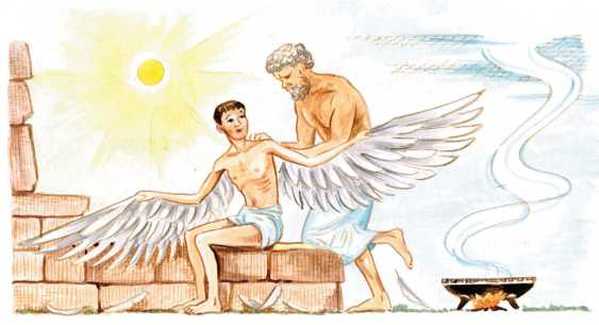
“Daedalus vero “Quid iuvat deos invocare” inquit, “dum hic quietus sedes? Qui ipse se iuvare non vult, auxilium deorum non meret. At noli timere! Ego consilium fugae iam excogitavi. Etsi clausae sunt aliae viae, una via nobis patet ad fugiendum. Intuere illam aquilam quae in magnum orbem circum carcerem nostrum volat! Quis est tam liber quam avis quae trans montes, valles, flumina, maria volare potest. Quin aves caeli imitamur? Minos, qui terrae marique imperat, dominus aeris non est: per aera hinc evolabimus! Hoc est consilium meum. Nemo nos volantes persequi poterit.” “Ego quidem studiosus sum volandi” inquit Icarus, “sed alae necessariae sunt ad volandum. Quoniam dii nobis alas non dederunt, volare non possumus. Homines sumus, non aves. Nemo nisi deus naturam suam mutare potest. Aves natura volare possunt, homines non item.” Tum Daedalus “Quid ego facere non possum?” inquit, “Profecto arte mea ipsa natura mutari potest. Multas res mirabiles iam confeci, quae artem meam omnibus demonstrant, non solum aedificia magnifica, ut hunc labyrinthum, verum etiam signa quae se ipsa movere possunt tamquam homines vivi. Alas quoque conficere possum, quamquam opus haud facile est.” “Audax quidem est consilium tuum” inquit Icarus, “sed omne consilium fugiendi me delectat, ac tu id quod semel excogitavisti perficere soles.” “Certe consilium meum perficiam” inquit pater, “Ecce omnia habeo quae necessaria sunt ad hoc opus: pennas, ceram, ignem. Igne ceram molliam, cera molli pennas iungam et in lacertis figam.”
“Daedalus igitur arte mirabili sibi et filio suo alia ingentes confecit ex pennis, quas cera iunxit et in lacertis fixit. Postquam finem operis fecit, “Opus iam perfectum est” inquit, “ecce exemplum artis meae novissimum. Aves quidem non sumus, sed aves imitabimur in volando. Vento celerius trans mare volabimus, nulla avis nos consequi poterit.”
“Icarus studiosus volandi alas huc illuc movit, nec se supra humum levare potuit. “Alae me sustinere non possunt” inquit, “Tu doce me volare!” Statim Daedalus se alis levavit et “Nisi alas recte moves” inquit, “volare non potes. Imitare me! Haud difficilis est ars volandi. Move alas sursum deorsum hoc modo!” Ita pater filium suum artem volandi docuit tamquam avis pullos suos. Tum puerum osculatus “Parati sumus ad volandum” inquit, “sed prius hoc te moneo: vola post me in medio aere inter caelum et terram, nam si in infimo aere prope mare volabis, pennae umidae fient, sin colabis in summo aere prope caelum, ignis solis ceram molliet atque pennas uret. Noli nimis audax esse in volando! Cautus esto, mi fili! Iam sequere me! Carcerem nostrum effugimus - liberi sumus!”
But Daedalus says, “What does help to invoke the gods while you sit here quietly? He who does not wish tom help himself does not deserve the help of the gods. But do not fear! I already thought up a plan for flight. Even though the other ways are closed, one way is prepared for us for flight. Look at that eagle that flies in a great circle around our prison! Who is as free as a bird that can fly across mountains, valleys, rivers and seas. Why don't we imitate the birds of the sky? Minos, who rules the lands and seas, he is not master of the air: we will fly through the air! This is my plan. No one can follow us flying." “I am certainly eager to fly," Icarus says, "but wings are necessary for flying. Because the gods have not given wings to us, we cannot fly. We are men not birds. No one except a god can change his nature. Birds can fly naturally, men not likewise." Then Daedalus says, "What can I not do? Certainly my skill can change nature itself. I have made many things already, which demonstrate my skill to everyone, not only amazing buildings like this labyrinth but also statues which can move themselves like living men. I can also make wings, although this task is not easy." "Your plan is certainly daring," Icarus says, "but every plan of escape delights me, and that which you think of once you are accustomed to complete." "I will certainly complete my plan," says the father, "Behold I have all the things which are necessary for this task: feathers, wax, fire. Fire will soften the wax, with the wax softened by the fire I will join the feathers on my arms."
"Therefore Daedalus with his amazing skill made wings from feathers for himself and his son, which he joined with the wax and attached onto their arms. After making an end to his work he said, "The is work is now complete, behold the newest example of my skill. We are certainly not birds, but we will imitate birds in flight. We will fly with a swift wind across the sea, no bird can follow us."
"Icarus eager to fly moves his wings this way and that, but he could not levitate above the ground. He says, "the wings cannot sustain me. You teach me to fly!" Daedalus immediately lifts himself with his wings and says, "if you do not move your wings correctly you cannot fly. Imitate me! Flying is not a difficult skill. Move your wings up and down this way!" Thus father taught his son the skill of flying as a bird its chicks. Then looking at the boy he says, "We are prepared to fly but first I warn you: fly behind me in the middle air between the sky and the land, for if you fly in the lower air near the sea, your feathers will be made wet, but if you fly in the highest air near the sky, the heat of the Sun will soften and consume your feathers. Do not be too daring in flight! Be cautious my son! Now follow me! We are escaping our prison - we are free!"
III
“Haec verba locutus Daedalus cum filio sursum e labyrintho evolavit, neque quisquam fugam eorum animadvertit nisi aliqui pastor, qui forte suspiciens eos tamquam magnas aves volantes vidit ac deos esse arbitratus est. Mox pater et filius Cretam reliquerunt, neque vero recta via Athenas in patriam suam volaverunt, sed nova libertate delectati in magnum orbem supra mare Aegaeum volare coeperunt. Icarus despiciens multitudinem insularum miratus est: “O, quot parvae insulae in mari ingenti sunt!” Daedalus vero “Illae insulae” inquit “haud parvae sunt, quamquam parvae esse videntur. Certe Melos insula, quae infra nos est, non tam parva est quam tibi videtur.” Icarus: “Sed illa insula quae nobis a sinistra est multo maior esse mihi videtur. Quae est illa insula?” Daedalus: “Peloponnesus est, Graeciae pars, nec vero insula est, sed paeninsula, nam Peloponnesus terra angusta, quae Isthmus vocatur, cum reliqua Graecia coniungitur. Prope Isthmum sita est Corinthus, urbs pulcherrima, nec procul absunt Athenae, patria nostra.” “Si altius volabimus, non solum Graeciam, sed paene totum orbem terrarum spectabimus” inquit puer temerarius atque etiam alius se levavit. Illinc non solum magnas Europae et Asiae partes despiciebat mirans, verum etiam oram Africae procul cernebat, deinde supra se solem in caelo sereno lucentem suspexit. Statim puer, cupidus solem propius aspiciendi, quamquam pater eum monuerat, in summum caelum ascendit...”
Hic Quintus, qui exitum fabulae studiose exspectat, interrogat: “Quid tum accidit?”
Syra: “Tum factum est id quod necesse erat accidere: ignis solis propinqui ceram, qua pennae iunctae et fixae erant, mollivit et pennas ussit. Puer territur, lacertos nudos quatiens, in mare cecidit ac mersus est, neque pater ei auxilium ferre potuit. Ea maris Aegaei pars in qua Icarus mersus est a nomine eius 'mare Icarium' appellatur. Item insula propinqua, in cuius litore corpus pueri inventum est, etiam nunc 'Icaria' vocatur.”
“Ecce omnem fabulam habes de puero temerario qui libertatem quaerens mortem invenit. Iam tempus dormiendi est. Nonne fessus es longas fabulas audiendo?”
Quintus caput quatit et “Non sum fessus, nec illa fabula longa esse mihi videtur. Ex omnibus fabulis haec de casu Icari me maxime delectat, etiam magis quam illa de filio Solis, qui currum patris regere conatus item de summo caelo cecidit, quod ab orbe solis stulte aberraverat. Semper valde delector tales fabulas audiendo.”
Syra: “Ego non minus delector narrando illas fabulas, non modo quod ipsae per se pulcherrimae esse mihi videntur, sed etiam quia exitus fabularum homines temerarios optime monent. Talis enim est hominum natura, et quidem maxime puerorum. Non solum delectandi causa, verum etiam monendi causa narratur fabula de filio Daedali, nam quod illi puero accidere poterit, idem omni puero accidere poterit, nisi patri suo paret. Noli Icarum imitari, mi Quinte! Semper cautus esto! Verum haud necesse est te a me moneri post id quod heri tibi accidit. Certe ille casus tuus melius te monet quam ulla fabula!”
His verbis puero monito, Syra tandem narrandi finem facit. Neque Quintus eam abeuntem revocat, sed in lecto recumbit oculosque claudit. Mox puer in somnis sibi videtur alis ornatus trans montes et flumina volare.
"Speaking these words Daedalus flew upward with his son from the labyrinth, and no one noticed their flight besides a certain shepherd, who by chance was looking up seeing them flying like large birds and thinks them to be gods. Soon father and son leave Crete, but they are not flying the correct way from Athens to their fatherland, but delighted by their new freedom they begin to fly in a large circle above the Aegean sea. Icarus looking down at the many islands wonders: "O how many little islands are in the vast sea!" but Daedalus says, "Those islands are not little, although they seem to be little. Certainly Melos island, which is below us, is not as small as it appears to you." Icarus: "But that island which is to our left seems to be much bigger to me. Which island is that?" Daedalus: "It is Peloponnese, part of Greece, but it is not an island, but a peninsula, for Peloponnese narrow land, which is called Isthmus, joins with the rest of Greece. Near Isthmus sits Corinth, a very beautiful city, but not far away from Athens, our fatherland." "If we will fly higher, we will see not only Greece, but almost the entire world" says the daring boy and lifts himself even higher. Looking down he sees not only large of Europe and Asia, but even discerns the shore of Africa far away, then looking up he saw the Sun shining in the clear sky. Immediately the boy, eager to look at the nearby Sun, even though his father warned him, ascended into the highest sky..."
Here Quintus, who eagerly waits for the end of the tale, asks: "What happened then?"
Syra: "Then that which happened that was necessary to occur: the heat of the sun near the wax, which joined and fastened the feathers, was softened and consumed the feathers. The terrified boy shaking his naked arms, fell into the sea and was submerged, and his father could not bring help to him. The part of the Aegean sea in which Icarus was submerged is called by his name, 'Icarus sea'. Likewise the nearby island, on whose shore the body of the boy was found, even now is called 'Icaria'"
"Behold you have all of the tale of the reckless boy who seeking freedom found death. Now it is time for sleeping. Are you not tired from hearing the long tales?"
Quintus shaking his head, "I am not tired, and that tale did not seem to be long to me. Of all these tales the fall of Icarus delights me the most, even more than that of the son of Sol, who trying to rule his father's chariot likewise fell from the highest sky, because he stupidly went away from the circle of the Sun. I am always very delighted to hear such tales."
Syra: "I am no less delighted telling those tales, not only because they seem to me to be very beautiful, but also because the end of the tales warn reckless men very well. For such is the nature of man, and indeed especially of boys. Not only for the sake of delighting, but also for the sake of warning the story of Daedalus's son is told, because it can happen to that boy, likewise it can happent to any boy, except he that obeys his father. Do not imitate Icarus my Quintus! Always be careful! But it is not necessary for you to be warned by me after that which happened to you yesterday. Certainly that fall warns you better than any tale!"
With these words of warning to the boy, Syra finally makes an end to her telling. And Quintus does not call her back as she goes away, but returns to bed and closes his eyes. Soon the boy seems to himself in his sleep to be adorned with wings flying across mountains and rivers.
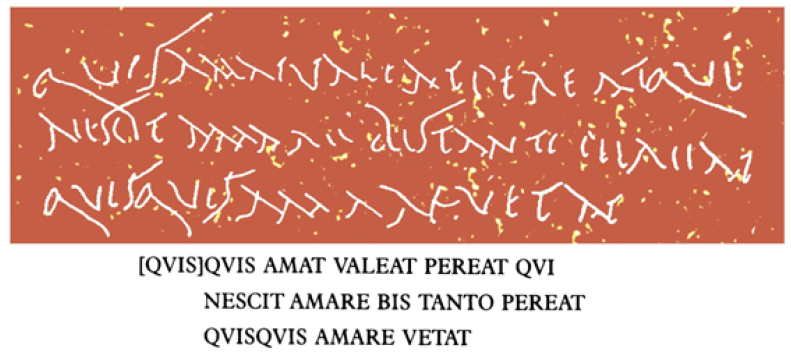
MAY HE WHO LOVES BE WELL
MAY HE WHO DOES NOT KNOW LOVE PERISH
MAY HE WHO
DENIES LOVE PERISH TWICE
GRAMMATICA LATINA
Gerundium
Hora in narrando consumpta, Syra plus temporis ad narrandum non habet et finem facit narrandi.
“Narrandum” est gerundium; quod ponitur in loco infinitivi et sic declinatur: accusativus -ndum, genetivus -ndi, ablativus (et dativus) -ndo.
Exempla:
Ovidius, semper paratus ad amandum, librum de amando scripsit, qui appellatur “Ars amandi”
Magister, qui artem docendi scit, paratus est ad docendum. Magister ipse discit alios docendo.
Industrii estote in scribendo, discipuli! Tempus scribendi est. Estisne parati ad scribendum?
Iam tempus dormiendi est, sed Quintus non est fessus audiendo neque paratus ad dormiendum.
Scribere scribendo, dicendo dicere disces.
LATIN GRAMMAR
Gerund
The hour was consumed in the telling, Syra does not have more time to tell and makes an end to the telling.
"Narrandum" is a gerund; which is placed in place of the infinitive and is declined thus: accusative -ndum, genetive -ndi, ablative (and dative) -ndo
Examples:
Ovid, is always prepared for loving, he wrote a book on loving, which is called "The art of loving"
The teacher, who knows the art of teaching, is prepared for teaching. The teacher learns by teaching others.
Be diligent in writing students! It is time for writing. Are you prepared for writing?
Now it is time for sleeping, but Quintus is not tired of hearing nor is he prepared for sleeping.
You learn to write by writing, to speak by speaking.
VOCABVLA
fuga, fugae f.
consilium, consili n.
carcer, carceris m.
orbis, orbis m.
natura, naturae f.
ars, artis f.
opus, operis n.
penna, pennae f.
ignis, ignis m.
lacertus, lacerti m.
libertas, libertatis f.
multitudo, multitudinis f.
paeninsula, paeninsulae f.
casus, casus m.
celer, -eris, -ere
reliquus, a, um
audax, audacis
liber, a, um
studiosus, a, um
ingens, ingentis
infimus, a, um
summus, a, um
cautus, a, um
temerarius, a, um
propinquus, a, um
persequor, persequi, persecutum
consequor, consequi, consecutum
confi confi confeci, confectum
consumo, -ere, -sumpsi, -sumptum
invenio, invenire, inveni, inventum
effugio, effugere, effugi, effugitum
iuvo, iuvare, iuvi, iutum
excogito, -are, -avi, excogitatum
imitor, imitari, imitatus sum
evolo, evolare, evolavi, evolatum
perfi perfi perfeci, perfectum
mollio, mollire, mollivi, mollitum
figo, figere, fixi, fixum
levo, levare, levavi, levatum
uro, urere, ussi, ustum
suspicio, -picere, -pexi, -pectum
despicio, -spicere, -spexi, -spectum
accido, accidere, accidi, accisum
quatio, quatere, -, quassum
aberro, -are, -avi, aberratum
revoco, -are, -avi, revocatum
videri
esto
quisquam
sursum
haud
paene
quidem
tamquam
quoniam
verum
sin
trans
gerundium, gerundii n.
VOCABULARY
flight, escape, fleeing
advice, discussion,
prison, jail
circle, sphere
nature, character
skill, art
need, work
feather, wing
fire, brightness
arm, strength (pl.)
freedom, liberty
multitude, crowd
peninsula
fall, accident, chance
swift, fast
remaining, rest of
bold, daring
free (man), unimpeded
eager, studious
mighty, huge
lowest, deepest
highest, greatest
cautious, prudent
rash, accidental
near, neighboring
to pursue, to overtake
to follow, to reach
to make, to complete
to destroy, to devour
to come upon, discover
to run away from
to help, to assist
to devise, to contrive
to imitate, to copy
to fly away, to rush out
to complete,
to soften, to mitigate
to fasten, to fix
to lift up, comfort
to burn
to look up to, to admire
to disdain, to despise
to cut, to fell
to shake
to stray, to wander
to recall, to regain
to appear, to seem
be (imp)
any, anything
up, on high
not, not at all
nearly, almost, mostly
indeed, certainly
as, just as
because, seeing that
however, to be sure
but if, if on the contrary
across, over
gerund