CAPITVLVM DVODECIMVMTWELFTH CHAPTER
MILES ROMANVSROMAN SOLDIER
I
Quintus est frater Marci. Iulia soror eius est. Marcus et Quintus fratres Iuliae sunt. Marcus patrem et matrem, fratrem et sororem habet. Nomen patris est 'Iulius', matris 'Aemilia'; 'Quintus' est nomen fratris, 'Iulia' sororis.
Marco una soror est. Iuliae duo fratres sunt. Nomina fratrum sunt 'Marcus' et 'Quintus'. Patri et matri una filia et duo filii sunt.
Matri 'Aemilia' nomen est. Quod nomen est patri? Ei nomen est 'Lucius Iulius Balbus'. Viro Romano tria nomina sunt. 'Lucius' est praenomen, id est nomen primum; 'Balbus' cognomen est. Filiis nomina sunt 'Marcus Iulius Balbus' et 'Quintus Iulius Balbus'. 'Marcus' et 'Quintus' praenomina sunt filiorum. Alia praenomina Latina sunt 'Aulus', 'Decimus', 'Gaius', 'Publius', 'Sextus', 'Titus'.
Aemiliae est unus frater, cui 'Aemilius' nomen est (praenomen 'Publius', cognomen 'Paulus'). Frater Aemiliae est avunculus liberorum. Aemilius autem procul a sorore sua abest. Itaque tristis est Aemilia, quae fretrem suum amat.
Marcus et Iulia matrem sua tristem in hortum exire vident et patrem interrogant: “Cur mater nostra tristis est?”
Iulius: “Mater vestra tristis est, quod Aemilius procul ab ea abest. Aemilius avunculus vester est, id est frater matris. Mater tristis est, quod fratrem suum videre non potest.”
Marcus: “Ubi est avunculus noster?”
Iulius: “Avunculus vester est in Germania. Aemilius miles est. In Germania multi sunt milites Romani.”
Iulia: “Quid est miles?”
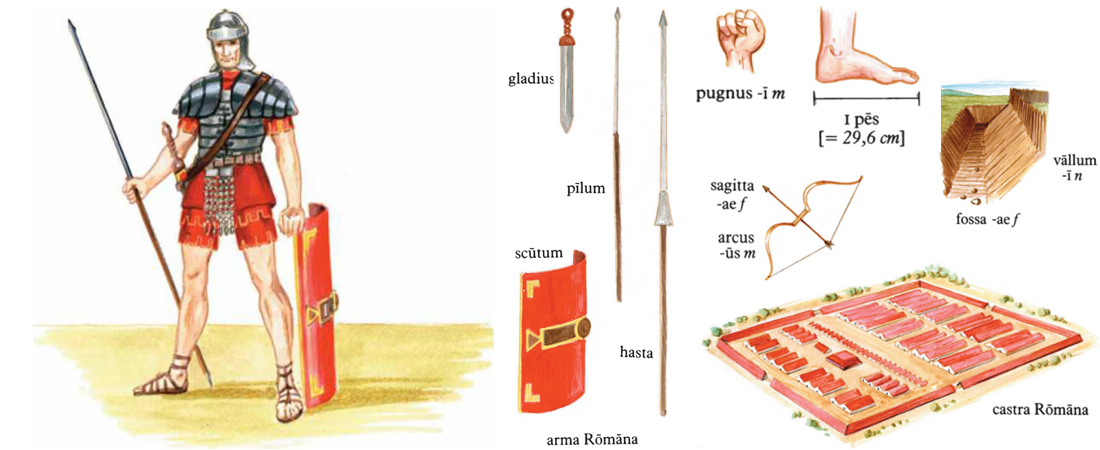
Iulius: “Miles est vir qui scutum et glaudium et pilum fert. Scutum et gladius et pilum sunt arma militis Romani. Miles est vir armatus.”
Quintus is Marcus's brother. Julia is his siste. Marcus and Quintus are Julia's brothers. Marcus has a father and mother, a brother and a sister. His father's name is 'Julius', 'Emilia' his mothers, 'Quintus' is his brother's name, 'Julia' his sister's.
Marcus has one sister. Julia has two brothers. Her brothers names are 'Marcus' and 'Quintus'. Father and mother have one daughter and two sons.
'Emilia' is the mother's name. What is the father's name? His name is 'Lucius Julius Balbus'. A Roman man has three names. 'Lucius' is the praenomen, that is the first name; 'Balbus' is the cognomen. The son's names are 'Marcus Julius Balbus' and 'Quintus Julius Balbus'. 'Marcus' and 'Quintus' are the sons' praenomens. Other Latin praenomens are 'Aulus', 'Decimus', 'Gaius', 'Publius', 'Sextus', 'Titus'.
Emilia has one brother, whose name is 'Emil' (praenomen 'Publius', cognomen 'Paulus'). Emilia's brother is the children's uncle. But Emil is far away from his sister. Therefore Emilia is sad because she loves her brother.
Marcus and Julia see their sad mother go into the garden and ask their father: "Why is our mother sad?"
Julius: "Your mother is sad because Emil is far away from her. Emil is your uncle, he is your mother's brother. Your mother is sad because she cannot see her brother."
Marcus: "Where is our uncle?"
Julius: "Your uncle is in Germany. Emil is a soldier. There are many Roman soldiers in Germany."
Julia: "What is a soldier?"
Julius: "A soldier is a man who carries a shield, sword, and javelin. A shield, sword, and javelin are Roman arms. A soldier is an armed man."
II
Iulia: “Quid agunt milites Romani in Germania?”
Iulius: “Milites nostri in Germania pugnant.”
Iulia: “Mei quoque fratres pugnant.”
Iulius: “Pueri pugnis, non armis pugnant. Milites pugnant gladiis, pilis, hastis.”
Marcus: “Num Aemilius et hastam et pilum fert?”
Iulius: “Aemilius pilum tantum fert, is enim pedes est, non eques. Eques est miles qui ex equo pugnant; qui pedibus pugnant pedes est. Equites hastas, pedites pila ferunt. Pilum non tam longum est quam hasta, neque gladius peditis tam longus est quam gladius equitis. Pilum Aemilii sex pedes longum est.”
Marcus: “Quam longus est gladius eius?”
Iulius: “Duos pedes longus est.”
Marcus: “Duos pedes tantum? Cur tam brevis est gladius?”
Iulius “Quod gladius brevis non tam gravis est quam gladius longus. Gladius equitis longior et gravior est quam peditis. Pedes, qui pedibus it multaque alia arma fert, gladium longum et gravem ferre non potest; itaque gladius eius brevis et levis est - brevior et levior quam is qui ab equite fertur. Etiam gladii qui a Germanis ferunt longiores et graviores sunt quam nostra sunt.”
Iulia: “Qui sunt Germani?”
Iulius: “Germani sunt homines barbari qui Germaniam incolunt. Germani est magna terra non procul a Gallia; Gallia autem provincia Romana est, ut Hispania, Syria, Aegyptus. Provincia est pars imperii Romani, ut membrum pars corporis est; Roma enim caput imperii est, provinciae membra sunt. Germania non est provincia Romana. Flumen Rhenus Germaniam a Gallia provincia dividit. Rhenus ac Danuvius flumina, quae Germaniam ab imperio Romano dividunt, fines imperii nostri sunt. Germania est patria Germanorum, ut Roma nostra patria est.”
Iulia: “Cur milites Romani contra Germanos pugnant? Suntne Germani homines improbi?”
Iulius: “Milites nostri contra Germanos pugnant, quod Germani amici Romanorum non sunt nec Romanis parent, Germani hostes Romanorum sunt, ac bellum est inter Germanos et Romanos. Germani exercitum nostrum oppugnant.”
Iulia: “Quid est 'exercitus'?”
Iulius: “Exercitus est magnus numerus militum qui contra hostes ducitur. Qui exercitum ducit dux exercitus est. Dux exercitui imperat, exercitus duci suo paret, nam dux ab exercitu metuitur.
“In Germania et in Britannia sunt magni exercitus Romani qui contra exercitus hostium pugnant. Milites et duces exercituum Romanorum ab hostibus metuuntur. In Hispania et in Gallia non multi sunt milites Romani, nam Hispani et Galli, qui eas provincias incolunt, iam exercitibus nostris parent. In exercitibus Romanis etiam Hispani et Galli multi militant, qui et alia arma et arcus sagittasque ferunt.”
Julia: "What are Roman soldiers doing in Germany?"
Julius: "Our soldiers are fighting in Germany."
Julia: "My brothers are also fighting."
Julius: "The boys are fighting with fists not arms. Soldiers fight with swords, javelins and spears."
Marcus: "Emil doesn't carry both spear and javelin does he?"
Julius: "Emil carries a javelin also, for he is a foot soldier not horseman. A horseman is a soldier who fights from a horse; he who fights from his feet is a foot soldier. Cavalry carry spears, foot soldiers carry javelins. A javelin is not as long as a spear, neither is the sword of a foot soldier as long as the horseman's sword. Emil's javelin is six feet long."
Marcus: "How long is his sword?"
Julius: "It is two feet long."
Marcus: "Only two feet? Why is the sword so short?"
Julius: "Because a short sword is not as heavy as a long sword. The cavalry's sword is longer and heavier than a foot soldier's. Foot soldiers, who go by foot and carry other arms, cannot carry a long and heavy sword; therefore his sword is short and light - shorter and lighter than that which is carried by a horseman. Even the swords carried by the Germans are longer and heavier than those by our men."
Julia: "Who are the Germans?"
Julius: "The Germans are barbarian men who live in Germany. Germany is a large land not far from Gaul; but Gaul is a Roman province, like Spain, Syria, and Egypt. A province is part of the Roman Empire, like a limb is part of the body; for Rome is the head of the Roman Empire, like provinces are limbs. Germany is not a Roman province. The Rhine river divides Germany from the Gaul province. The Rhine and Danube rivers, which divides Germany from the Roman Empire, are our empire's territory. Germany is the fatherland of the Germans, like Rome is our fatherland."
Julia: "Why are Roman soldiers fighting against the Germans? Are the Germans bad men?"
Julius: "Our soldiers are fighting against the Germans because Germans are not friends of the Romans nor do they obey the Romans, the Germans are enemies of the Romans, and there is a war between the Germans and Romans. The Germans attack our army."
Julia: "What is an 'army'?"
Julius: "An army is a large number of soldiers who are led against an enemy. He who leads an army is the leader of the army. The leader commands the army, the army obeys their leader, for the leader is feared by the army.
"In Germany and in Britain there are large Roman armies who fight against the armies of the enemy. The soldiers and leaders of the Roman armies are feared by the enemies. In Spain and in Gaul there are not many Roman soldiers for the Spanish and Gauls, which live in those provinces, already obey our armies. In the Roman armies there are even many Spaniards and Gauls who serve as soldiers, who carry other arms and bows and arrows."
III
Iulia: “Ubi habitat Aemilius?”
Iulius: “Aemilius in castris habitat mille passus a fine imperii. Castra sunt militum oppidum.”
Marcus: “Quam longus est passus?”
Iulius: “Unus passus est quinque pedes, ergo mille passus sunt quinque milia pedum. In castris Aemilii sex milia militum habitant. Nullae feminae aut pueri illic habitant, nec enim feminae puerique militare possunt. Circum castra fossa et vallum longum et altum est.”
Marcus: “Quam altum est vallum castrorum.”
Iulius: “Prope decem pedes altum est, et duo milia passuum longum. Quattuor portae per vallum in castra ducunt. Inter duas portas est via lata, quae castra in duas partes dividit; ea via centum pedes lata est.
“In bello portae castrorum clauduntur. Cum exercitus Germanorum castra oppugnat, Romani castra defendunt: vallum ascendunt ac pila in Germanos iaciunt. Illi autem nec pila in castra iacere possunt, quod fossa nimis lata et vallum nimis altum est, nec vallum ascendere, quod Romani pilis et gladiis vallum defendunt. Hostes castra nostra expugnare non possunt.
“Ecce portae aperiuntur atque equitatus noster in hostes impetum facit. Barbari perterriti, qui impetum equitatus sustinere non possunt, arma ad terram iaciunt atque in magnas silvas fugiunt.
“Miles Romanus, qui hostem armatum accurrere videt, non ab eo fugit, sed armis se defendit. Milites Romani fortes sunt. Miles fortis hostem non metuit, sed sine metu impetum in hostem facit. Aemilius, avunculus vester, miles fortis est.
“Circum imperium Romanum multi sunt hostes. Castra et oppida nostra ab hostibus oppugnantur neque expugnantur, nam milites nostri provincias ac patriam nostram a Germanis et ab aliis hostibus defendunt.”
Marcus: “Etiam Germani suam patriam defendunt.”
Iulius: “Sed patria nostra pulchrior est quam illorum! Atque Germani homines barbari sunt.”
Marcus: “Nonne fortes sunt Germani?”
Iulius: “Fortes sunt illi, sed Romani fortiores sunt, nec arma Germanorum tam bona sunt quam nostra. Scutum eorum nimis parvum est, pilum nimis longum et grave; nec enim pilum tam grave procul iaci potest. Itaque pilum nostrum breve et leve est - brevius et levius quam pilum Germanorum. Milites Romani bene pugnant, quod pila eorum brevia et levia sunt, non longa et gravia ut Germanorum. Patria nostra bonis armis defenditur. Nullus hostis Romam expugnare potest.”
Marcus: “Cur Romani Germaniam non expugnant?”
Iulius: “Germania non solum armis defenditur, sed etiam altis montibus, magnis silvis atque latis et altis fluminibus.”
Julia: "Where does Emil live?"
Julius: "Emil lives in a camp a thousand paces from the territory of the empire. Camps are towns of soldiers."
Marcus: "How long is a pace?"
Julius: "One pace is five feet, therefore one thousand paces are five thousand feet. Six thousand soldiers live in Emil's camp. No women or boys live there, for women and boys cannot be soldiers. Around the camp is a ditch and a long and high rampart."
Marcus: "How high is the camp's rampart?"
Julius: "It is about ten feet high and two thousand paces long. Four gates lead through the rampart into camp. Between the two gates is a wide road, which divides the camp into two parts; that road is one hundred feet wide.
"In a war the camp's gates are closed. When the German army attacks the camp, the Romans defend the camp: they climb the rampart and throw javelins at the Germans. But they cannot throw javelins into the camp because the ditch is too wide and the rampart is too high, nor can the rampart be climbed because the Romans defend the rampart with javelins and swords. The enemy cannot storm our camp.
"Behold the gates are opened and our cavalry makes an attack against the enemy. The barbarians are terrified who cannot withstand the cavalry's attack they throw their arms to the ground and flee into the great forest.
"A Roman soldier, who sees an enemy come running with arms, he does not flee from him but defends himself with arms. Roman soldiers are brave. A brave solder does not fear the enemy, but makes an attack against the enemy without fear. Emil, your uncle, is a brave soldier.
"Around the Roman Empire there are many enemies. Our camps and towns are attacked by the enemy but not conquered, for our soldiers defend our provinces and our fatherland from the Germans and other enemies."
Marcus: "The Germans are also defending their fatherland."
Julius: "But our fatherland is more beautiful than theirs! And the Germans are barbarian men."
Marcus: "Are the Germans not brave?"
Julius: "Those are brave, but Romans are more brave, German arms are not as good as ours. Their shield is too small, their javelin too long and heavy, for a javelin so heavy cannot be thrown far. Therefore our javelins are short and light - shorter and lighter than the German's javelins. Roman soldiers fight well because their javelins are short and light, not long and heavy like the Germans. Our fatherland is defended with good arms. No enemy can conquer Rome."
Marcus: "Why are the Romans not conquering the Germans?"
Julius: "Germany is defended not only with arms, but also with high mountains, great forests and wide and deep rivers."
GRAMMATICA LATINA
Declinatio quarta
'Exercitus' (m) declinatur hoc modo (vide exempla in versibus 80-89 huius capituli):
| Singularis | Pluralis | |
| Nominativus | exercit|us | exercit|us |
| Accusativus | exercit|um | exercit|us |
| Genetivus | exercit|us | exercit|uum |
| Dativus | exercit|ui | exercit|ibus |
| Ablativus | exercit|u | exercit|ibus |
Ut 'exercitus' declinantur masculina: arcus, passus, equitatus, impetus, metus, versus, cet.; femininum: manus.
Adiectivum
[I/II] Declinatio prima et secunda.
Mons altus. Arbor alta. Vallum altum.
'Alt|us -a -um' est adiectivum primae et secundae declinationis. Masculinum 'altus' declinatur ut 'servus', femininum 'alta' ut 'femina', neutrum 'altum' ut 'oppidum'.
| Singularis | Pluralis | |||||
| Masc. | Fem. | Neutr. | Masc. | Fem. | Neutr. | |
| Nom. | alt|us | alt|a | alt|um | alt|i | alt|ae | alt|a |
| Acc. | alt|um | alt|am | alt|um | alt|os | alt|as | alt|a |
| Gen. | alt|i | alt|ae | alt|i | alt|orum | alt|arum | alt|orum |
| Dat. | alt|o | alt|ae | alt|o | alt|is | alt|is | alt|is |
| Abl. | alt|o | alt|a | alt|o | alt|is | alt|is | alt|is |
Hoc modo declinantur haec adiectiva: albus, bonus, fessus, foedus, iratus, laetus, latus, longus, magnus, malus, meus, novus, plenus, primus, sanus, tuus, cet.; (-er -ra -rum:) pulcher, aeger, niger, ruber, noster, vester, cet.
[III] Declinatio tertia.
Gladius brevis. Via brevis. Pilum breve.
'Brevis -e' est adiectivum tertiae declinationis. Masculinum et femininum 'brevis' declinitur ut 'ovis' (sed abl. sing. -i), neutrum 'breve' ut 'mare'.
| Singularis | Pluralis | |||
| Masc./Fem. | Neutr. | Masc./Fem. | Neutr. | |
| Nom. | brev|is | brev|e | brev|es | brev|ia |
| Acc. | brev|em | brev|e | brev|es | brev|ia |
| Gen. | brev|is | brev|is | brev|ium | brev|ium |
| Dat. | brev|i | brev|i | brev|ibus | brev|ibus |
| Abl. | brev|i | brev|i | brev|ibus | brev|ibus |
Hoc modo deeclinantur haec adiectiva: brevis, fortis, gravis, levis, tenuis, tristis, cet.
Exempla:
Pedes fortis Romanus gladium brevem et levem, scutum magnum et grave fert; eques hastam fert longam et gravem. Pediti forti Romano est gladius brevis et levis, scutum magnum et grave; equiti hasta longa et gravis est. Pedes gladio brevi et levi, scuto magno et gravi armatus est; eques hasta longa et graví pugnat.
Pedites fortes Romani gladios breves et leves, scuta magna et gravia ferunt; equites hastas ferunt longas et graves. Peditibus fortibus Romanis sunt gladii breves et leves, scuta magna et gravia; equitibus hastae longae et graves sunt. Pedites gladiis brevibus et levibus, scutis magnis et gravibus armati sunt; equites hastis longis et gravibus pugnant.
Comparativus
Hic murus altior est quam ille.
Hoc vallum altius est quam illud.
'Altor -ius' comparativus est. Comparativus est adiectivum declinationis tertiae:
| Singularis | Pluralis | |||
| Masc./Fem. | Neutr. | Masc./Fem | Neutr. | |
| Nom. | altior | altius | altior|es | altior|a |
| Acc. | altior|em | altius | altior|es | altior|a |
| Gen. | altior|is | altior|is | altior|um | altior|um |
| Dat. | altior|i | altior|i | altior|ibus | altior|ibus |
| Abl. | altior|e | altior|e | altior|ibus | altior|ibus |
Exempla: brevior, fortior, gravior, levior, longior, pulchrior.
Gladius equitis longior et gravior est quam peditis. Eques gladium longiorem et graviorem fert quam pedes. Eques gladio longiore et graviore pugnat.
Gladii equitum longiores et graviores sunt quam peditum. Equites gladiis longioribus et gravioribus pugnant.
Pilum brevius et levius est quam hasta. Pila breviora et leviora sunt quam hastae.
Delia ancilla pulchrior est quam Syra. Leander, qui ancillae pulchrioris amicus est, ancillae pulchriori rosam dat. Quid pulchrius est quam rosa?
Milites Romani fortiores sunt quam hostes. Dux Romanus militibus fortioribus imperat quam dux hostium. Ille dux militum fortiorum est.
LATIN GRAMMAR
Fourth declension
'Army' (m) is declined this way (see the examples in lines 80-89 of this chapter):
| Singular | Plural | |
| Nominative | army | armies |
| Accusative | army | armies |
| Genetive | army's | armies' |
| Dative | to the army | to the armies |
| Ablative | with the army | with the armies |
Masculine declined like 'army': bow, pace, cavalry, attack, fear, against, etc. feminine: hand
Adjective
[1/2] First and second declension
High mountain. High tree. High rampart.
''High' is an adjective of the first and second declensions. The masculine 'high' is declined like 'slave', feminine 'high' like 'woman', neuter 'high' like 'town'.
| Singular | Plural | |||||
| Masc. | Fem. | Neutr. | Masc. | Fem. | Neutr. | |
| Nom. | high | high | high | highs | highs | highs |
| Acc. | high | high | high | highs | highs | highs |
| Gen. | high's | high's | high's | highs' | highs' | highs' |
| Dat. | to high | to high | to high | to highs | to highs | to highs |
| Abl. | with high | with high | with high | with highs | with highs | with highs |
These adjectives are declined this way: white, good, tired, ugly, angry, happy, wide, long, great, evil, mine, new, full, first, safe, your, etc.; (-er -ra -rum:) beautiful, sick, black, red, our, your, etc.
[3] Third declension
Short sword. Short road. Short javelin.
Brief is an adjective of the third declension. Masculine and feminine brief is declined like 'sheep' (but abl. sing. -i), neuter 'short' like 'sea'.
| Singular | Plural | |||
| Masc./Fem. | Neutr. | Masc./Fem. | Neutr. | |
| Nom. | brief | brief | brief (pl) | brief (pl) |
| Acc. | brief | brief | brief | brief |
| Gen. | brief's | brief's | brief | brief |
| Dat. | to brief | to brief | to brief | to brief |
| Abl. | with brief | with brief | with brief | with brief |
These adjectives are declined this way: short, brave, heavy, light, thin, sad, etc.
Examples:
The brave Roman foot soldier carries a short and light sword, a large and heavy shield; the horseman carries a long and heavy spear. The sword of a brave Roman foot soldier is short and light, the shield is large and heavy; the spear of the horseman is long and heavy. The foot soldier is armed with a short and light sword, a large and heavy shield; the horseman fights with a long and heavy spear.
Brave Roman foot soldiers carry short and light swords, large and heavy shields; horsemen carry long and heavy spears. The swords of brave Roman foot soldiers are short and light, the shields large and heavy; the spears of the horsement are long and geavy. Foot soldiers are armed with short and light swords, large and heavy shields; horsement fight with long and heavy spears.
Comparative
This wall is higher than that one.
This rampart is higher than that one.
Higher' is comparative. A comparative is an adjective of the third declension:
| Singular | Plural | |||
| Masc./Fem. | Neutr. | Masc./Fem. | Neutr. | |
| Nom. | higher | higher | highers | highers |
| Acc. | higher | higher | highers | highers |
| Gen. | of the higher | of the higher | of the highers | of the highers |
| Dat. | to the higher | to the higher | to the highers | to the highers |
| Abl. | with the higher | with the higher | with the highers | with the highers |
Examples: shorter, braver, heavier, lighter, longer, more beautiful.
The sword of the horseman is longer and heavier than the foot soldier's. The horseman carrys a longer and heavier sword than the foot soldier. The horseman fights with a longer and heavier sword.
The swords of the horsemen are longer and heavier than the foot soldier's. The horsemen fight with longer and heavier swords.
The javelin is shorter and lighter than the spear. Javelins are shorter and lighter than spears.
The handmaid Delia is more beautiful than Syra. Leander, who is the friend of the more beautiful handmaid, gives a rose to the more beautiful handmaid. What is more beautiful than a rose?
Roman soliders are more brave than the enemy. The Roman leader commands braver soldiers than the enemy's leader. That leader of braver soldiers.
VOCABVLA
frater, fratris m.
soror, sororis f.
nomen, nominis n.
praenomen, nominis n.
cognomen, nominis n.
avunculus, i m.
miles, militis m.
scutum, i n.
gladius, i m.
pilum, i n.
arma, armorum n.
arcus, us m.
sagitta, ae f.
pugnus, i m.
hasta, ae f.
pedes, peditis m.
eques, equitis m.
pars, partis f.
finis, finis m.
patria, ae f.
hostis, hostis m.
bellum, i.
exercitus, us m.
dux, ducis m.
castra, castrorum n.
passus, us m.
fossa, ae f.
vallum, i n.
equitatus, us m.
impetus, us m.
metus, us m.
versus
mille, milis n.
tristis, triste
armatus, a, um
brevis, breve
gravis, grave
levis, leve
barbarus, a, um
altus, a, um
latus, a, um
fortis, forte
vester, -ra, -rum
ferre
pugnare
incolere
dividere
oppugnare
metuere
militare
defendere
iacere
expugnare
fugere
contra
ac
adjectivum
comparativus
VOCABULARY
brother
sister
name
first name
surname
uncle
soldier
shield
sword
javelin
weapons
bow
arrow
fist
spear, javelin
foot soldier
horseman, rider
part
boundary, end
native land
enemy, stranger, foreigner
war
army
leader, guide
camp, military camp
step, pace
ditch, trench
wall, rampart
cavalry
attack
fear
toward, in the direction of
thousand
sad, sorrowful
armed
short, little
heavy
light, thin
foreign, savage
high, deep
wide, broad
strong, brave
your
to bring, to bear
to fight
to inhabit
to divide
to attack
to fear
to serve as a soldier
to defend
to throw
to storm, to conquer
to run away, to flee
against
and
adjective
comparative