CAPITVLVM OCTAVVMEIGHTH CHAPTER
TABERNA ROMANAROMAN SHOP
I
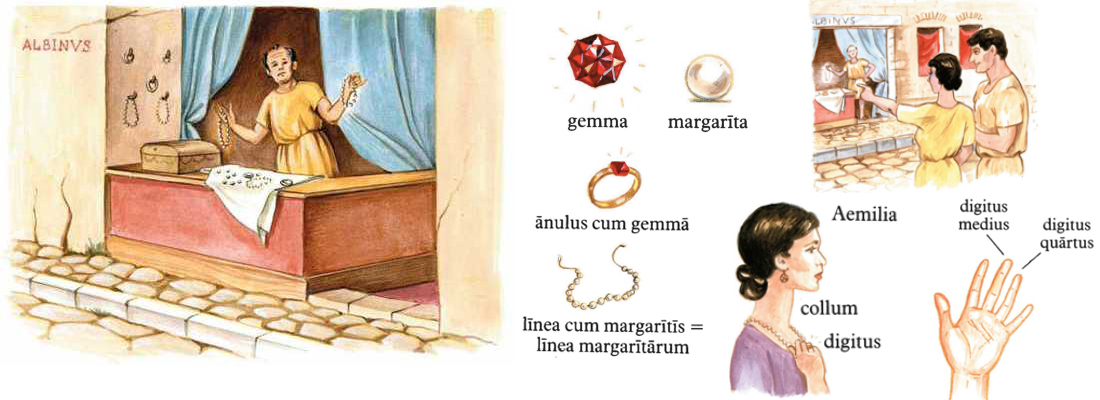
Ecce taberna Romana, in qua gemmae et margaritae multae sunt. Cuius est haec taberna? Albini est. Albinus hanc tabernam habet. Qui tabernam habet tabernarius est. Albinus est tabernarius Romanus qui gemmas et margaritas vendit. Alii tabernarii libros vendunt, alii mala et pira, alii rosas et lilia.
Gemmae et margaritae sunt ornamenta. Anulus cum gemma ornamentum pulchrum est. Etiam linea cum margaritis ornamentum est. Linea sine margaritis non est ornamentum!
Multae feminae quae in hac via ambulant ante tabernam Albini consistuint, nam feminae ornamentis delectantur. Eae quae magnam pecuniam habent multa ornamenta emunt. Quae nullam aut parvam pecuniam habent ornamenta aspiciunt tantum, non emunt. Etiam viri multi ad hanc tabernam adeunt. Qui magnam pecuniam habent ornamenta emunt et feminis dant; ceteri rursus abeunt. Feminae quarum viri magnam pecuniam habent multa ornamenta a viris suis accipiunt.
Aemilia, cuius vir pecuniosus est, multa ornamenta ab eo accipit. Aemilia anulum in digito et margaritas in collo multaque alia ornamenta habet. Anulus digitum Aemiliae ornat, margaritae collum eius ornant. Feminae gemmis et margaritis anulisque ornantur.
In via prope tabernam Albini vir et femina ambulant. Qui vir et quae femina? Est Medus, qui cum Lydia, amica sua, ambulat. Medus est servus Iulii, sed dominus eius Romae non est. Medus sine domino suo cum femina formosa in viis Romae ambulat.
Lydia ornamentum pulchrum in collo habet. Quod ornamentum? Ornamentum quod Lydia habet est linea margaritarum. Collum Lydiae margaritis pulchris ornatur; Lydia autem nullum aliud ornamentum habet, quia pecuniosa non est, neque pecuniosus est amicus eius. (Pecuniosus est qui magnam pecuniam habet.)
Behold a Roman shop in which there are many gems and pearls. Whose shop is this? It is Albinus's. Albinus has this shop. He who has a shop is a shopkeeper. Albinus is a Roman shopkeeper who sells gems and pearls. Other shopkeepers sell books, others apples and pears, others roses and lillies.
Gems and pearls are jewelry. A ring with a gem is beautiful jewelry. A string with pearls is also jewelry. A string without pearls is not jewelry!
Many women who walk on this road stop in front of Albinus's shop, for women are delighted by jewelry. Those who have much money buy much jewelry. Those who have little or no money only look at the jewelry, not buy it. Also many men come to this shop. He who has much money buys jewelry and gives them to women; others leave again. Women whose husbands have much money receive much jewelry from their husbands.
Emilia, whose husband is wealthy, receives much jewely from him. Emila has a ring on her finger and pearls on her neck and many other pieces of jewelry. A ring decorates Emilia's finger, pearls decorate her neck. Women are decorated by gems and pearls and rings.
On the road near Albinus's ship a man and woman are walking. Which man and which woman? It is Medus, who is walking with Lydia his girlfriend. Medus is Julius's slave, but his master is not in Rome. Medus is walking without his master with a beautiful woman in the roads of Rome.
Lydia has beautiful jewelry on her neck. What jewelry? The jewelry which Lydia has is a string of pearls. Lydia's neck is decorated with beautiful pearls; but Lydia has no other jewelry, because she is not wealthy, nor is her boyfriend wealthy. (A wealthy person is one who has a lot of money).
II
Albinus clamat: “Ornamenta! Ornamenta feminarum! Or-na-men-ta! Emite ornamenta!”
Lydia consistit oculosque ad tabernam Albini vertiti: Lydia tabernam aspicit. Medus non consistit neque tabernam aspicit.
Lydia: “Consiste, Mede! Aspice illam tabernam! O, quam pulchra sunt illa ornamenta!” Lydia tabernam Albini digito monstrat. Medus se vertit, tabernam videt, cum Lydia ad tabernam adit. Medus et Lydia ante tabernam consistunt. Albinus eos salutat et margaritas in linea ante oculos Lydiae tenet: Albinus Lydiae margaritas ostendit.
Albinus: “In hoc ornamento viginti margaritae magnae sunt. Nonne pulchrae sunt hae margaritae?”
Medus: “Amica mea multas margaritas habet.”
Lydia: “In hac taberna multa alia ornamenta sunt.”
Albinus iis tres anulos sine gemmis ostendit: “Aspicite hos anulos! Nonne hi anuli pulchri sunt?”
Medus et Lydia anulos aspiciunt.
Lydia: “In his anulis gemmae nullae sunt!”
Medus Albinum interrogat: “Quot nummis constat anulus in quo gemma est?”
Albinus Medo anulum gemmatum ostendit.
Albinus: “Hic anulus centum nummis constat.”
Medus: “Quid?”
Albinus: “Pretium huius anuli est centum sestertii.”
Medus: “Centum sestertii? Id magnum pretium est!”
Albinus: “Immo parvum pretium est! Aspice hunc anulum: in hoc anulo magna gemma est. Tanta gemma sola octoginta sestertiis constat.”
Medus: “Num anulus sine gemma viginti tantum sestertiis constat?” Albinus non respondet.
Medus, qui alium anulum gemmatum post Albinum videt: “Hic anulus pulcher non est. Quot sestertiis constat ille anulus?”
Albinus: “Qui anulus?”
Medus: “Ille post te. Quantum est pretium illius anuli?” Medus anulum post Albinum digito monstrat.
Albinus: “Ille quoque anulus centum sestertiis constat. Pretium illius anuli tantum est quantum huius; sed amica tua hunc anulum amat, non illum.”
Lydia anulum gemmatum ante oculos tenet.
Lydia: “O, quam pulchrum hoc ornamentum est! Illud ornamentum non tam pulchrum est quam hoc, neque illa gemma tanta est quanta haec.”
Medus: “Tanta gemma ad tam parvum anulum non convenit.”
Albinus shouting: "Jewelry! Women's jewelry! Je-wel-ry! Buy the jewelry!"
Lydia stops and turns her eyes to Albinus's shop: Lydia sees the shop. Medus does not stop nor does he see the shop.
Lydia: "Stop Medus! Look at that shop! O what beautiful jewelry there is!" Lydia points her finger at Albinus's shop. Medus turns himself around, sees the shop, and goes with Lydia to the shop. Medus and Lydia stop in front of the shop. Ablinus greets them and holds pearls on a string in front of Lydia's eyes: Albinus shows the pearls to Lydia.
Albinus: "On this jewelry there are twenty large pearls. Are these pearls not beautiful?"
Medus: "My girlfriend has many pearls."
Lydia: "In this shop there are many other jewels."
Albinus shows them three rings without gems: "Look at these rings! Are not these rings beautiful?"
Medus and Lydia look at the rings.
Lydia: "On these rings there are no gems!"
Medus asks Albinus: "How much coins do rings which have gems cost?"
Albinus shows a ring with a gem to Medus.
Albinus: "This ring costs one hundred coins."
Medus: "What?"
Albinus: "The price of this ring is one hundred sesterii."
Medus: "One hundred sestertii? That is a large price!"
Ablinus: "On the contrary it is a small price! Look at this ring: in this ring there is a large gem. The gem alone costs as much as eighty sestertii."
Medus: "Surely a ring without a gem doesn't cost as much as twenty sestertii does it?" Albinus does not answer.
Medus, who sees another gemmed ring behind Albinus: "This ring is not beautiful. How much does that ring cost?"
Albinus: "Which ring?"
Medus: "That ring behind you. How much is the price of that ring?" Medus points out the ring behind Albinus with his finger.
Albinus: "That ring also costs one hundred sestertii. The price of that ring is as much the amount of this one; but your girlfriend loves this ring, not that one."
Lydia holds the gemmed ring in front of her eyes.
Lydia: "O, what beautiful jewelry this is! That jewelry is not as beautiful as this, nor does that have as much gems that this one has."
Medus: "Such a gem is not fitting to such a small ring."
III
Lydia, quae haec verba non audit, Medo digitos suos ostendit, in quibus nulli anuli sunt.
Lydia: “Aspice, Mede! In digitis meis nulli sunt anuli. Aliae feminae digitos anulorum plenos habent - mei digiti vacui sunt!”
Medus: “Sacculus quoque meus vacuus est!”
Lydia anulum in mensa ponit. In oculis eius lacrimae sunt. Medus, qui lacrimas videt, sacculum suum in mensa ponit - neque vacuus est sacculus, sed plenus nummorum! Quanta pecunia est in sacculo Medi? In eo nonaginta sestertii insunt.
Medus: “Ecce sestertii nonaginta.”
Albinus: “Sed nonaginta non satis est. Pretium anuli est sestertii centum!”
Lydia: “Da huic tabernario centum sestertios!”
Medus: “Id nimis magnum pretium est! Alii tabernarii anulum gemmatum octoginta sestertiis vendunt.”
Albinus: “Qui sunt illi tabernarii?”
Medus: “Qui in aliis viis tabernas habent.”
Albinus: “Quae sunt illae viae in quibus illae tabernae sunt? Et quae sunt illa ornamenta quae in illis tabernis parvo pretio emuntur? Non sunt ornamenta! Sed aspicite haec ornamenta: hos anulos, has gemmas, has margaritas! Haec ornamenta proba sunt! Neque pretium horum ornamentorum nimis magnum est!”
Medus: “Accipe nummos nonaginta - aut nullos!”
Albinus: “Num hic nonaginta sestertii sunt?”
Medus: “Numera eos!”
Albinus numerat sestertios, quorum numerus est nonaginta.
Albinus: “Sunt nonaginta.”
Medus: “Satisne est?” Albinus non respondet, sed nummos sumit Medoque anulum dat. Albinus pecuniam accipit et Medo anulum vendit sestertiis nonaginta.
Medus se ad Lydiam vertit: “Accipe hunc anulum ab amico tuo...” Medus anulum in digito Lydiae ponit. In quo digito? In digito medio.
Medus: “Hic anulus ad digitum tuum non convenit. Anulus nimis parvus est aut digitus nimis magnus!”
Lydia: “O Mede! Digitus medius nimis magnus est. Pone anulum in digito quarto!”
Medus anulum in digito Lydiae quarto ponit. Anulus satis magnus est et ad digitum convenit, nam digitus quartus non tantus est quantus digitus medius. Lydia laeta digitum suum aspicit et amico suo osculum dat.
Medus et Lydia a taberna abeunt. Lydia, quae Romae habitat, Medo viam monstrat.
Albinus rursus clamat: “Ornamenta! Or-na-men-ta!” et alios viros pecuniosus, quorum amicae nulla aut pauca ornamenta habent, exspectat.
Lydia, who did not hear these words, shows her fingers to Medus, in which there are no rings.
Lydia: "Look Medus! There are no rings on my fingers. Other women's fingers have plenty of rings - my fingers are empty."
Medus: "My bag is also empty!"
Lydia places the ring on the table. In her eyes there are tears. Medus, who sees the tears, places his bag on the table - the bag is not empty but full of coins! How much money is in Medus's bag? In it there are ninety sesterces.
Medus: "Here is ninety sestertii."
Albinus: "But ninety is not enough. The price of the ring is one hundred sesterces!"
Lydia: "Give this shopkeeper one hundred sesterces!"
Medus: "That is too great a price! Other shopkeepers sell gemmed rings for eighty sesterces."
Albinus: "Which shopkeepers are those?"
Medus: "Those who have shops on other roads."
Albinus: "What are those roads in which those shops are? And what is that jewelry in which those shops sell for a small price? They are not jewelry! But look at this jewelry: these rings, these gems, these pearls! These are good jewels! The price of these jewels is not too great!"
Medus: "Take ninety coins - or nothing!"
Albinus: "There is not ninety sesterces here is there?"
Medus: "Count them!"
Albinus counts the sesterces, of which the number is ninety.
Albinus: "There are ninety."
Medus: "Is it enough?" Albinus does not answer, but picks up the coins and gives the ring to Medus. Albinus takes the money and sells the ring to Medus for ninety sesterces.
Medus turns himself to Lydia: "Accept this ring from your boyfriend..." Medus places the ring on Lydia's finger. On which finger? On the middle finger.
Medus: "This ring does not fit on your finger. The ring is too small or your finger is too large!"
Lydia: "O Medus! The middle finger is too large. Place the ring on the fourth finger!"
Medus places the ring on Lydia's fourth finger. The ring is large rnough and fits to the finger, for the fourth finger is not as big as the middle finger. Lydia smiles looking at her finger and gives her boyfriend a kiss.
Medus and Lydia go away from the shop. Lydia, who lives in Rome, shows the way to Medus.
Albinus against shuting: "Jewelry! Je-wel-ry!" and other wealthy men, whose girlfriend's have no or little jewelry, wait.
GRAMMATICA LATINA
Pronomina 'quis', 'qui', 'is', 'ille'
[A] Masculinum
Quis saccum portat? Servus saccum portat. Qui servus? Servus qui saccum portat est Syrus. Is/ille servus saccum portat.
Iulius servum vocat. Quem servum? Servus quem Iulius vocat est Syrus. Iulius eum/illum servum vocat.
Iulius dominus servi est. Cuius servi? Syrus est servus cuius dominus Iulius est. Iulius dominus eius/illius servi est.
Iulius servo malum dat. Cui servo? Servus cui Iulius malum dat est Syrus. Iulius ei/illi servo malum dat.
Saccus a servo portatur. A quo servo? Servus a quo saccus portatur est Syrus. Saccus ab eo/illo servo portatur.
Servi saccos portant. Qui servi? Servi qui saccos portant sunt Syrus et Leander. Ii/illi serví saccos portant.
Iulius servos vocat. Quos servos? Servi quos Iulius vocat sunt Syrus et Leander. Iulius eos/illos servos vocat.
Iulius dominus servorum est. Quorum servorum? Servi quorum dominus est Iulius sunt Syrus et Leander. Iulius dominus eorum/illorum servorum est.
Iulius servis mala dat. Quibus servis? Servi quibus Iulius mala dat sunt Syrus et Leander. I. iis/illis servis mala dat.
Sacci a servis portantur. A quibus servis? Servi a quibus sacci portantur sunt Syrus et Leander. Ab iis/illis servis sacci portantur.
[B] Femininum.
Ancilla abest. Quae ancilla? Ancilla quae abest est Syra. Ea/illa ancilla abest.
Iulius ancillam vocat. Quam ancillam? Ancilla quam Iulius vocat est Syra. Iulius eam/illam ancillam vocat.
Iulius dominus ancillae est. Cuius ancillae? Syra est ancilla cuius dominus Iulius est. I. dominus eius/illus ancillae est.
Iulius ancillae malum dat. Cui ancillae? Ancilla cui Iulius malum dat est Syra. Iulius ei/illi ancillae malum dat.
Iulius ab ancilla salutatur. A qua ancilla? Ancilla a qua Iulius salutatur est Syra. Iulius ab ea/illa ancilla salutatur.
Ancillae absunt. Quae ancillae? Ancillae quae absunt sunt Syra et Delia. Eae/illae ancillae absunt.
Iulius ancillas vocat. Quas ancillas? Ancillae quas Iulius vocat sunt Syra et Delia. Iulius eas/illas ancillas vocat.
Iulius dominus ancillarum est. Quarum ancillarum? Ancillae quarum dominus est Iulius sunt Syra et Delia. Iulius dominus earum/illarum ancillarum est.
Iulius ancillis mala dat. Quibus ancillis? Ancillae quibus Iulius mala dat sunt Syra et Delia. I. iis/illis ancillis mala dat.
Iulius ab ancillis salutatur. A quibus ancillis? Ancillae a quibus Iulius salutatur sunt Syra et Delia. Ab iis/illis ancillis Iulius salutatur.
[C] Neutrum.
Quid est anulus? Anulus est ornamentum. Quod ornamentum? Anulus est ornamentum quod digitum ornat. Id/illud ornamentum pulchrum est.
Quid Lydia in collo habet? Ornamentum habet. Quod ornamentum? Ornamentum quod Lydia in collo habet est linea margaritarum. Lydia id/illud ornamentum amat.
Pretium ornamenti est HS (= sestertii) C. Cuius ornamenti? Ornamentum cuius pretium est HS C est anulus. Pretium eius/illius ornamenti est HS C.
Fluvius oppido aquam dat. Cui oppido? Oppidum cui fluvius aquam dat est Capua. Fluvius ei/illi oppido aquam dat.
Cornelius in parvo oppido habitat. In quo oppido? Oppidum in quo Cornelius habitat est Tusculum. In eo/illo oppido habitat Cornelius.
Quae oppida prope Romam sunt? Ostia et Tusculum sunt oppida quae prope Romam sunt. Ea/illa oppida prope Romam sunt.
Albinus ornamenta vendit. Quae ornamenta? Ornamenta quae A. vendit sunt anuli. Ea/illa Ornamenta vendit A.
Pretium ornamentorum est HS C. Quorum Ornamentorum? Ornamenta quorum pretium est HS C anuli sunt. Pretium eorum/illorum ornamentorum est HS C.
Fluvii oppidis aquam dant. Quibus oppidis? Oppida quibus fluvii aquam dant sunt Capua et Brundisium. Fluvii iis/illis oppidis aquam dant.
Feminae ornamentis delectantur. Quibus Ornamentis? Ornamenta quibus feminae delectantur sunt margaritae et gemmae. Iis/illis ornamentis delectantur feminae.
| Pronomen 'hic' | ||||
| Masculinum | Femininum | Neutrum | ||
| Sing. | Nom. | hic murus | haec via | hoc verbum |
| Acc. | hunc murum | hanc viam | hoc verbum | |
| Gen. | huius muri | huius viae | huius verbi | |
| Dat. | huic muro | huic viae | huic verbo | |
| Abl. | hoc muro | hac via | hoc verbo | |
| Plur. | Nom. | hi muri | hae viae | haec verba |
| Acc. | hos muros | has vias | haec verba | |
| Gen. | horum murorum | harum viarum | horum verborum | |
| Dat. | his muris | his viis | his verbis | |
| Abl. | his muris | his viis | his verbis | |
LATIN GRAMMAR
Pronouns 'who', 'what', 'he', 'that'
[A] Masculine
Who carries the bag? The slave
carries the bag. Which slave? The slave who carries the bag is Syrus. That slave carries the bag.
Julius calls the slave. Which slave? The slave that Julius calls is Syrus. Julius calls that slave.
Julius is the master of the slave. Of which slave? Syrus is the slave of which Julius is the master. Julius is the master of that slave.
Julius gives an apple to the slave. To which slave? The slave who Julius gives an apple to is Syrus. Julius gives an apple to that slave.
The bag is carried by the slave. By which slave? The slave by which the bag is carried is Syrus. The bag is carried by that slave.
The slaves carry the bags. Which slaves? The slaves who carry the bags are Syrus and Leander. Those slaves carry the bags.
Julius calls the slaves. Which slaves? The slaves that Julius calls are Syrus and Leander. Julius calls those slaves.
Julius is the master of the slaves. Of which slaves? The slaves of which Julius is the master are Syrus and Leander. Julius is the master of those slaves.
Julius gives apples to the slaves. To which slaves? The slaves to which Julius gives apples are Syrus and Leander. Julius gives apples to those slaves.
The bags are carried by the slaves. By which slaves? The slaves by which the bags are carried are Syrus and Leander. The bags are carried by those slaves.
[B] Feminine
The handmaid is away.Which handmaid? The handmaid rthat is away is Syra. That handmaid is away.
Julius calls the handmaid. WHich handmaid? The handmaid that Julius calls is Syra. Julius calls that handmaid.
Julius is master of the handmaid. Of which handmaid? Syra is the handmaid of which Julius is the master. Julius is the master of that handmaid.
Julius gives an apple to the handmaid. To which handmaid? The handmaid to which Julius gives an apple is Syra. Julius gives and apple to that handmaid.
Julius is greeted by the handmaid. By which handmaid? The handmaid by which Julius is greeted is Syra. Julius is greeted by that handmaid.
The handmaids are away. Which handmaids? The handmaids that are away are Syra and Delia. Those handmaids are away.
Julius calls the handmaids. Which handmaids? The handmaids which Julius calls are Syra and Delia. Julius calls those handmaids.
Julius is the master of the handmaids. Of which handmaids? The handmaids of which Julius is the master are Syra and Delia. Julius is the master of those handmaids.
Julius gives apples to the handmaids. To which handmaids? The handmaids to which Julius gives apples are Syra and Delia. Julius gives apples to those handmaids.
Julius is greeted by the handmaids. By which handmaids? The handmaids by which Julius is greeted are Syra and Delia. Julius is greeted by those handmaids.
[C] Neuter.
What is a ring? A ring is jewelry. What jewelry? A ring is jewelry which decorates the finger. That jewelry is beautiful.
What does Lydia have on her neck? She has jewelry. What jewelry? The jewelry which Lydia has on her neck is a string of pearls. Lydia loves that jewelry.
The price of the jewelry is 100 sestertii. Which jewelry? The jewelry whose price is 100 sesterces is a ring. The price of that jewelry is 100 sestertii.
The river gives water to the town. To which town? The town to which the river gives water is the Capua. That river gives gives water to the town.
Cornelius lives in the little town. In which town? The town in which Cornelius lives is Tusculum. Cornelius lives in that town.
What towns are near Rome? Ostia and Tusculum are towns which are near Rome. Those towns are near Rome.
Albinus sells jewelry. What jewelry? The jewelry that Albinus sells are rings. Albinus sells those jewels.
The price of the jewelry is 100 sestertii. For which jewelry? The jewelry whose price is 100 sesterces are rings. The price of that jewelry is 100 sesterces.
The rivers give water to the towns. To which towns? The towns to which the rivers give water are the Capua and Brunidia. The rivers give water to those towns.
Women are delighted by jewelry. By which jewelry? The jewelry by which women are delighted are pearls and gems. Women are delighted by those jewels.
| Pronoun 'this' | ||||
| Masculine | Feminine | Neuter | ||
| Sing. | Nom. | this wall | this road | this word |
| Acc. | this wall | this road | this word | |
| Gen. | of this wall | of this road | of this word | |
| Dat. | to this wall | to this road | to this word | |
| Abl. | with this wall | with this road | with this word | |
| Plur. | Nom. | these walls | these roads | these words |
| Acc. | these walls | these roads | these words | |
| Gen. | of these walls | of these roads | of these words | |
| Dat. | to these walls | to these roads | to these words | |
| Abl. | with these walls | with theses roads | with these words | |
VOCABVLA
taberna, ae f.
gemma, ae f.
margarita, ae f.
tabernarius, i m.
ornamentum, i n.
anulus, i m.
linea, ae f.
digitus, i m.
collum, i n.
pretium, i n.
sestertius, i m.
pecuniosus, a, um
gemmatus, a, um
medius, a, um
quartus, a, um
viginti
octoginta
nonaginta
vendit
consistit
emit
aspicit
abit
accipit
ornat
clamat
monstrat
ostendit
constat
convenit
alius, a, ud
ille, illa, illud
tantus, a, um
quantus, a, um
satis
nimis
aut
pronomen
VOCABULARY
shop; stall; booth; store
gem, precious stone, jewel
pearl
shopkeeper
jewel; decoration
ring
string, line
finger; toe
neck; throat
price; value
sesterce; small silver coin
rich, wealthy
jeweled; set with a jewel
middle
fourth
twenty
eighty
ninety
sells
stop; pause; linger
buy
look; gaze on
depart; go away
take; grasp; receive
equip; dress; decorate, adorn
shout; proclaim
show; point out
show; reveal; make clear
be fixed, cost
fit, be fitting, agree, come together, meet
other; another
that; those, the one, he
so big, so great
how large, (as large) as
enough
too; too much
or
pronoun