CAPITVLVM VICESIMVM TERTIVMTWENTY-THIRD CHAPTER
EPISTVLA MAGISTRITHE TEACHER'S LETTER
I
Iulius, qui canem latrare audivit, ianitorem atrium intrantem interrogat: “Quis advenit?”
Ianitor: “Tabellarius advenit Tusculo. Ecce epistula quam illinc ad te tulit.” Hoc dicens ianitor epistulam domino suo tradit.
Iulius: “Quidnam hoc est? Quisnam Tusculo epistulam ad me misit?”
Ianitor: “Nescio. Tantum scio epistulam Tusculo missam et a tabellario ad te latam esse.”
Iulius: “Non opus est idem bis dicere. Ego id quod semel dictum est bene intellego. Recede hinc ad canem tuum!” Sic Iulius ianitorem dimittit.
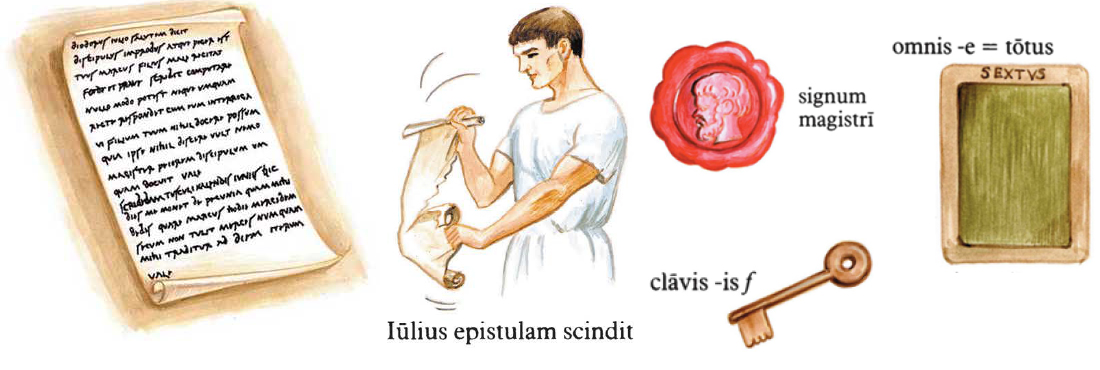
Dominus ceram aspiciens signum magistri cognoscit (est enim parva eius imago) et “Missa est” inquit “a magistro Diodoro. Nolo has litteras legere, nam certe magister poscit pecuniam quam ei debeo. Duorum mensium mercedem magistro debeo.”
Aemilia: “At fortasse epistula alias res continet. Quis scit? Fortasse magister aliquid scripsit de Marco? Signo integro, nemo scit.”
Iulius signum rumpit et epistulam aperit. Ecce ea quae in epistula magistri scripta sunt:
Diodorus Iulio salutem dicit.
Discipulus improbus atque piger et tuus Marcus filius. Male recitat, foede et prave scribit, computare nullo modo potest, neque umquam recte respondet cum eum interrogavi. Filium tuum nihil docere possum quia ipse nihil discere vult. Nemo magister peiorem discipulum umquam docuit. Vale.
Scribebam Tusculi kalendis Iuniis. Hic dies me monet de pecunia quam mihi debes. Quare Marcus hodie mercedem secum non tulit? Merces numquam mihi traditur ad diem. Iterum vale.
Interim Marcus, cuius vultus ad nomen magistri colorem mutavit, pallidus et tremens patrem legentem spectat. Cur pallet puer? Pallet ob timorem. (Qui timet pallere solet.)
Item Aemilia vultum Iulii severum intuetur. Postquam ille epistulam legit usque ad finem, uxor eum interrogat: “Quid scripsit magister?”
Julius, who hears the dog barking, enters the atrium asking the doorkeeper: "Who arrived?"
Doorkeeper: "The postman arrived from Tusculum. Here is the letter which he brought to you." Saying this the doorkeeper handed the letter to his master.
Julius: "What is this? Who sent a letter to me from Tusculum?"
Doorkeeper: "I don't know. I only know the letter was sent from Tusculum and was brought to you by a postman."
Julius: "It is not right to say the same this twice. I understood well that which was said the first time. Go back there to your dog!" Thus Julius dismisses the doorkeeper.
The master looking at the wax recognizes the seal of the teacher (for it is a small image of him) and says, "It was sent by the teacher Diodorus. I don't want to read this letter, for certainly the teacher is demanding the money which I owe him. I owe two months of wages to the teacher."
Emilia: "But perhaps the letter contains other things. Who knows? Perhaps the teacher wrote something about Marcus? With the seal unbroken no one knows."
Julius breaks the seal and opens the letter. Behold that which was written in the teacher's letter:
Diodorus gives greetings to Julius.
Your son Marcus is a bad and lazy student. He recites poorly, he writes ugly and incorrectly, he cannot calculate anything, nor ever answer correctly when I ask him. Your son can be taught nothing because he wants to learn nothing. No teacher has ever taught a worse student. Farewell.
I wrote from Tusculum on Kalends of June. This day reminds me concerning the money which you owe to me. Why did Marcus not bring the payment with him today? The payment is never handed over to me on the day. Again farewell.
Meanwhile Marcus, whose face changes color at the name of the teacher, looks at his father reading pale and trembling. Why is the boy pale? He is pale from fear. (He who is afraid is accustomed to be pale).
Likewise Emilia looks at the stern face of Julius. After reading that letter all the way to the end, his wife asks him: "What did the teacher write?"
II
Iulius: “Prior epistulae pars de alia re est; in parte posteriore magister me monet de pecunia quam ei debeo.”
Aemilia: “Cur non solvis pecuniam quae magistro debetur? Certe magister, qui filios nostros tam bene scribere et legere docet, mercedem suam meret. Sed quidnam scriptum est in priore epistulae parte? Nonne magister Marcum laudat?”
Iulius: “Hac epistula nulla laus continetur, nec enim puer piger atque improbus laudem meret! Tune putas te his litteris laudari, Marce?”
Marcus vultum a patre averit nec ullum verbum respondet, at genua trementia et vultus pallidus responsum planum est, quod pater facile intellegit. Saepe silentium est responsum planissimum.
Tacente Marco, Aemilia “Quid fecit Marcus?” inquit, “Dic mihi omnia!”
Iulius: “Marcus prope omnia fecit quae facere non debuit! Haec epistula omnem rem planam facit. - O Marce! Iam plane intellego falsa esse omnia quae nobis narravisti: magister planis verbis scribit 'te discipulum improbissimum fuisse ac foede et prave scripsisse'!”
Marcus: “At tabulam vobis ostendi...”
Iulius: “Aspice hanc tabulam: videsne nomen 'Sexti' litteris planis in parte superiore inscriptum? Tune soles nomina aliena inscribere in tabula tua? Haec non tua, sed Sexti tabula est. Hocine negare audes?”
Marcus, qui iam non audet mentiri, nihil negat, sed omnia fatetur: “Recte dicis, pater. Tabula Sexti est. Tabulas mutavi inter pugnam.”
Aemilia: “Pugnam? Quam pugnam narras?”
Iulius: “Marcus mihi iam narravit 'se cum Sexto pugnavisse.' - Nonne tibi satis fuit vestem tuam novam perdere? Etiamne tabulam alienam...?”
Marcus: “Tabulam Sexti non perdidi, pater. Vide: integra est tabula.”
Iulius: “At certe pater Sexti putabit eum perdidisse tabulam suam. Fortasse Sextus a patre suo punietur ob hanc rem. Intellegisne factum tuum indignum esse? Nonne te pudet hoc fecisse? Profecto me pudet hoc a meo filio factum esse!”
Marcus, qui paulo ante ob timorem pallebat, iam rubet propter pudorem. Puerum pudet facti sui. (Is quem factorum suorum pudet rubere solet.)
Julius: "The first part of the letter is of another matter; in the last part the teacher reminds me of the money which I owe to him."
Emilia: "Why did you not pay that which is owed to the teacher? Certainly the teacher who teachers our sons to read and write so well, deserves his payment. But what is written in the first part of the letter? Did the teacher not praise Marcus?"
Julius: "This letter contains no praise, for a lazy and bad boy deserves no praise! Do you think you are praised by this letter Marcus?"
Marcus turns his face from his father but does not answer with any word, but his trembling knees and pale face is a plain answer, which his father easily understands. Silence is often a very clear answer.
With Marcus silent, Emilia asks, "What did Marcus do? Tell me everything!"
Julius: "Marcus did nearly everything what he should not do! This letter makes all things clear. - O Marcus! I now understand clearly that everything which you told to us is false: the teacher wrote clearly 'your student was very bad and wrote ugly and incorrectly'!"
Marcus: "But the tablet I showed you..."
Julius: "Look at this tablet: do you see the name 'Sextus' written with clear letters on the top part? Are you accustomed to writing another name on your tablet? This is not yours but is Sextus's tablet. Do you dare deny this?"
Marcus, who does not dare lie now, denies nothing, but confesses everything: "You speak correctly father. It is Sextus's tablet. I traded tablets during the fight."
Emilia: "Fight? What fight are you speaking of?"
Julius: "Marcus told me already that 'he had fought with Sextus' - Was it not enough enough for you to damage your new clothes? Also another's tablet...?"
Marcus: "I did not break Sextus's tablet. Look: the tablet is unbroken."
Julius: "But certainly Sextus's father will think his tablet had been broke. Perhaps Sextus will be punished by his father for this matter. Do you understand that what you have done is shameful? Surely it makes you ashamed to have done this? It certainly shames me that this has been done by my son!"
Marcus, who a little before was pale from fear, is now red because of shame. The boy is ashamed of his deeds. (He who is ashamed of his deeds is accustomed to be red.)
III
Marcus: “Certe malus puer fui, sed posthac bonus puer futurus sum: semper vobis pariturus sum, numquam pugnaturus sum in via nec umquam in ludo dormiturus sum. Hoc vobis promitto, pater et mater! Mihi credite!”
Marcus 'se malum puerum fuisse' fatetur ac simul promittit 'se posthac bonum puerum futurum esse, semper se parentibus pariturum esse nec umquam in via pugnaturum nec in ludo dormiturum esse' - id quod saepe antehac promisit!
Iulius: “Primum fac quod promisisti, tum tibi credemus!” Iulius non credit Marcum promissum facturum esse.
Marcus: “Omnia quae promisi facturus sum. Noli me verberare! Iam bis verberatus sum a magistro.”
“Ergo verbera magistri non satis fuerunt!” inquit Iulius, “Profecto verbera meruisti!” Tum oculos a filio avertens: “Abi hinc ab oculis meis! Duc eum in cubiculum eius, Dave, atque include eum! Postea fer mihi clavem cubiculi!”
Postquam Davus puerum ex atrio duxit, dominus “Haec omnia” inquit “facta sunt, quod Medus heri domo fugit nec hodie Marcum in ludum euntem et illinc redeuntem comitari potuit. Posthac Marcum sine comite ambulare non sinam. Cras Davus eum comitabitur; is certe bonus comes erit.”
Marco in cubiculum ducto atque incluso, Davus redit et “Marcus” inquit “inclusus est. Ecce clavis cubiculi.”
Iulius clavem subit ac surgit. Aemilia, quae putat eum ad Marcum ire, “Quo is, Iuli?” inquit, “Marcumne verberatum is?” Aemilia Marcum a patre verberatum iri putat. “Noli eum verberare! Non puto eum posthac in via pugnaturum neque in ludo dormiturum esse.”
Iulius: “Putasne iam mutatum esse istum puerum? Ego eum nec mutatum esse nec posthac mutatum iri credo! Quamquam heri a me semel verberatus est atque hodie bis a magistro, nec verbera patris nec magistri eum meliorem fecerunt.”
Aemilia: “Ergo non opus est iterum eum verberare. Nec laudibus nec verberibus melior fieri potest.”
Iulius: “Noli timere, Aemilia! Marcum in cubiculo relinquam. Iam epistulam scripturus sum.” Iulius dicit 'se epistulam scripturum esse.'
Aemilia: “Cuinam scripturus es?”
Iulius: “Magistro scilicet. Cras Davus, Marci comes, epistulam meam secum feret, quae a Marco ipso tradetur magistro. Tabellarius, qui epistulam magistri tradidit, tempus perdit, si foris responsum meum opperitur. Dimitte eum, Dave! Dic ei 'responsum meum cras a Marco traditum iri'.”
Aemilia: “Nonne Marcus simul cum epistula tua mercedem debitam tradet magistro?”
Iulius: “Minime! Ego enim plane respondebo 'me mercedem solvere nolle'!”
Aemilia: “Quid ais? Nonne te pudet pauperi magistro mercedem negare? Quam ob rem mercedem debitam solvere non vis? Causam afferre oportet.”
Iulius: “Magister ipse mihi causam attulit.”
Aemilia: “Quonam modo? Quaenam causa allata est a magistro?”
Iulius: “In his litteris magister ipse fatetur 'se filium meum nihil docere posse': ergo mercedem non meruit. Pecuniam quae merita non est non solvam. Nolo pecuniam meam perdere!”
Epistulam sumens Aemilia “Itane scribit magister?” inquit; tum, epistula lecta, “Hoc te non excusat, nam plane scribit 'Marcum ipsum nihil discere velle', et qui nihil discere vult, nihil discere potest. Non modo posse, sed etiam velle opus est: quod non vis, non potes.”
Iulius ridens “Recte dicis” inquit, “Ego enim pecuniam solvere nolo: ergo solvere non possum!”
Hoc dicens Iulius epistulam magistri scindit.
Marcus: "Certainly I was a bad boy, but after this I will be a good boy: I will always obey you, I will never fight in the road nor will I sleep in school. I promise this to you father and mother! Believe me!"
Marcus confesses that 'he had been a bad boy' and at the same time promised 'after this to be a good boy, to always obey his parents and not ever fight in the road nor to sleep in school' - that which he often promised before!
Julius: "First do what you promised then we will believe you!" Julius does not believe the promise Marcus has made.
Marcus: "I will do everything which I promised. Do not beat me! I was already beaten twice by the teacher."
"Therefore the beatings where not enough!" Julius says, "Certainly the beatings were deserved!" Then turning his eyes from his son: "Go away from my eyes! Lead him to his room Davus, and lock him in! Afterwards bring the room's key to me!"
After Davus led the boy out of the atrium, the master says, "All of these things occurred because Medus fled the house yesterday but today could not accompany Marcus going to school and returning from there. After this I will not allow Marcus to walk without a companion. Tomorrow Davus will accompany him, he will certainly be a good companion."
With Marcus lead and locked into his room, Davus returns and says, "Marcus is locked in. Here is the room's key."
Julius stands up and takes the key. Emilia, who thinks he is going to Marcus says, "Where are you going Julius? Are you going to beat Marcus?" Emilia thinks Marcus is going to be beaten by his father. "Do not beat him! I do not think he will fight in the road or sleep in school after this."
Julius: "Do you think the boy to be changed already? I do don't believe him to have changed nor is he going to change after this! Even though he was beaten by me once yesterday and twice today by the teacher, but neither the beatings by the father nor by the teacher made him better."
Emilia: "Therefore it is not fitting to beat him again. Neither praise nor beatings can make him better."
Julius: "Do not fear Emilia! I will leave Marcus in his room. Now I will write a letter." Julius says that 'he is writing a letter.'
Emilia: "To whom are you writing?"
Julius: "To the teacher of course. Tomorrow Davus, Marcus's companion, will carry me letter with him, which will be handed over to the teacher by Marcus himself. The postman, who handed over the teacher's latter, is wasting time if he waits for my answer at the door. Send him away Davus! Say to him 'my answer will go to be handed over by Marcus tomorrow'."
Emilia: "Will Marcus not hand over the payment owed to the teacher with your letter?"
Julius: "Certainly not! For I will answer clearly 'I owe no payment'!"
Emilia: "What are you saying? Will you not be shamed to deny payment to the poor teacher? Why do you not want to pay the payment owed on account of this matter? It is right to give a reason."
Julius: "The teacher himself gave the reason to me."
Emilia: "In what way? What reason was given by the teacher?"
Julius: "In this letter the teacher himself confessed 'my son can be taught nothing': therefore he does not merit payment. I do not owe money which is not deserved. I don't want to waste my money!"
Emilia picking up the letter says, "You will write the teacher thus?" then reading the letter, "This does not excuse you, for he wrote clearly 'Marcus himself wishes to learn nothing', and he who wishes to learn nothing, can be taught nothing. it is right to not only be able but also to want: what you do not want you cannot do."
Julius laughing says, "You speak correctly. For I do not want to pay the money: therefore I cannot pay!"
Saying this Julius tears up the teacher's letter.
GRAMMATICA LATINA
Participium et infinitivus futuri
[A] Activum.
Miles: “Fortiter pugnaturus sum.” Miles dicit “se fortiter pugnaturum esse.”
“Pugnaturus -a -um” est participium futuri. Participium futuri est adiectivum declinationis I/II. “Pugnaturum esse” est infinitivus futuri, qui constat ex participio futuri et “esse”.
Exempla: pariturus, dormiturus, facturus, scripturus, futurus.
Marcus: “Posthac bonus discipulus futurus sum...” Marcus dicit “se posthac bonum discipulum futurum esse, semper magistro pariturum esse nec umquam in ludo dormiturum esse.” Magister non credit eum promissum facturum esse.
Pueri: “Posthac boni discipuli futuri sumus...” Pueri dicunt “se posthac bonos discipulos futuros esse, semper magistro parituros esse nec umquam in ludo dormituros esse” Magister non credit eos promissum facturos esse.
[B] Passivum.
Iulius: “Sextus a magistro laudabitur.” Iulius dicit “Sextum a magistro laudatum iri.”
“Laudatum iri” est infinitivus futuri passivi, quí ex supino et “iri” constat.
LATIN GRAMMAR
Participle and future infinitive
[A] Active.
Soldier: "I will fight bravely." The soldier says "that he will fight bravely."
“Pugnaturus -a -um” is future participle. Future participle is an adjective of the 1/2 declension. “Pugnaturum esse” is future infinitive, which consists of the future participle and "esse".
Examples: will obey, sleep, make, write, do.
Marcus: "After this I will be a good student..." Marcus says "after this that he will be a good student, will always obey the teacher nor ever sleep in school." The teacher does not believe that he will do the promise.
Boys: "After this we will be good students..." The boys say "after this that they will be good students, always obey the teacher and not ever sleep in school" The teacher does not believe that they will do the promise.
[B] Passive.
Julius: "Sextus will be praised by the teacher." Julius says "Sextus will be praised by the teacher."
“Laudatum iri” is the passive future infinitive, which consists of the supine and "iri".
VOCABVLA
signum, signi n.
littera, litterae f.
vultus, vultus m.
laus, laudis f.
factum, facti n.
pudor, pudoris m.
promissum, promissi n.
verber, verbera
clavis, calvis f.
comes, comitis c.
integer, integra, integrum
pallidus, a, um
planus, a, um
superior
trado, -ere, tradidi, traditus
dimitto, -ere, dimisi, dimissus
debeo, -ere, debui, debitus
contineo, -ere, continui, contentus
salutum dicere
palleo, pallere, pallui
solvo, -ere, solvi, solutus
mereor, mereri, meritus sum
averto, -ere, averti, aversus
inscribo, -ere, inscripsi, inscriptus
nego, negare, negavi, negatus
fateor, fateri, fassus sum
perdo, perdere, perdidi, perditus
pudeo, pudere, pudui, puditus
rubeo, rubere
promitto, -ere, promisi, promissus
includo, -ere, inclusi, inclusus
comitor, comitari, comitatus sum
illinc
hinc
quidnam?
quisnam?
fortasse
umquam
posthac
antehac
heri
ob
VOCABULARY
sign, seal
letter, epistle
face, expression
praise, approval, merit
deed, fact, act
decency, shame
promise
whip, lash, beating
door-key
companion, partner
untouched, whole
pale
obvious, level, flat
higher
to hand over, to deliver
to dismiss, send away
to owe, be obliged
to contain, to secure
to say greeting
to look pale, to pale at
to release, to pay off
to earn, to merit
to turn away from
to inscribe, to write on
to deny, to refuse
to admit, to praise
to ruin, to destroy
to make ashamed
to redden, become red
to promise
to imprison, to enclose
to accompany, to escort
from that place
from this place
what?
who?
perhaps, it may be
ever, at any time
after this, hereafter
before this, previously
yesterday
on account of, for