CAPITVLVM DECIMVMTENTH CHAPTER
BESTIA ET HOMINESBEASTS AND MEN
I
Equus et asinus, leo et lupus, canis et ovis bestiae sunt. Leo et lupus sunt bestiae ferae, quae alias bestias capiunt et edunt. In Africa sunt multi leones. Pastores Africae leones timent, nam leones non solum oves pastorum edunt, sed etiam pastores ipsos! Non bestia, sed homo est pastor; leones autem non solum alias bestias, sed etiam homines edunt. Ferae et homines amici non sunt. Canis amicus hominis est, ea bestia fera non est.
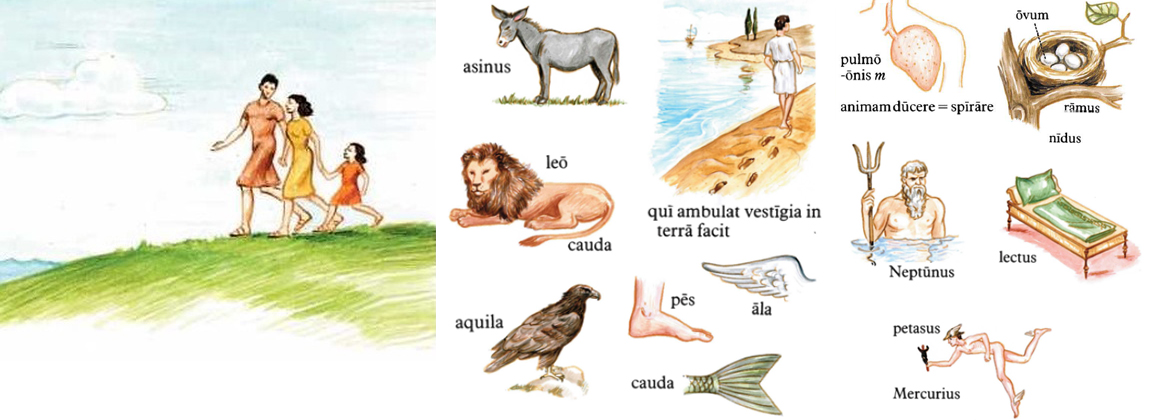
Aliae bestiae sunt aves, aliae pisces. Aquila est magna avis fera, quae parvas aves capit et est. Aves in aere volant. Pisces in aqua natant. Homines in terra ambulant. Avis duas alas habet. Homo duos pedes habet. Piscis neque alas neque pedes habet. Avis quae volat alas movet. Homo qui ambulat pedes movet. Piscis qui natat caudam movet. Cum avis volat, alae moventur. Cum homo ambulat, pedes moventur. Cum piscis natat, cauda movetur. Qui ambulat vestigia in terra facit. Qui volat aut natat vestigia non facit.
In horto et in silva multae aves sunt. Canis aves, quae inter arbores volant, aspicit. Canis ipse non volat, nam canis alas non habet. Canis volare non potest. Neque pastor volare potest. Pastor duos pedes habet, itaque pastor ambulare potest. Homines ambulare possunt, quod pedes habent, neque volare possunt, quod alas non habent.
Mercurius autem ut avis volare potest, nam in pedibus et in petaso eius alae sunt. Mercurius non homo, sed deus est. Mercurius est deus mercatorum. (Mercator est homo qui emit et vendit.) Mercurius imperia deorum ad homines portat, is enim nuntius deorum est.
Pisces neque volare neque ambulare possunt. Pisces in aqua natare possunt. Etiamne homines natare possunt? Alii homines natare possunt, alii non possunt. Marcus et Quintus natare possunt, Iulia non potest.
The horse and donkey, lion and wolf, dogs and sheep are beasts. The lion and wold are wild beasts, which capture and eat other beasts. In Africa there are many lions. African shepherds fear lions, for lions eat not only the shepherd's sheep but even the shepherds themselves! The shepherd is not a beast but a man; but the lion eats not only other beasts, but even men. Wild animals and men are not friends. The dog is a friend of men, it is not a wild beast.
Some beasts are birds others fish. The eagle is a large wild bord, which captures and eats small birds. Birds fly in the air. Fish swim in the water. Men walk on the land. Birds have two wings. Man has two feet. Fish have neither wings nor feet. The bird that flies moves its wings. A man who walks moves his feet. Fish who swim move it's fin. When a bird flies, wings are moved. When a man walks, feet are moved. When a fish swims, a fin is moved. He who walks makes footprints on the ground. He who flies or swims does not make footprints.
In the garden and in the forest there are many birds. A dog sees birds who fly between the trees. The dog itself cannot fly, for it does not have wings. A dog cannot fly. Nor can the shepherd fly. The shepherd has two feet, therefore the shepherd can walk. Men can walk, because they have feet, they cannot fly, because they don't have wings.
But Mercury can fly like a bird, for there are wings on his feet and his hat. Mercury is not a man but a god. Mercury is the god of merchants. (A merchant is a man who buys and sells.) Mercury carries the commands of the gods to men, for he is the messenger of the gods.
Fish can neither fly nor walk. Fish can swim in the water, Can men also swim? Some men can swim, others cannot. Marcus and Quintus can swim, Julia cannot.
II
Neptunus natare potest; is enim deus maris est. (Oceanus est magnum mare.) Mercurius et Neptunus dei Romani sunt. Romani et Graeci deos multos habent. Homines deos neque videre neque audire possunt. Dei ab hominibus neque videri neque audiri possunt.
Padus magnum flumen est. In eo flumine multi sunt pisces. Pisces in aqua fluminis natant. In fluminibus et in maribus magnus numerus piscium est. Flumina et maria plena sunt piscium. Homines multos pisces capiunt. Nemo pisces fluminum et marium numerare potest. Pisces numerari non possunt.
Pisces in aqua vivunt, neque in terra vivere possunt, nam pisces in aere spirare non possunt. Homo sub aqua spirare non potest. Homo vivit, dum spirat. Qui spirat vivus est, qui non spirat est mortuus. Homo mortuus neque videre neque audire, neque ambulare neque currere potest. Homo mortuus se movere non potest. Cum homo spirat, anima in pulmones intrat et rursus ex pulmonibus exit. Anima est aer qui in pulmones ducitur. Qui animam ducit animal est. Non solum homines, sed etiam bestiae animalia sunt. Alia animalia in terra vivunt, alia in mari.
Sine anima nemo potest vivere. Homo qui animam non ducit vivere non potest. Spirare necesse est homini. Esse quoque homini necesse est, nemo enim sine cibo vivere potest. Necesse est cibum habere. Pecuniam habere necesse est, nam qui pecuniam non habet cibum emere non potest. Sine pecunia cibus emi non potest. Necesse non est gemmas habere, nemo enim gemmas esse potest. Gemmae edi non possunt; sed qui gemmas suas vendit pecuniam facere et cibum emere potest. Mercator qui ornamenta vendit magnam pecuniam facit. Feminae quae pecuniam facere volunt ornamenta sua vendunt.
Aves nidos faciunt in arboribus; nidi earum inter ramos et folia arborum sunt. Aquilae in montibus nidos faciunt. In nidis sunt ova. Aves ova pariunt, ex quibus parvi pulli exeunt. Canis non ova, sed pullos vivos parit. Feminae liberos pariunt. -
Neptune can swim; for he is the god os the sea. (An Ocean is a large sea.) Mercury and Neptune are Roman gods. Romans and Greeks have many gods. Men can neither see nor hear the gods. The gods are neither seen nor heard by men.
The Po is a large river. In it there are many fish. Fish swim in the water of the river. There is a large number of fish in the river and the sea. Rivers and the sea are full of fish. Men capture many fish. No one can count the fish of rivers and seas. Fish cannot be counted.
Fish live in the water, they cannot live on land, for fish cannot breath air. Man cannot breath water. Man lives while breathing. He breaths is alive, he who is not breathing is dead. A dead man neither sees nor hears, nor can he walk or run. A dead man cannot move himself. When man breaths the breath enters into the lungs and goes out from the lungs again. Breath is air which is breathed into the lungs. He who breaths is an animal. Not only humans, but beasts also are animals. Some animals live on land, others in the sea.
Without breath non can live. A man who does not breathe cannot live. Breathing is necessary for humans. Eating is also necessary for humans, for no one can live wihout food. It is necessary to have food. Is it necessary to have money, for he who does not have money can not buy food. Without money food canot be bought. It is not necessary to have gems, for no one can eat gems. Gems cannot be eaten; but he who sells his gems can make money and buy food. A merchant who sekks jewelry makes much money. Women who wish to make money sell their jewelry.
Birds make nests in trees; their nests are between the branches and leaves of trees. Eagles make nests in the mountains. In the nests there are eggs. Birds give birth to eggs, out of which little chicks come out. Dogs do give birth to eggs, but to living puppies. Women give birth to children. -
III
Marcus et Quintus et Iulia in horto sunt. Iulia pilam tenet et cum pueris pila ludere vult, neque ii cum puella ludere volunt; pueri enim nidos quaerunt in arboribus. Itaque puella ludit cum cane sua Margarita.
Iulia: “Cape pilam, Margarita!”
Canis pilam capit et caudam movet. Puella laeta ridet et canit. Pueri puellam canere audiunt.
Quintus: “Audi: Iulia vocem pulchram habet.”
Marcus: “Vox eius non pulchra est!”
Canis avem supra se volare videt eamque capere vult, neque potest. Canis iratus latrat: “Baubau!” Eius vox pulchra non est, canis canere non potest! Aves canere possunt, pisces non possunt: pisces voces non habent.
Cum aquila supra hortum volat et cibum quaerit, parvae aves canere non audent, et inter folia arborum se occulatant. Itaque aquila eas reperire non potest. Neque aves neque nidi avium ab aquila reperiri possunt, quod ramis et foliis occultantur.
Marcus autem nidum reperit et Quintum vocat: “Veni, Quinte! In hac arbore nidus est.” Accurrit Quintus.
Marcus: “Age! Ascende in arborem, Quinte!”
Quintus in arborem ascendit; iam is supra Marcum in arbore est. Marcus ipse in arborem ascendere non audet!
Marcus interrogat: “Quot sunt ova in nido?”
Quintus: “Nulla ova, sed quattuor pulli.”
Nidus est in parvo ramo. Ramus qui nidum sustinet non crassus, sed tenuis est. Ramus tenuis Quintum sustinere non potest, is enim puer crassus est. Ecce ramus cum puero et nido et pullis ad terra cadit!
Marcus, Quintus and Julia are in the garden. Julia holds a ball and wanst to play ball with the boys, but they don't want to play with the girl; for the boys are looking for nests in the trees. Therefore the girl is playing with her dog Margarita.
Julia: "Catch the ball Margarita!"
The dog catches the ball and moves its tail. The happy girl laughs and sings. The boys hear the girl singing.
Quintus: "Listen; Julia has a beautiful voice."
Marcus: "Her voice is not beautiful!"
The dog sees a bird flying above it and wants to catch it, but it can't. The angry dog barks: "Bark!" It's voice is not beautiful, the dog cannot sing! Birds can sing, fish cannot: fish have no voice.
When an eagle flies above the garden and seeks food, small birds are not heard singing, and hide among the leaves of the trees. Therefore eagles cannot find them. Neither birds nor nests of birds can be found by eagles, because they are hidden by branches and leaves.
But Marcus finds a nest and calls Quintus: "Come Quintus! There is a nest in this tree." Quintus comes running.
Marcus: "Come on! Climb the tree Quintus!"
Quintus climbs the tree; now he is above Marcus in the tree. Marcus does not dare climb the tree himself!
Marcus asking: "How many eggs are in the nest?"
Quintus: "No eggs, but four chicks."
The nest is on a small branch. The branch which holds the nest is not thick but thin. The thin branch cannot hold Quintus, for the boy is fat. Behold the branch with the boy, nest and chicks fall to the ground!
Marcus Quintum ad terram cadere videt. Ridetne Marcus? Non ridet. Marcus enim perterritus est. Iam Quintus et pulli quattuor sub arbore iacent. Neque puer neque pulli se movent. Pulli mortui sunt. Quintusne mortuus est? Non est. Quintus enim spirat. Qui spirat mortuus esse non potest. Sed Marcus eum spirare non videt, neque enim anima videri potest.
Quid facit Marcus? Marcus perterritus ad villam currit et magna voce clamat: “Age! Veni, pater!”
Iulius puerum vocare audit et exit in hortum. Pater filium perterritum ad se accurrere videt eumque interrogat: “Quid est, Marce?”
Marcus: “Quintus...est...mortuus!”
Iulius: “Quid? mortuus? O dei boni!”
Pater, ipse perterritus, cum Marco ad Quintum currit. Iulia quoque accurrit cum cane sua. Quintus oculos aperit. Iulius eum oculos aperire videt.
Iulius: “Ecce oculos aperit: ergo vivus est.”
Marcus et Iulia Quintum vivum esse vident. Puer autem ambulare non potest, neque enim pedes eum sustinere possunt; ergo necesse est eum portare. Quintus a Iulio in villam portatur et in lecto ponitur.
Aemilia filium suum a Iulio portari videt, et interrogat: “Cur puer ipse ambulare non potest?”
Iulius “Quintus ambulare non potest, quod non est avis neque alas habet! Qui volare vult neque potest, ad terram cadit!”
Aemilia Quintum a Iulio in lecto poni aspicit.
Marcus sees Quintus falling to the ground. Is Marcus laughing? He is not laughing. For Marcus is terrified. Now Quintus and the four chicks are lying under the tree. Neither the boy nor the chicks are moving themselves. The chicks are dead. Is Quintus dead? He is not. For Quintus is breathing. He who breathes cannot be dead. But Marcus does not see him breathing, nor can he see his breath.
What is Marcus doing? Marcus runs to the villa terrified and shots with a loud voice: "Come on! Come father!"
Julius hears the boy calling and goes out into the garden. The father sees his terrified son running to him and asks him: "What is it Marcus?"
Marcus: "Quintus...is....dead!"
Julius: "What? dead? O good gods!"
The father, terrified himself, runs with Marcus to Quintus. Julia also comes running with her dog. Quintus opens his eyes. Julius sees him open his eyes.
Julius: "Behold he opens his eyes: therefore he is alive."
Marcus and Julia see Quintus being alive. But the boy cannot walk, nor can his feet sustain him; therefore it is necessary to carry him. Quintus is carried by Julius into the villa and is placed on the bed.
Emilia sees her son carried by Julius and asks: "Why is the unable to walk himself?"
Julius: "Quintus cannot walk because he is not a bird nor does he have wings! He who wishes to fly but cannot, falls to the ground!"
Emilia looks ast Quintus is placed on the bed by Julius.
GRAMMATICA LATINA
Infinitivus
[A] Activum
Iulius Marcum non videre, sed audire potest. Pater filium vocare audit, et acurrere videt.
'Voca|re', 'vide|re', 'accurr|ere', 'audi|re', 'infinitivus est. Infinitivus: -re.
[1] -are: cantare, pulsare, plorare, interrogare, verberare, numerare, salutare, imperare, habitare, amare, delectare, portare, ambulare, exspectare, intrare, ornare, clamare, monstrare, errare, volare, natare, spirare, dare; cet.
[2] -ere: ridere, videre, respondere, habere, tacere, parere, timere, tenere, iacere, movere, cet.
[3] -ere: ponere, sumere, discedere, carpere, agere, vehere, claudere, vertere, currere, vendere, emere, consistere, ostendere, bibere, petere, ducere, relinquere, quaerere, vivere, ludere, canere, ascendere, cadere, capere, facere, aspicere, accipere, parere; cet.
[4] -ire: venire, audire, dormire, aperire, reperire; ire (ad-ire, ab-ire, ex-ire); cet.
Medus servus esse non vult. Nemo gemmas esse potest. 'Esse' quoque et 'esse' infinitivus est.
LATIN GRAMMAR
Infinitive
[A] Active
Julius cannot see Marcus but can hear him. The father hears his son calling and sees him come running.
Call, see, come running, hear, is infinitive. Infinitive: -re
[1] sing, punch, cry, ask, beat, count, greet, command, live, love, delight, carry, walk, wait, enter, adorn, shout, show, wander, fly, swim, breathe, give, etc.
[2] laugh, see, answer, have, be silent, obey, fear, hold, lie down, move, etc.
[3] place, pick up, depart, pluck, drive, carry, close, turn around, run, sell, buy, stop, show, drink, seek, lead, leave, look for, live, play, sing (of), climb, fall, make, look at, receive, give birth to, etc.
[4] come, hear, sleep, open, find, go (go to, go from, go out); etc.
Medus does not wish to be a slave. No one can eat gems. 'To be' and also 'to eat' is infinitive.
[A] Passivum
Marcus a Iulio non videri, sed audiri potest. Marcus Quintum a Iulio portari et in lecto poni videt.
'Porta|ri', 'vide|ri', 'pon|i', 'audi|ri' infinitivus passivi est. Infinitivus passivi: -ri/-i.
[1] -ari: portari, numerari, vocari
[2] -eri: videri, teneri.
[3] -i: poni, emi, edi, claudi.
[4] -iri: audiri, reperiri, aperiri.
Pisces numerari non possunt. Syra rosam a Iulia teneri videt. Gemmae edi non possunt. Magnum ostium a parva puella neque aperiri neque claudi potest.
Declinatio tertia
'Avis' (f) et 'piscis' (m) declinantur ut 'ovis'. Ut 'pastor' declinatur 'mercator' (m).
'Leo' (m) et 'homo' (m) declinantur hoc modo:
| Sing. | Plur. | Sing. | Plur. | |
| Nom. | leo | leon|es | homo | homin|es |
| Acc. | leon|em | leon|es | homin|em | homin|es |
| Gen. | leon|is | leon|um | homin|is | homin|um |
| Dat. | leon|i | leon|ibus | homin|i | homin|ibus |
| Abl. | leon|e | leon|ibus | homin|e | homin|ibus |
'Vox' (f) et 'pes' (m) declinantur hoc modo:
| Sing. | Plur. | Sing. | Plur. | |
| Nom. | vox | voc|es | pes | ped|es |
| Acc. | voc|em | voc|es | ped|em | ped|es |
| Gen. | voc|is | voc|um | ped|is | ped|um |
| Dat. | voc|i | voc|ibus | ped|i | ped|ibus |
| Abl. | voc|e | voc|ibus | ped|e | ped|ibus |
'Flumen', 'mare', 'animal' (n): vide cap. XI
[A] Passive
Marcus is not seen by Julius, but can be heard. Marcus sees Quintus carried by Julius and placed on the bed.
'Carried', 'seen', 'heard' is infinitive passive. Infinitive passive: -ir/-i.
[1] carried, counted, called
[2] seen, held
[3] placed, bought, eaten, closed
[4] heard, found out
Fish cannot be counted. Syra sees a rose held by Julia. Gems cannot be eaten. A large door can meither be opened nor closed by a little girl.
Third declension
'Bird' (f) and 'fish' (m) are declined like 'sheep'. 'Shepherd' is declined like 'merchant' (m).
'Lion' (m) and 'man' (m) are declined this way:
| Sing. | Plur. | Sing. | Plur. | |
| Nom. | lion | lions | man | men |
| Acc. | lion | lions | man | men |
| Gen. | lion's | lions' | man's | mens' |
| Dat. | to the lion | to the lions | to the man | to the men |
| Abl. | with the lion | with the lions | with the man | with the men |
'Voice' (f) and 'foot' (m) are declined this way:
| Sing. | Plur. | Sing. | Plur. | |
| Nom. | voice | voices | foot | feet |
| Acc. | voice | voices | foot | feet |
| Gen. | voice's | voices' | foot's | foots' |
| Dat. | to the voice | to the voices | to the foot | to the feet |
| Abl. | with the voice | with the voices | with the foot | with the feet |
'River', 'sea', 'animal' (n): see ch. 11
VOCABVLA
asinus, i m.
leo, leonis m.
bestia, ae f.
homo, hominis m.
fera, ae f.
avis, avis f.
piscis, piscis m.
aquila, ae f.
aer, aeris m or f.
ala, ae f.
pes, pedis m.
cauda, ae f.
petasus, i m.
deus, i m.
mercator, mercatoris, m.
nuntius, i m.
mare, maris n.
flumen, flumenis n.
anima, ae f.
pulmo, pulmonis m.
animal, animalis n.
nidus, i m.
ramus, i m.
folium, i n.
ovum, i n.
pullus, i m.
pila, ae f.
vox, vocis f.
lectus, i m.
ferus, a, um
vivus, a, um
mortuus, a, um
crassus, a, um
tenuis, e
perterritus, a, um
capere
volare
natare
movere
facere
vivere
spirare
parere
ludere
canere
audere
occultare
ascendere
sustinere
cadere
potest
possunt
vult
volunt
necesse est
nemo, neminis m or f.
cum
quod
enim
ergo
infinitivus
VOCABULARY
donkey
lion
beast
man, human
wild animal
bird
fish
eagle
air
wing
foot
tail
hat
god
merchant
messenger
the sea
river
soul, spirit
lung
animal
nest
branch
leaf
egg
young one, chicken
ball
voice
bed, couch
wild
alive
dead
thick
thin
terrified
to capture
to fly
to swim
to move
to make, to do
to live
to breathe
to bear, to give birth to
to play
to sing
to dare
to hide
to climb
to hold up
to fall
he, she, or it is able
they are able
he, she, or it wants
they want
it is necessary
no one
with, when
because
for
therefore
infinitive