CAPITVLVM QVARTVMFOURTH CHAPTER
DOMINVS ET SERVIMASTER AND SLAVES
I
SCAENA PRIMA
Personae: Iulius, Aemilia, Medus.
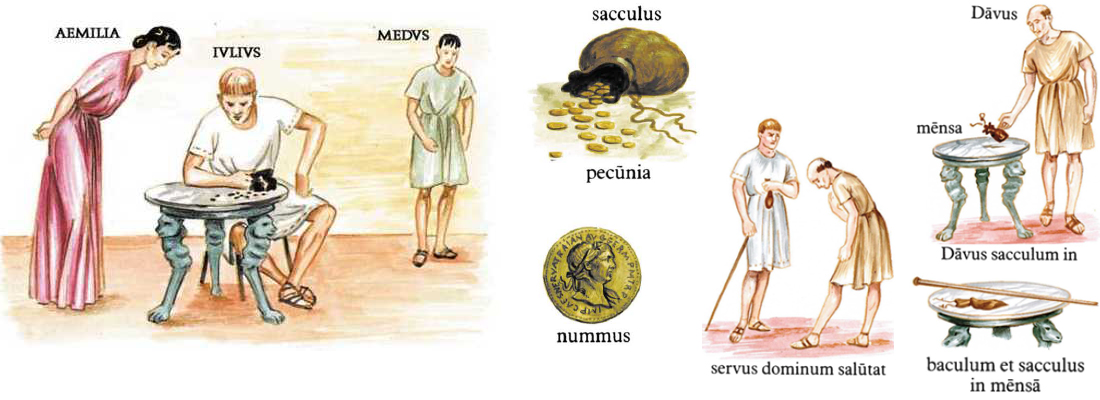
Sacculus Iulii non parvus est. In sacculo eius est pecunia. Iulius pecuniam in sacculo habet.
Aemilia sacculum videt Iuliumque interrogat: “Quot nummi sunt in sacculo tuo?”
Iulius respondet: “Centum.”
Aemilia: “Num hic centum nummi sunt?”
Iulius pecuniam numerat: “Unus, duo, tres, quattuor, quinque, sex, septem octo, novem, decem. Quid? Decem tantum?”
Iulius rursus pecuniam numerat: “Unus, duo, tres, quattuor... novem, decem.” Numerus nummorum non est centum, sed decem tantum.
Iulius: “Quid? In sacculo meo non centum, sed tantum decem nummi sunt! Ubi sunt ceteri nummi? Servi mei ubi sunt?”
Medus: “Servus tuus Medus hic est.”
Iulius servum suum Medum videt, Davum non videt. Medus adest. Davus non adest, sed abest. Iulius et Aemilia et Medus adsunt. Davus ceterique servi absunt.
Iulius: “Quid? Unus servus tantum adest! Ubi est Davus? Davum voca!”
Medus Davum vocat: “Dave!” sed Davus Medum non audit neque venit.
Medus rursus Davum vocat: “Da-a-ve! Veni!”
Davus venit. Iam duo servi adsunt.
FIRST SCENE
Persons: Julius, Emilia, Medus.
The bag of Julius is not little. There is money in his bag. Julius has money in his bag.
Emilia sees the bag and asks Julius: "How many coins are ther in your bag?"
Julius answers: "One hundred."
Emila: "There are not one hundred coins here is there?"
Julius counting the money: "One, two, three, four, five, six, seven, eight, nine, ten. What? Only ten?"
Julius counting the money again: "One, two, three, four... nine, ten." The number of coins is not one hundred, but only ten.
Julius: "What? In my bag there is not one hundred, but only ten coins!" Where are my other coins? Where are my slaves?"
Medus: "Your slave Medus is here."
Julius sees his slave Medus, he does not see Davus. Medus is present. Davus is not present, but absent. Julius, Emelia and Medus are present. Davus and the other slaves are away.
Julius: "What? Only one slave is present! Where is Davus? Call Davus!"
Medus is calling Davus: "Davus!" but Davus does not hear Medus nor does he come.
Medus again calling Davus: "Da-a-vus! Come!"
Davus comes. Now two slaves are present.
II
SCAENA SECVNDA
Personae: Iulius, Aemilia, Medus, Davus.
Davus, qui dominum suum non videt, Medum interrogat: “Quid est, Mede?”
Medus: “St! Dominus adest. Saluta dominum!”
Servus dominum salutat: “Salve, domine!”
Dominus servum salutat: “Salve, serve!”
Davus: “Quid est, domine?”
Iulius: “St! Tace, serve! Tace et audi!” Servus tacet.
Iulius: “In sacculo meo sunt decem tantum nummi. Ubi sunt ceteri nummi mei?”
Davus tacet, neque respondet.
Aemilia: “Responde, Dave! Dominus te interrogat.”
Davus respondet: “Pecunia tua hic non est. Interroga Medum!”
Iulius Medum interrogat: “Ubi sunt nummi mei, Mede?” Medus nullum verbum respondet.
Iulius rursus eum interrogat: “Ubi est pecunia mea? Responde, serve!”
Medus Davum accusat: “Pecunia tua in sacculo Davi est. Davus pecuniam tuam habet.”
Aemilia: “Audi, Dave! Medus te accusat.”
Davus: “Quem Medus accusat? Me?”
Iulius: “Tace, Mede! Servus qui servum accusat improbus est!” Medus tacet.
Iulius Davum non accusat, sed interrogat eum: “Estne pecunia mea in sacculo tuo, Dave?”
Davus: “In sacculo meo non est pecunia tua, domine.”
Iulius: “Ubi est sacculus tuus?”
Davus: “Hic est. Ecce sacculus meus.”
Iulius: “Sacculum tuum in mensa pone!”
Davus sacculum suum in mensa ponit. Iam sacculus eius in mensa est. Iulius baculum suum in mensa ponit. Baculum domini in mensa est.
Davus: “Vide: in sacculo meo nulla pecunia est.”
Iulius nullam pecuniam videt in sacculo. In sacculo Davi nulli nummi sunt. Sacculus eius vacuus est. Davus pecuniam domini non habet.
Iulius: “O! Davus bonus servus est: pecuniam meam non habet. Ecce nummus tuus, Dave!” Iulius unum nummum ponit in sacculo Davi. Iam sacculus Davi non est vacuus: in sacculo eius est unus nummus. Davus laetus est.
Iulius: “Sume sacculum tuum et discere, bone serve!” Davus sacculum suum sumit et discedit.
Medus baculum, quod in mensa est, videt. Medus quoque discedit! Cur discedit Medus? Medus discedit, quia is pecuniam domini in sacculo suo habet!
Davus et Medus absunt.
SECOND SCENE
Persons: Julius, Emilia, Medus, Davus.
Davus, who does not see his master, asks Medus: "What is it Medus?"
Medus: "St! The master is present. Greet the master!"
The slave greets the master: "Hail, master!"
The master greets the salve: "Hail, slave!"
Davus: "What is it, master?"
Julius: "St! Be silent, slave! Be silent and listen!" The slave is silent.
Julius: "In my bag there are only ten coins. Where are rest of my coins?"
Davus is silent, he does not answer.
Emilia: "Answer Davus! The master is asking you."
Davus answering: "Your money is not here. Ask Medus!"
Julius asking Medus: "Where are my coins Medus?" Medus answers with no word.
Julius again asking him: "Where is my money? Answer slave!"
Medus accuses Davus: "Your money is in the bag of Davus. Davus has your money."
Emilia: "Listen Davus! Medus is accusing you."
Davus: "Whom is Medus accusing? Me?"
Julius: "Be silent Medus! The slave who accuses a slave is bad!" Medus is silent
Julius does not accuse Davus, but asks him: "Is my money in your bag Davus?"
Davus: "Your money is not in my bag, master."
Julius: "Where is your bag?"
Davus: "It is here. Behold my bag."
Julius: "Place your bag on the table!"
Davus places his bag on the table. Now his bag is on the table. Julius places his staff on the the table. The staff of the master is on the table.
Davus: "Look: there is no money in my bag."
Julius sees no money in the bag. In the bag of Davus there are no coins. His bag is empty. Davus does not have the money of the master.
Julius: "O! Davus is a good slave: he does not have my money. Here is your coin Davus!" Julius places one coin in the bag of Davus. Now Davus's bag is not empty: in his bag there is one coin. Davus is happy.
Julius: "Pick up your bag and depart, good slave!" Davus picks up his bag and departs.
Medus sees the staff, which is on the table. Medus also departs! Why is Medus leaving? Medus is leaving, because he has the master's money is his bag.
Davus and Medus leave.
III
SCAENA TERTIA
Personae: Iulius, Aemilia.
Iulius: “Davus bonus servus est. Is non habet pecuniam meam. - Sed ubi est pecunia mea, Mede? Quis pecuniam meam habet?” Medus non respondet.
Iulius: “Ubi est Medus? Cur non respondet?”
Aemilia: “Medus non respondet, quia abest. Nullus servus adest.”
Iulius Medum vocat: “Mede! Veni!” sed Medus, qui abest, eum non audit neque venit.
Iulius rursus vocat: “Me-de! Veni, improbe serve!”
Medus non venit.
Iulius: “Cur non venit Medus?”
Aemilia: “Medus non venit, quia is habet pecuniam tuam! Eius sacculus non est vacuus!” Aemilia ridet. Iulius iratus est - is non ridet!
Iulius: “Ubi est baculum meum?” Iulius baculum, quod in mensa est, non videt.
Aemilia: “Ecce baculum in mensa.”
Iulius baculum suum sumit et discedit.
THIRD SCENE
Persond: Julius, Emilia.
Julius: "Davus is a good slave. He does not have my money. - But where is my money Medus? Who has my money?" Medus does not answer.
Julius: "Where is Medus? Why does he not answer?"
Emilia: "Medus does not answer, because he is away."
Julius calls Medus: "Come! Medus!" but Medus, who is away, does not hear him nor does he come.
Julius again calls: "Me-dus! Come, bad slave!"
Medus does not come.
Julius: "Why does Medus not come?"
Emilia: "Medus does not come, because he has your money! His bag is not empty!" Emilia is laughing. Julius is angry - he is not laughing.
Julius: "Where is my staff?" Julius does not see his staff, because it is on the table.
Emilia: "Behold the staff is on the table"
Julius picks up his staff and departs.
GRAMMATICA LATINA
Vocativus
Medus Davum vocat: "Dave!"
'Dave' vocativus est. Vocativus: -e (nominativus: -us).
Exempla: Mede, domine, serve, improbe.
Servus: "Salve, domine!" Iulius Medum vocat: "Mede! Veni, improbe serve!"
Imperativus et indicativus
Dominus: "Voca Davum!" Servus Davum vocat.
Dominus: "Tace et audi!" Servus tacet et audit.
Dominus: "Discede, serve!" Servus discedit.
Dominus imperat. Servus paret.
'Voca' imperativus est. 'Vocat' indicativus est. 'Tace', 'audi', 'discede' est imerativus. 'Tacet', 'audit', 'discedit' indicativus est. Imperativus: -ā, -ē, -e, -ī.
Indicativus: -at, -et, -it, -it.
LATIN GRAMMAR
Vocative
Medus calls Davus: "Davus!"
'Dave' is vocative. Vocative: -e (nominative: -us)
Examples: Mede, domine, serve, improbe
Slave: "Hail, master!" Julius calling Medus: "Medus! Come, bad slave!"
Imperative and indicative
Master: "Call Davus!"
The slave calls Davus.
Master: "Be silent and listen!" The slave is silent and listens.
Master: "Leave, slave!" The slave leaves.
The master commands. The slave obeys.
'Voca' is imperative. 'Vocat' is indicative. 'Tace', 'audi', 'discede' is imperative. 'Tacet', 'audit', 'discedit' is indicative. Imperative: -ā, -ē, -e, -ī. Indicative: -at, -et, -it, -it.
VOCABVLA
sacculus, i m.
pecunia, ae f.
nummus, i m.
mensa, ae f.
baculum, i n.
vacuus, a, um
bonus, a, um
quattuor
quinque
septem
octo
novem
decem
habet
numerat
adest
abest
salutat
tacet
accusat
ponit
sumit
discedit
imperat
paret
nullus
eius
suus
is
quod
rursus
tantum
salve
vocativus
imperativus
indicativus
VOCABULARY
little bag, little sack
money
coin
table
staff; rod; stick
empty
good
four
five
seven
eight
novem
ten
have; hold
count
be near; be present
be away; absent
greet
be silent
accuse
put; place
pick up
leave; depart
command
obey
no; none; not any
his; hers; its
his; hers; its (own)
he
because; who; that; which
turned back; again
only
hail; hello; welcome
vocative
imperative
indicative