CAPITVLVM TERTIVM DECIMVMTHIRTEENTH CHAPTER
ANNVS ET MENSESTHE YEAR AND MONTHS
I
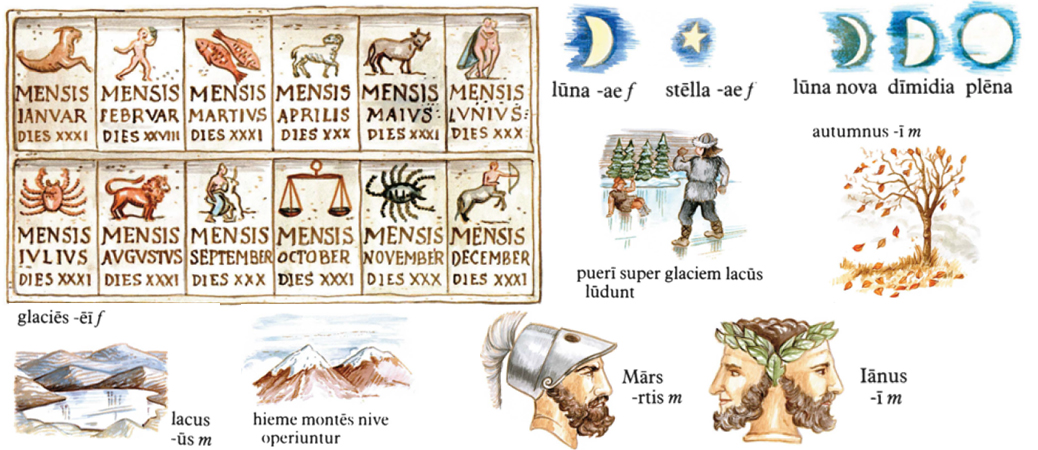
Annus in duodecim menses dividitur, quibus haec sunt nomina: Ianuarius, mensis primus; Februarius, secundus; Martius, tertius; Aprilis, quarus; Maius, quintus; Iunius, sextus; Iulius, septimus; Augustus, octavus; September, nonus; October, decimus; November, undecimus; December, mensis duodecimus ac postremus.
Unus annus duodecim menses vel trecentos sexaginta quinque dies habet. Saeculum est centum anni. Centum anni vel saeculum est longum tempus. Duo saecula sunt ducenti anni. Homo sanus nonaginta vel etiam centum annos vivere potest; ducentos annos vivere nemo potest.
Mensi primo et mensi tertio a deis nomina sunt: Ianuario a deo Iano, Martio a deo Marte. Ianus et Mars sunt dei Romani. Ianus est deus cui duae facies sunt. Mars deus belli est.
Mensis September nominatur a numero septem, October, November, December ab octo, novem, decem. Nam tempore antiquo Martius mensis primus erat. Tunc September mensis septimus erat, October, November, December menses octavus, nonus, decimus erant. Nunc autem mensis primus est Ianuarius, September igitur mensis nonus est, October decimus, November undecimus, December duodecimus.
Quam longus est mensis November? November triginta dies longus est. December unum et triginta dies habet. Ianuarius tam longus est quam December, sed Februarius brevior est: duodetriginta aut undetriginta dies tantum habet. Februarius brevior est quam ceteri undecim menses: is mensis anni brevissimus est. Martius unum et triginta dies longus est (et item Maius, Iulius, Augustus, October). Aprilis triginta dies habet (item Iunius et September). Sex menses sunt dimidia pars anni, tres menses quarta pars anni.
Dies est dum sol in caelo est. Prima pars diei est mane, pars postrema vesper. Dies est tempus a mane ad vesperum. Nox est tempus a vespero ad mane. Vesper est finis diei atque initium noctis. Mane finis noctis est atque initium diei.
Dies in duodecim horas dividitur. Ab hora prima dies initium facit. Hora sexta, quae hora media est inter horam primam et duodecimam, 'meridies' nominatur. Hora sexta vel meridies diem dividit in duas aequas partes: 'ante meridiem' et 'post meridiem'. Meridie sol altissimus in caelo est. Sex horae sunt dimidia pars diei.
A year is divided into twelve months by which these are named: January, the first month; February, the second; March, the third; April, the fourth; May, the fifth; June, the sixth; July, the seventh; August, the eighth; September, the ninth; October, the tenth; November, the eleventh; December the twelfth and final month.
One year has twelve months or three hundred and sixty days. An age is one hundred years. One hundred years or an age is a long time. Two ages are two hundred years. A healthy man can live ninety or even one hundred years; no one can live two hundred years.
The first month and third month are named from gods: January from the god Janus, March from the god Mars. Janus and Mars are Roman gods. Janus is the god of whom there are two faces. Mars is the god of war.
The month September is named from the number seven, October, November, December from eight, nine, ten. For in ancient times March was the first month. Then September was the seventh month, October, November, December were the eighth, ninth, tenth months. But now the first month is January, therefore September is the ninth month, October tenth, November eleventh, December twelfth.
How long is the month of November? November is thirty days long. December has thirty-one days. January is as long as December, but February is shorter: it has only twenty-eight or twenty-nine days. February is shorter than the other eleven months: is it the shortest month of the year. March is thirty-one days long (and likewise May, July, August, October). April has thirty days (likewise June and September). Six months are one half of the year, three months one fourth of the year.
It is day while the Sun is in the sky. The first part of day is morning, the last part evening. Day is the time from morning to evening. Night is the time from evening to morning. Evening is the end of the day and beginning of night. Morning is the end of night and beginning of day.
Day is divided into twelve hours. From the first hour day begins. The sixth hour which is the median between the first and twefth hour, is named 'noon'. The sixth hour or noon divides the day into two equal parts: 'before noon' and 'after noon'. At noon the Sun is the highest in the sky. Six hours are one-half of the day.
II
Nocte sol non lucet, sed luna et stellae lucent. Luna ipsa suam lucem non habet, lux lunae a sole venit; itaque luna non tam clara est quam sol. Sol est stella clarissima, quae luce sua et terram et lunam illustrat. Neque tota luna sole illustratur, sed tantum ea pars quae vertitur ad solem; cetera pars obscura est. Cum exigua pars lunae tantum videtur, luna 'nova' esse dicitur. Die septimo vel octavo post lunam novam luna dimidia videtur, quae formam habet litterae D. Die quinto decimo post lunam novam luna plena est et formam habet litterae O. Cum luna non lucet, nox obscura est.
Dies mensis primus 'kalendae' nominatur. Dies primus mensis Ianuari dicitur 'kalendae Ianuariae'; is dies anni primus est atque initium anni novi. Diei primo mensis Iulii 'kalendae Iuliae' nomen est; is est dies anni medius.
Dies tertius decimus post kalendas 'idus' nominatur. 'Idus Ianuariae' dies tertius decimus est post kalendas Ianuarias. Item 'idus Februariae' dicitur dies tertius decimus mensis Februarii. Sed 'idus Martiae' dies est quintus decimus mensis Martii, nam mense Martio (item Maio, Iulio, Octobri) idus non dies tertius decimus, sed quintus decimus post kalendas est. Dies nonus ante idus dicitur 'nonae' (nonae Ianuariae: dies quintus Ianuarii; nonae Februariae: dies quintus Februarii; nonae Martiae: dies septimus Martii; cet.)
At night the Sun does not shine, but the Moona and stars shine. The Moon does not have light itself, the light of the Moon comes from the Sun; therefore the Moon is not as bright as the Sun. The Sun is a very bright star, that shines its light on both Earth and the Moon. Not all of the Moon is illuminated by the Sun, but only that part which is turned to the Sun; the other part is dark. When only a small part of the Moon is seen, the Moon is said to be 'New'. The seventh or eight day after the New Moon half the Moon is seen, which has the form of the letter D. The fifteenth day after the New Moonis the Full Moon and has the form of the letter O. When the Moon is not shining, it is a dark night.
The first days of the month are named 'Kalends'. The first day of the month of January is called 'Kalends of January'; it is the first day of the year and the begining of a new year. The first day of the month of July is named 'Kalends of July'; that day is the middle of the year.
The thirteenth day after Kalends is named 'ides'. 'Ides of January' is thirteenth days after Kalends January. Likewise the thirteenth day of the month of February is called the 'ides of February'. But the 'ides of March' is the fifteenth day of the month of March for the month of March (likewise May, July, October) the ides is not thirteen, but fifteen days after Kalends. Nine days before ides is called 'nones' (nones of January: fifth day of January; nones of February: fifth day of February; nones of March: seventh day of March; etc.)
Dies octavus ante kalendas Ianuarias, qui dicitur 'ante diem octavum kalendas Ianuarias', est dies anni brevissimus. Ante diem octavum kalendas Iulias dies anni longissimus est. Ante diem octavum kalendas Apriles (id est die octavo ante kalendas Apriles) nox atque dies aequi sunt; is dies 'aequinoctium' dicitur. Item ante diem octavum kalendas Octobres aequinoctium dicitur, nam eo quoque die nox aequa est atque dies.
Tempora anni sunt quattuor: aestas et hiems, ver et autumnus. Aestas est tempus a mense Iunio ad Augustum, hiems a mense Decembri ad Februarium. Mensis Iunius initium aestatis, December initium hiemis est. Tempus a Martio ad Maium ver dicitur, a mense Septembri ad Novembrem autumnus. Ver a mense Martio initium facit. Autumnus a Septembri incipit.
Aestate dies longi sunt, sol lucet, aer calidus est. Aestas est tempus calidum. Hiems tempus frigidum est. Hieme non solum imber sed etiam nix de caelo cadit. Imber est aqua quae de nubibus cadit. Nix frigidior est quam imber. Hieme montes et campi nive operiuntur. Vere campi nova herba operiuntur, arbores novis foliis ornantur, aves, quae hieme tacent, rursus canere incipiunt. Autumno folia de arboribus cadunt et terram operiunt. In Germania hiemes frigidiores sunt quam in Italia: alta nice operitur tota terra et lacus glacie operiuntur; hieme Germani pueri super glaciem lacuum ludere possunt. Ianuarius mensis anni frigidissimus est. Mense calidissimi sunt Iulius et Augustus. Eo tempore multi Romani urbem relinquunt et villas suas petunt, neque enim totam aestatem in urbe vivere volunt. -
Eight days before the Kalends of January, which is called 'ante diem octavum kalendas Ianuarias', is the shortest day of the year. Before the eighth day of Kalends July is the longest day of the year. Ante diem octavum kalendas Apriles (that is the eighth day before Kalends April) night and day are equal; this day is called 'equinox'. Likewise before the eighth day before Kalends October is called equinox, for that day night and day are also equal.
There are four seasons of the year: summer and winter, spring and autumn. Summer is the time from the month of June to August, winter from the month of December to February. The month of June is the beginning of summer, December is the beginning of winter. The time from March to May is called spring, from the month of September to November is autumn. Spring begins from the month of March. Autumn begins from September.
In summer the days are long, the Sun shines, the air is hot. Summer is time of heat. Winter is the time of cold. In winter not only rain but also snow falls from the sky. Rain is water which falls from clouds. Snow is colder than rain. In winter snow covers mountains and fields. In spring new grass covers the fields, trees are decorated with new leaves, birds, who are silent in winter, again begin to sing. In autumn the leaves fall from the trees and cover the ground. In Germany winters are colder than in Italy: deep snow covers all the ground and ice covers the lakes; in winter German boys can play on top of the frozen lakes. January is the coldest month of the year. The warmest months are July and August. At that time many Romans leave the city and seek their villas, for they do not wish to live in the city the whole summer. -
III
Hora nona est. Aemilia apud filium aegrum sedet. Cubiculum luce solis illustratur. Aemilia ad fenestram it caelumque spectat.
Aemilia: “Hora nona est. Sol altus in caelo est nec nubibus operitur.”
Quintus: “Quando sol altissimus est?”
Aemilia: “Hora sexta vel meridie. Sed post meridiem aer calidior est quam ante meridiem.”
Aemilia fenestram claudit. Iam satis obscurum est cubiculum
Quintus: “O, quam longae sunt horae, cum necesse est totum diem in lecto iacere!”
Aemilia: “Ver est. Dies atque horae longiores sunt vere quam hieme.”
Quintus: “Quando longissimi sunt dies?”
Aemilia: “Mense Iunio.”
Quintus: “Iamne mensis Iunius est?”
Aemilia: “Maius est: hic dies est mensis Maii postremus. Hoc anni tempore dies non tam calidi sunt quam aestate et noctes frigidiores sunt.”
Quintus: “Qui mensis anni calidissimus est?”
Aemilia: “Iulius.”
Quintus: “Cur ille mensis patris nomen habet?”
Aemilia ridet et respondet: “Mensis Iulius non a patre tuo nomen habet - non tantus vir est ille! - sed a Iulio Caesare. Ante tempora Caesaris ei mensi erat nomen 'Quintilis' a 'quinto' numero - non a nomine tuo!”
Quintus: “Estne Iulius mensis quintus?” Puer digitis numerare incipit: “Mensis primus Ianuarius, secundus Februarius, tertius Martius, quartus...”
Aemilia: “Antiquis temporibus Martius non tertius, sed primus mensis erat; tunc igitur Quintilis, qui nunc Iulius nominatur, mensis quintus erat, non septimus, ut nunc est. Item mensi Augusto nomen erat 'Sextilis', quia sextus erat, nunc Augustus nominatur a Caesare Augusto. - Sed hoc satis est. Iam necesse est te dormire.” Mater enim faciem filii aspicit eumque oculos claudere videt. Aemilia puerum dormire velle putat.
Quintus: “Sed dies est. Sol lucet. Nocte iube me dormire, cum sol in caelo non est! Ubi sol est nocte, cum hic non lucet?”
Aemilia: “Cum hic nox est, sol lucet in aliis terris procul ab Italia et ab urbe Roma. Cum nox est illic, hic in Italia dies est.”
Quintus: “Ergo nunc in aliis terris et urbibus nox est atque homines dormiunt. Hic dies est, nec tempus est dormire!”
It is the ninth hour. Emilia sits with her sick son. The light of the Sun illuminates the room. Emilia goes to the window and looks at the sky.
Emilia: "It is the ninth hour. The Sun is high in the sky and is not covered by clouds."
Quintus: "When is the Sun highest?"
Emilia: "The sixth hour or noon. But after noon the air is hotter than before noon."
Emilia closes the window. Now the room is dark enough.
Quintus: "O, how long are the hours, when it is necessary to lie in bed all day!"
Emilia: "It is spring. Days and hours are longer in spring than in winter."
Quintus: "When are the days longest?"
Emilia: "The month of June."
Quintus: "Is it now the month of June?"
Emilia: "It is May: this is the last day of the month of May. This time of year the days are not as hot as the summer and the nights are colder."
Quintus: "What month of the year is the hottest?"
Emilia: "July."
Quintus: "Why does that month have father's name?"
Emilia laughs and answers: "The month of July does not have the name from your father - he is not so great a man! - but from Julius Caesar. Before the time of Caesar the name of that month was 'Quintilis' from the number 'five' - not from your name!"
Quintus: "Is July the fifth month?" The boy begins to count his fingers: "First month January, second February, third March, fourth..."
Emilia: "In ancient times March was not the third, but the first month; therefore then Quintilis, which is now named July, was the fifth month, not seventh, like it is now. Likewise the month of August was named 'Sextilis', which was the sixth, now August is named from Caesar Augustus. - But this is enough. Now is necessary for you to sleep." For the mother looked at the face of her son and sees him close his eyes. Emilia thinks the boy wishes to sleep.
Quintus: "But it is day. The Sun is shining. Order me to sleep at night when the Sun is not in the sky! Where is the Sun at nightm when it is not shining?"
Emilia: "When it is night, the Sun shines in other lands far from Italy and from the city of Rome. When it is night there, it is day here in Italy."
Quintus: "Therefore now it is night in other lands and cities and people are sleeping. It is day here, it is not the time to sleep!"
GRAMMATICA LATINA
Declinatio quinta
Dies brevissimus est ante diem VIII kalendas Ianuarias. Mane initium diei est. Diei primo Ianuarii nomen est kalendae Ianuariae; ab eo die incipit novus annus. Mense Iunio dies longi sunt. Iunius XXX dies habet: numerus dierum est XXX. Diebus primis mensium nomina sunt: kalendae Ianuariae, Februariae, Martiae, Apriles, cet. Ab iis diebus menses incipiunt.
| Singularis | Pluralis | |
| Nominativus | di|es | di|es |
| Accusativus | di|em | di|es |
| Genetivus | di|ei | di|erum |
| Dativus | di|ei | di|ebus |
| Ablativus | di|e | di|ebus |
Ut 'dies' m declinatur 'meridies' m, item 'facies' f, 'glacies' f, et pauca alia vocabula feminina.
- 'Mane' est vocabulum neutrum indeclinabile.
Superlativus
Aetna mons altus est, altior quam ceteri montes Siciliae: is mons Siciliae altissimus est.
Via Appia longa est, longior quam ceterae viae Italiae: ea via Italiae longissima est.
'Ire' verbum breve est, brevius quam cetera verba Latina: id verbum Latinum brevissimum est.
'Altior, longior, brevius' comparaitivus est. 'Altissimus, longissima, brevissimum' superlativus est. Superlativus est adiectivum declinationis I et II: -issim|us -a -um.
LATIN GRAMMAR
Fifth declension
The day is shortest 8 days before Kalends January. Morning is the beginning of day. The name of the first day of January is the Kalends of January; from that day a new year begins. In the month of June the days are long. June has 30 days: the number of days is 30. The names to the first days of the month are: Kalends of January, February, March, April, etc. From those days the month begins.
| Singular | Plural | |
| Nominative | day | days |
| Accusative | day | days |
| Genitive | day's | days' |
| Dative | to the day | to the days |
| Ablative | with the day | with the day |
Like 'day' m is declined 'noon' m, likewise 'faces' f, 'ice' f, and a few other feminine words.
- 'Morning' is an indeclinable neuter word.
Superlative
Mount Aetna is tall, taller than the other mountains of Siciliy: it is the tallest mountain of Sicily.
The Appia road is long, longer than the other roads of Italy: it is the longest road of Italy.
'Go' is a short word, shorter than other Latin words: it is the shortest Latin word.
'Higher, longer, shorter' is comparative. 'Highest, longest, shortest' is superlative. Superlative is an adjective of declensions 1 and 2: -issm|us -a -um
VOCABVLA
annus, anni m.
mensis, mensis m.
dies, diei m.
saeculum, saeculi n.
tempus, temporis n.
facies, faciei f.
mane (adv)
vesper, vesperi m.
nox, noctis f.
initium, initii n.
hora, horae f.
meridies, meridiei m.
luna, lunae f.
stella, stellae f.
lux, lucis f.
forma, formae f.
kalenda, kalendae f.
idus, idus f.
nona, nonae f.
aequinoctium, aequinoctii n.
aestas, aestatis f.
hiems, hiemis f.
ver, veris n.
autumnus, a, um
imber, imbris m.
nix, nivis f.
lacus, laci m.
glacies, glaciei f
urbs, urbis f.
postremus, a, um
dimidius, a, um
aequus, a, um
clarus, a, um
totus, a, um
obscurus, a, um
exiguus, a, um
calidus, a, um
frigidus, a, um
indeclinabilis
undecim
triginta
sexaginta
ducenti
trecenti
quintus, a, um
sextus, a, um
septimus, a, um
octavus, a, um
nonus, a, um
decimus, a, um
undecimus, a, um
duodecimus, a, um
nominare
illustrare
incipere
operire
velle
erat
erant
vel
tunc
nunc
igitur
item
quando
superlativus
VOCABULARY
year
month
day
age; generation
time; season
face
in the morning
evening
night
beginning
hour
noon
moon; midday
star
light
form; shape
1st of the month
13th or 15th of the month
5th or 7th of the month
equinox
summer
winter
spring
autumn; fall
rain; shower
snow
lacus
ice
city
next; last
half
equal
clear, bright
whole, all, entire
dark
small, meager
warm, hot
cold, cool
indeclinable
eleven
thirty
sixty
two hundred
three hundred
fifth
sixth
seventh
eigth
ninth
tenth
eleventh
twelfth
to name
to light up
to begin
to cover
to want; to wish
he, she, or it was
they were
or
then
now
therefore
likewise, besides, also
when
superlative