CAPITVLVM SEXTVM DECIMVMSIXTEENTH CHAPTER
TEMPESTASTHE STORM
I
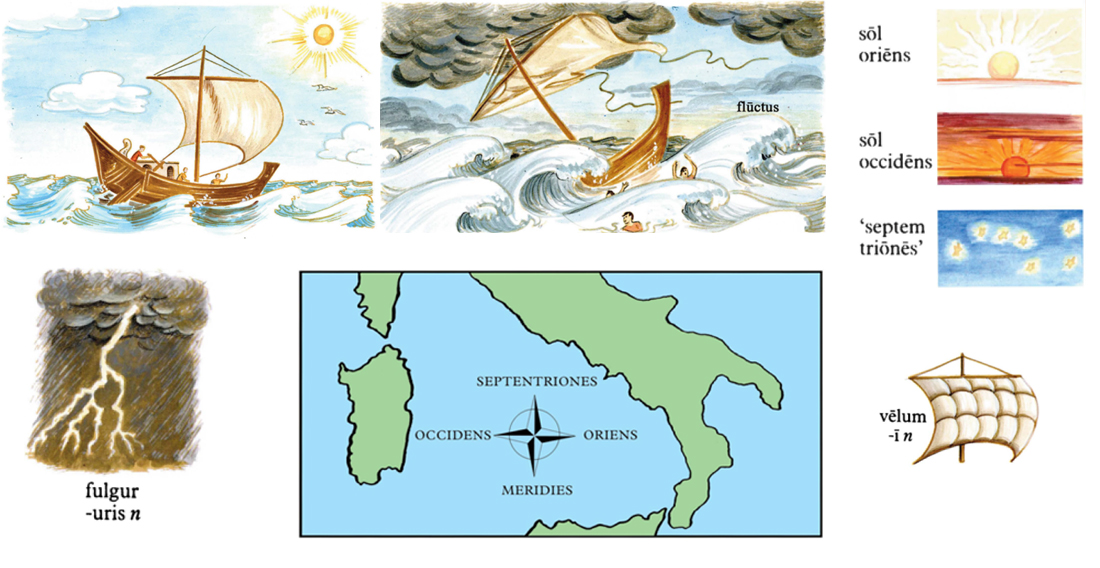
Italia inter duo maria interest, quorum alterum, quod supra Italiam situm est, 'mare Superum' sive 'Hadriaticum' appellatur, alterum, infra Italiam situm, 'mare Inferum' sive 'Tuscum'. Totum illud mare longum et latum quod inter Europam et Africam interest 'mare nostrum' appellatur a Romanis.
Urbs Roma non ad mare, sed ad Tiberim flumen sita est viginti milia pasuum a mari. Quod autem paulum aquae est in Tiberi, magnae naves in eo flumine navigare non possunt. Itaque parvae tantum naves Romam adeunt.
Ostiam omnes naves adire possunt, id enim est oppidum maritimum quod magnum portum habet. Ad ostium Tiberis sita est Ostia. ('Ostium' sive 'os' fluminis dicitur is locus quo flumen in mare influit; Ostia sita est eo loco quo Tiberis in mare Inferum influit.)
Alia oppida maritima quae magnos portus habent sunt Brundisium, Arminum, Genua, Puteoli. Haec omnia oppida in ora maritima sita sunt. (Ora maritima est finis terrae, unde mare incipit. Portus est locus in ora maritima quo naves ad terram adire possunt.) In ora Italiae multi portus sunt. Ex omnibus terris in portus Italiae veniunt naves, quae merces in Italiam vehunt. (Merces sunt res quas mercatores emunt ac vendunt.)
Non modo merces, sed etiam homines navibus vehuntur. Portus Ostensis semper plenus est hominum qui in alias terras navigare volunt. Is qui navigare vult adit nautam qui bonam navem habet. Si aer tranquillus est, necesse est ventum opperiri. (Ventus est aer qui movetur.) Cum nullus ventus super mare flat, tranquillum est mare; cum magnus ventus flat, mare turbidum est. Tempestas est magnus ventus qui mare turbat ac fluctus facit qui altiores sunt quam naves. Nautae tempestates metuunt, nam magni fluctus naves aqua implere possunt. Tum naves et nautae in mare merguntur.
Nautae nec mari turbido nec mari tranquillo navigare volunt; itaque in portu ventum secundum opperiuntur (id est ventus qui a tergo flat). Vento secundo naves e portu agrediuntur: vela vento implentur ac naves plenis velis per mare vehuntur.
Italy is in between two seas, of which one, because it sits above Italy, is called 'the Upper Sea' or 'Adriatic', the other, sits below Italy, 'Lower Sea' or 'Tuscum'. That entire long and wide sea which is between Europe and Africa is called 'our sea' by the Romans.
The city of Rome is not at the sea, but sits at the Tiber river twenty miles from the sea. Because there is little water in the Tiber, large ships cannot sail in that river. Therefore only small ships go to Rome.
All ships can go to Ostia, for it a coastal town which has a large port. Ostia sits at the mouth of the Tiber. ('The mouth' or 'os' of a river is named for that place which the river flows into the sea; Ostia sits in that place which the Tiber flows into the Lower Sea.)
Other coastal towns which have large ports are Brindisi, Arminum, Genoa, Puteoli. All of these towns are situated on the sea shore. (The sea shore is end of the land, from where the sea begins. The port is the place on the sea shore where ships can go to land.) On the shore of Italy there are many ports. Ships come in the ports of Italy from all lands, which carry goods into Italy. (Goods are things which merchants buy and sell.)
Not only goods, but also men are carried by ships. The port of Ostia is always full of men who wish to sail to other lands. He who wishes to sail goes to a sailor who has a good ship. If the air is calm, it is necessary to wait for wind. (Wind is air which is moving). When no wind flows above the sea, it is a calm sea; when a great wind flows, the sea is stormy. A storm is a great wind which disturbs the sea and makes waves which are higher than the ship. Sailors fear storms, for large waves can fill ships with water. Then the ship and sailors are submerged in the sea.
Sailors wish for neither a stormy sea nor a calm sea; therefore they wait in port for a following wind (that is a wind which flows from behind). A following wind advances a ship from port: sails are filled with wind and the full sails carry the ship through the sea.
II
Pars navis posterior puppis dicitur. In puppi sedet nauta qui navem gubernat. Quomodo navis in medio mari gubernari potest, cum terra nulla videtur? Gubernator caelum spectat: in alto mari sol aut stellae ei duces sunt. Ea pars caeli unde sol oritur dicitur oriens. Partes caeli sunt quattuor: oriens et occidens, meridies et septentriones. Occidens est pars caeli quo sol occidit. Meridies dicitur ea caeli pars ubi sol meridie videtur; pars contraria septentriones appellatur a septem stellis quae semper in ea caeli parte stant. Iis qui ad septentriones navigant, oriens a dextra est, a sinistra occidens, meridies a tergo. Oriens et occidens partes contrariae sunt, ut meridies et septentriones. -
Hodie caelum serenum et ventus secundus est. Naves multae simul e portu Ostiensi egrediuntur. Inter eos homines qui naves conscendunt est Medus, qui ex Italia proficiscitur cum amica sua Lydia. Medus, qui Graecus est, in patriam sua redire vult. Graecia non modo ipsius patria est, sed etiam Lydiae.
Medus et Lydia ex Italia proficiscentes omnes res suas secum ferunt: pauca vestimente, paulum cibi nec multum pecuniae. Praeterea Lydia parvum librum fert, quem sub vestimentis occultat.
Sole oriente navis eorum e portu egreditur multis hominibus spectantibus. Navis plenis velis altum petit. Aliae naves eam sequuntur.
Medus in puppim ascendit. Lydia eum sequitur. Ex alta puppi solem orientem spectant. Iam procul abest Ostia, homine qui in portu sunt vix oculis cerni possunt. Medus montem Albanum, qui prope villam Iulii situs est, cernit et “Vale, Italia!” inquit, “Valete montes et valles, campi silvaeque! Ego in terram eo multo pulchriorem, in patriam meam Graeciam!” Medus laetatur neque iam dominum suum severum veretur.
Lydia colles in quibus Roma sita est procul cernit et “Vale, Roma!” inquit, “Non sine lacrimis te relinquo, nam tu altera patria es mihi.” Lydia vix lacrimas tenere potest.
Medus faciem Lydiae intuetur et “Nonne gaudes” inquit, “mea Lydia, quod nos simul in patriam nostram redimus?”
Lydia Medum intuens “Gaudeo” inquit “quod mihi licet tecum venire. At non possum laetari quod omnes amicas meas Romanas relinquo. Sine lacrimis Roma proficisci non possum.” De oculis Lydiae lacrimae labuntur.
Medus eam complecitur et “Terge oculos!” inquit, “Ego, amicus tuus, qui te amo, tecum sum. In patriam nostram imus, ubi multi amici nos opperiuntur.” His verbis Medus amicam sua tristem consolatur.
Paulo post nihil a nave cernitur praeter mare et caelum. Medus gubernatorem interrogat: “Quam in partem navigamus?” Ille respondet: “In meridiem. Ecce sol oriens mihi a sinistra est. Sole duce navem guberno. Bene navigamus vento secundo atque caelo sereno.”
The rear part of the ship is called the poop deck. On the poop deck a sailor sits who steers the ship. How can a ship be steered in the middle of the sea, when no land is seen? The helmsman looks at the sky: in the deep sea the Sun or stars lead him. The part of the sky from where the sun rises is called east. There are four parts of the sky: east and west, south and north. The west is the part of the sky where the Sun sets. South is named for that part of the sky where the Sun is seen at noon; the part opposite is called north for the seven stars which always stand in that part of the sky. Those who sail north, east is on the right, west on the left, south is behind. East and west are opposite parts, like south and north -
Today the sky is calm and there is a following wind. Many ships are departing from the port of Ostia at the same time. Among these people who are boarding ships is Medus, who is setting out from Italy with his girlfriend Lydia. Medus, who is Greek, wishes to return to his fatherland. Greece is not only his fatherland, but also Lydia's.
Medus and Lydia set out from Italy carry all of their things with them: a few clothes, little food and not much money. Also Lydia carries a small book, which is hidden under her clothes.
While the Sun rises their ship sets out from the port with many people watching. The ship makes for deep sea with full sails. Other ships follow it.
Medus goes up into the poop deck. Lydia follows him. From the high poop deck they look east. Now they are far from Ostia, people who are in port can barely be discerned. Medus discerns mount Albanum, which is near Julius's villa and says, "Farewell Italy! Farewell mountains and valleys, fields and forests! I am going to a much more beautiful land, to my fatherland Greece!" Medus rejoices now that he does not fear his strict master.
Lydia discerns the hills in which Rome sits far away and says, "Farewell Rome! It is not without tears I leave you, for you are another fatherland to me." Lydia can barely hold back tears.
Medus looks at Lydia's face and says, "Are you not rejoicing my Lydia because we are returning to our fatherland together?"
Lydia looking at Medus says, "I am rejoicing because it is right for me to go with you. But I cannot rejoice because I am leaving all of my Roman friends. I cannot leave Rome without tears." Tears fall frm Lydia's eyes.
Medus comforts her and says, "Wipe your eyes! I, your boyfriend, who loves you, am with you. We go into our fatherland, where many friends wait for us." With these words Medus consoles his sad girlfriend.
A little after nothing was perceived besides the sea and sky. Medus asks the helmsman: "Into what part are you sailing?" He responds: "South. Behold the Sun is to my left. With the Sun leading I steer the ship. We are sailing well with a following wind and calm sky."
III
Dum ille loquitur, Medus occidentem spectat et nubes atras procul supra mare oriri videt; simul mare tranquillum fit. “Non serenum est caelum” inquit, “Ecce nubes atrae...”
Gubernator statim loqui desinit et nubes spectat; tum vela aspiciens exclamat: “Quid (malum!) hoc est? Nubes atrae ab occidente oriuntur et ventus simul cadit! O Neptune! Defende nos a tempestate!” Nauta Neptunum, deum maris, veretur.
“Cur Neptunum invocas?” inquit Medus, “Prope tranquillum est mare.”
Gubernator: “Adhuc tranquillum est, sed exspecta paulum: simul cum illis nubibus atris tempestas oriri solet cum tornitru et fulguribus. Neptunum invoco, quod ille dominus maris ac tempestatum est.” Nauta perterritus tempestatem venientem opperitur.
Paulo post totum caelum atrum fit, ac fulgur unum et alterum, tum multa fulgura caelum et mare illustrant. Statim sequitur tonitrus cum imbre, et simul magnus ventus flare incipit. Mare tempestate turbatur, ac navis, quae et homines et merces multas vehit, fluctibus iactatur et vix gubernari potest. Nautae multum aquae e nave hauriunt, sed navis nimis gravis est propter merces. Hoc videns gubernator “Iacite merces!” inquit nautis, qui statim merces graves in mare iacere incipiunt, spectante mercatore, qui ipse quoque nave vehitur. Ille tristis merces suas de nave labi et in mare mergi videt. Nemo eum consolatur! Navis paulo levior fit, simul vero tempestas multo turbidior et fluctus multo altiores fiunt.
Medus perterritus exclamat: “O Neptune! Serva me!” sed vox eius vix auditur propter tornitrum. Navis aqua impleri incipit, neque enim nautae satis multum aquae haurire possunt.
Ceteris perterritis, Lydia caelum intuetur et clamat: “Serva nos, domine!”
Medus: “Quis est ille dominus quem tu invocas?”
Lydia: “Est dominus noster Iesus Christus, qui non modo hominibus, sed etiam ventis et mari imperare potest.”
Medus: “Meus dominus non est ille! Ego iam nullius domini servus sum. Nemo mihi imperare potest!”
Hic magnus fluctus navem pulsat. Medus Lydiam labentem complecitur ac sustinere conatur, nec vero ipse pedibus stare potest. Medus et Lydia simul labuntur. Medus surgere conatur, nec vero se loco movere potest, quod Lydia perterrita corpus eius complecitur.
Lydia iterum magna voce Christum invocat: “O Christe! Iube mare tranquillum fieri! Serva nos, domine!”
Medus os aperit ac Neptunum iterum invocare vult, sed magnus fluctus os eius aqua implet. Medus loqui conatur neque potest.
Tum vero ventus cadere incipit! Iam fluctus non tanti sunt quanti paulo ante. Nautae fessi aquam haurire desinunt ac laetantes mare iterum tranquillum fieri aspiciunt.
While he is talking, Medus looks west and sees black clouds rise above the sea far away; at the same time the sea becomes calm. "The sky is not calm," he says, "behold black clouds..."
The helmsman immediately stops talking and looks at the clouds; then looking at the wind shouts: "What (evil) is this? Black clouds rising from the west and at the same time the wind falls! O Neptune! Defend us from the storm!" Sailors fear Neptune, god of the sea.
"Why do you call Neptune?" Medus says, "the sea is calm nearby."
Helmsman: "Now it is calm, but wait a little: a storm with thunder and lightning is accustomed to rise at the same time with those black clouds. I call Neptune, because he is lord of the sea and storms." The terrified sailor waits for the storm to come.
A little after all of the sky becomes black, and one lightning and another, then much lightning lights up the sky and sea. Immediately thunder follows with rain, and at the same time a great wind begins to blow. The sea is disturbed by the storm, and the ship, which carries both many people and goods, is tossed about by the waves and can barely be steered. Many sailors darin water from the ship, but the ship is too heavy because of the goods. Seeing this the helmsman says, "Throw over the goods!" The sailors, who immediately being to throw the heavy goods into the sea, while the merchant watches, who himself is also carried by the ship. He is sad seeing his goods fall from the ship and submerged in the sea. No one consoles him! The ship is made a little lighter, but at the same time the storm becomes more rough and with much higher waves.
Medus terrified shouts: "O Neptune! Save me!" but his voice can barely be heard on account of the thunder. The ship begins to fill with water, for the sailors cannot drain enough water.
With the others terrified, Lydia looks at the sky and shouts: "Save us Lord!"
Medus: "Who is the lord whom you are caling?"
Lydia: "It is our Lord Jesus Christ, who can not only command men, but even the winds and the sea."
Medus: "He is not my lord! I am a slave to no master. No one can command me!"
Here a great wave hits the ship. Medus embraces the falling Ludia and tries to sustain her, but he cannot stand on his feet himself. Medus and Lydia fall together. Medus tries to stand up, but he cannot move from that place, because Lydia is holding his terrified body.
Lydia again calls Christ with a loud voice: "O Christ! Command the sea to be calm! Save us Lord!"
Medus opens his eyes and wants to call Neptune again, but the waves fill his mouth with water. Medus tries to speak but cannot.
But then the wind begins to fall! Now the waves are not as much as a little before. The tired sailors stop draining the water and look rejoicing at the sea being made calm again.
GRAMMATICA LATINA
Verba deponentia
Medus laetatur (= gaudet) nec dominum veretur (= timet). Nauta non proficiscitur (= abit), sed ventum secundum opperitur (= exspectat).
'Laetari', 'vereri', 'proficisci', 'opperiri' verba deponentia sunt. Verbum deponens est verbum quod semper formam verbi passivi habet (praeter participium: laetans, verens, proficiscens, opperiens) atque in loco verbi activi ponitur.
Alia exempla verborum deponentium: consolari, conari, intueri, sequi, loqui, labi, complecti, egredi, oriri.
Medus ex Italia proficiscens solem orientem intuetur. Navis e portu egreditur; aliae naves eam sequuntur. Dum Lydia loquitur, lacrimae de oculis eius labuntur. Medus eam complectitur et consolari conatur.
LATIN GRAMMAR
Deponent verbs
Medus rejoices (= rejoice) he is not fearing his master (= fear). The is not leaving (= leaving), but is waiting for a following wind ( = waiting).
'Rejoicing', 'fearing', 'leaving', 'waiting' are deponent verbs. A deponent verb is a verb which always has the form of a passive verb (besides the parciple: rejoicing, fearing, leaving, waiting) and is put in place of the active verb.
Other examples of deponent verbs: comforting, trying, looking, following, speaking, falling, filling, going out, rising.
Medus leaving from Italy looks at the rising Sun. The ship is going out from the port; other ships are follwoing it. While Lydia is speaking, tears are falling from her eyes. Medus is embracing her and trying to comfort her.
VOCABVLA
navis, navis f.
portus, portus m.
locus, i m.
ora, ae f.
merx, mercis f.
nauta, ae m.
ventus, i m.
tempestas, tempestatis f.
fluctus, fluctus m.
velum, i n.
puppis, puppis f.
gubernator, gubernatoris m.
oriens, orientis m.
occidens, occidentis m.
septentriones, septentrionis m.
altum, i n.
tonitrus, tonitrus m.
fulgur, fulguris n.
situs, situs m.
superus, a, um
inferus, a, um
maritimus, a, um
tranquillus, a, um
turbidus, a, um
contrarius, a, um
serenus, a, um
ater, atra, atrum
intersum, interesse, interfui, interfuturus
appello, -are, -avi, -atum
navigo, -are, -avi, -atum
influo, influere, influxi, influxus
opperior, opperiri, opperitus sum
flo, flare, flavi, flatum
turbo, -are, -avi, atum
impleo, implere, implevi, impletum
egredior, egredi, egressus sum
guberno, -are, -avi, -atum
orior, oriri, oritus sum
occido, occidere, occidi, occasum
conscendo, conscendere, -di, -sum
profiscor, profisci, profiscitus sum
sequor, sequi, secutus sum
cerno, cernere, crevi, cretum
laetor, laetari, laetatus sum
vereor, vereri, veritus sum
intueor, intueri, intuitus sum
labor, labi, lapsus sum
complector, complecti, complexus sum
consolor, consolari, consolatus sum
loquor, loqui, locutus sum
invoco, -are, -avi, -atum
iacto, -are, -avi, -atum
haurio, haurire, hausi, haustum
servo, -are, avi, atum
conor, conari, conatus sum
fio, fieri, factus sum
paulum, a, um
semper
simul
vix
praeterea
iterum
sive
vero
propter
deponens
VOCABULARY
ship
port
place
shore
merchandise
sailor
wind
storm
wave
sail
poop deck
pilot, captain
the east
the west
the north
high; high seas
thunder
lightning
situated
above
below
coastal
calm
rough
against
calm; serene
black
to be between
to call; to name
to sail; to navigate
to flow in
to wait for
to blow
to disturb
to fill
to exit
to govern; to steer
to rise
to set
to embark
to set sail
to follow
to see; to discern
to rejoice
to fear
to gaze upon
to fall
to hug; to embrace
to comfort
to speak
to call upon; to pray
to throw; to throw away
to empty
to save
to try
to be; to become
little
always
at the same time
barely; scarecly
besides
again; a second time
or if; or
yes; in truth; certainly
near; on account of
deponent