CAPITVLVM VNDETRICESIMVMTWENTY-NINTH CHAPTER
NAVIGARE NECESSE ESTIT IS NECESSARY TO SAIL
I
Multae naves multique nautae quotannis in mari pereunt. In fundo maris plurimae naves mersae iacent. Nec tamen ullis periculis a navigando deterrentur nautae. “Navigare necesse est” aiunt, et mercatores, qui ipsi pericula maris adire non audent, haec adiciunt: “Vivere non est necesse!” Mercatores merces suas magni aestimant, vitam nautarum parvi aestimant!
Nec vero omnes mercatores domi remanent, cum merces eorum navibus vehuntur. Nonnulli in terras alienas navigant, quod merces pretiosas nautis credere nolunt, sicut mercator ille Romanus qui eadem nave vehitur qua Medus et Lydia. Is laetus Ostia profectus est cum mercibus pretiosis quas omni pecunia sua in Italia emerat eo consilio ut eas maiore pretio in Graecia venderet. Ita sperabat se magnum lucrum facturum esse. Iam vero ea spes omnis periit, nam fluctibus mersae sunt merces in quibus omnem spem posuerat. Subito mercator e divitissimo pauperrimus factus est. Non mirum est eum maestum esse.
Mercator ad gubernatorem accedens multis cum lacrimis queritur: “Heu, me miserum! Omnia quae possidebam in fundo maris sunt. Quid faciam? Quid sperem? Quomodo uxorem et liberos alam? Ne as quidem mihi reliquus est: omnia amisi. Heu!”
“Desine queri!” inquit gubernator, “Non enim omnia amisisti si uxor et liberi tui salvi sunt. Nonne liberos pluris aestimas quam merces istas? Divitias amittere miserum est, at multo miserius liberos amittere.”
Talibus verbis nauta mercatorem maestum consolari conatur, sed frustra, nam ille protinus “Noli tu me consolari” inquit, “qui ipse imperavisti ut merces meae iacerentur!”
Gubernator: “Iactura mercium navis servata est.”
Mercator: “Recte dicis: meae merces eiectae sunt, ut navis tua salva esset!”
Gubernator: “Merces iecimus ut nos omnes salvi essemus. Iactura mercium non modo navis, sed etiam vita omnium nostrum servata est. Merces quidem perierunt, sed nemo nostrum periit. Ergo bonum animum habe! Laetare una nobiscum te vitam non amisisse simul cum mercibus! Homines felices sumus.”
Mercator: “Vos quidem felices estis, nemo enim vestrum assem amisit. Mirum non est vos laetari. At nolite me monere ut laetus sim, postquam omnia mihi eripuistis! Laetitia vestra me non afficit.”
Gubernator: “Nec quisquam nostrum tristitia tua afficitur. Semper gaudeo cum de liberis meis cogito, qui maxima laetitia afficiuntur cum patrem suum e navigatione periculosa salvum redire vident.”
Mercator: “Ego quoque liberos meos amo nec eos dolore afficere volo. Sed quomodo vivamus sine pecunia? Quomodo cibum et vestem emam infantibus meis? O di immortales! Reddite mihi merces!”
Gubernator: “Quid iuvat deos precari ut res amissae tibi reddantur? Frustra hoc precaris.”
Mercator: “Quid ergo faciam? Ipse de nave saliam, an in eadem nave maneam vobiscum?” Vir ita perturbatus est ut se interroget, utrum in mare saliat an in nave remaneat.
Many ships and many sailors perish in the sea every year. In the deep of the sea many ships lie submerged. Nevertheless those dangers do not deter sailors from sailing. "It is necessary to sail," they say, and merchants, who do not dare go out to the dangers of the sea themselves, say this, "It is not necessary to live!" Merchants value their cargo high, they value the lives of sailors little!
But not all merchants remain at home, when their cargo is carred by ships. Not many sail into foreign lands because they do not believe the sailors value their cargo, as that Roman merchant who is being carried by the same ship as Medus and Lydia. He happily set out from Ostia with his valuable merchandise that he bought with all his money in Italy and planned to sell in Greece for a greater price. Thus he hoped to make a great fortune. But now those hopes have all perished, for the waves sank the cargo in which he places all hope. Suddenly the merchant was made very poor from very rich. It is no surprise that he is sad.
The merchant comes up to the helmsman complainng with many tears: "Heu, I am miserable! All that I own is at the bottom of the sea. What will I do? What hope is there? How will I feed my wife and children? Not even a penny is left: everything is gone. Heu!"
"Stop complaining!" the helmsman says, "For not everything is lost if your wife and children are safe. Do you not value your children more than that cargo? To lose wealth is miserable, but to lose children is more miserable."
With such words the sailor tried to console the sad merchant, but in vain, for he immediately says, "Do not console me, he who commanded that my cargo be thrown over!"
Helmsman: "Throwing over the cargo saved the ship"
Merchant: "You speak correctly: my cargo was thrown over to save your ship!"
Helmsman: "We threw over the cargo to save all our lives. Throwing over the cargo saved not only the ship, but also all our lives. The cargo certainly perished, but no one of us perished. Therefore have a good soul! Rejoice together with us that your life was not lost like with your cargo! We are lucky men."
Merchant: "You are certainly lucky, for not one of your pennies was lost. It is not a marvel that you are happy. But do not advise me to be happy, after all of my things were snatched away! Your happiness does not affect me."
Helmsman: "Nor are we affected by your sorrow. I always rejoice when I think of my children, who are affected wtih the greatest happiness when they see their father return safe from the dangers of sailing."
Merchant: "I also love my children and do not want to cause them pain. But how do we live without money? How will I buy food and clothes for my infants? O immortal gods! Return my cargo!"
Helmsman: "What help is it to pray to the gods to return your lost things to you? You pray this in vain."
Merchant: "What therefore will I do? Jump from this ship or remain in the same ship with you?" Thus the disturbed man asks himself whether he will jump into the sea or remain in the ship.
II
“Sali modo!” inquit gubernator, “Nemo nostrum te prohibebit. At certe non tam felix eris quam Arion, qui delphino servatus est.”
Mercator, qui Arionem ignorat, “Quisnam est Arion?” inquit, “Ne nomen quidem mihi notum est.”
Gubernator: “Ignarus quidem es si illum ignoras. Arion, vir nobilis Lesbi natus, tam pulchre fidibus canebat ut alter Orpheus appellaretur. An tam ignarus es ut etiam Orpheus tibi ignotus sit?”
Mercator: “Minime vero. Orpheus quidem omnibus notus est. Is fidicen nobilissimus fuit qui tam pulchre canebat ut bestiae ferae, naturam suam oblitae, accederent, ut eum canentem audirent, ac rapidi fluvii consisterent, ne strepitu cantum eius turbarent. Orpheus etiam ad Inferos descendit ut uxorem suam mortuam inde reduceret... Sed perge narrare de Arione.”
Gubernator, cum omnes attentos videat, hanc fabulam narrat:
“Cum Arion, nobilissimus sui temporis fidicen, ex Italia in Graeciam navigaret magnasque divitias secum haberet, nautae pauperes, qui homini diviti invidebant, eum necare constituerunt. Ille vero, consilio eorum cognito, pecuniam ceteraque sua nautis dedit, hoc solum orans ut sibi ipsi parcerent. “Ecce” inquit “omnia quae possideo iam vestra sunt. Divitias meas habete, parcite vitae! Permittite mihi in patriam reverti! Hoc solum precor.” Nautae precibus eius ita permoti sunt ut manus quidem ab eo abstinerent; sed tamen imperaverunt ut statim in mare desiliret! Ibi homo territus, cum iam vitam desperaret, id unum oravit ut sibi liceret vestem ornatam inducere et fides capere et ante mortem carmen canere. Id nautae, studiosi cantum eius audiendi, ei permiserunt. Ille igitur, pulchre vestitus et ornatus, in celsa puppi stans carmen clara voce ad fides cecinit. Ut Orpheus cantu suo feras ad se alliciebat, ita tunc Arion canendo pisces allexit ad navem. Postremo autem cum fidibus ornamentisque, sicut stabat canebatque, in mare desiluit.
"Just jump!" the helmsman says, "None of us will prevent you. But you will certainly not be as lucky as Arion, who was saved by a dolphin."
The merchant, who does not know Arion says, "Who is Arion? Not even his name is known to me."
Helmsman: "You are certainly ignorant if you are ignorant of him. Arion, a noble man born in Lesbos, played the lyre so beautifully that he was called the second Orpheus. Or are you so ignorant that even Orpheus is unknown to you?"
Merchant: "Certainly not. Orpheus is indeed known to all. He was a very renowned lyre player who played so beautifully that wild beasts, forgetting their nature, came to him to hear his playing, and the rapid rivers stopped lest the noise disturb his playing. Orpheus also descended to Inferno to return his wife from the dead... But continue telling of Arion."
The helmsman, when he saw everyone paying attention, told the tale:
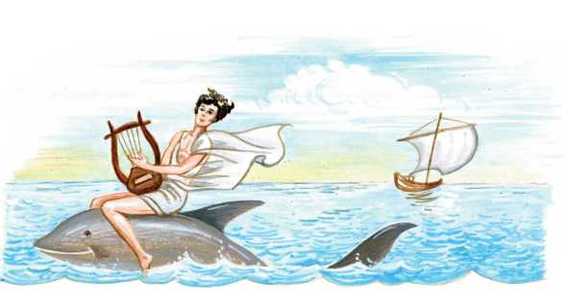
"When Arion, a very renowned lyre player in his time, sailed from Italy to Greece and had great riches with him, the poor sailors, who envied rich men, decided to kill him. But he, knowing their plan, gave money and other things to the sailors, begging them to only spare him. "Behold," he said, "All the things that I own are yours. Have my riches, spare my life! Allow me to return to my fatherland! I pray this alone." The sailors moved thus by his prayers that they kepts their hands from them; but nevertheless ordered that he immediately jump into the sea! There the terrified man, when already despairing for his life, begged for one thing that he be allowed to put on his fine clothes and take his lyre and before his death sing a song. The sailors, eager for hearing his song, allowed this. Therefore he, with his beautiful and decorative clothing, standing in the high stern sings with a loud voice with his lyre. As Orpheus attracted wild animals to him with song, thus Arion singing attracted fish to the ship. But finally with his lyre and jewels, as he was standing and singing, he jumped into the sea."
“Tum vero nova et mira res accidit: delphinus, cantu allectus, repente hominem natantem subiit eumque in dorso suo sedentem vexit et in litore Graeciae salvum exposuit. Inde Arion protinus Corinthum petivit, ubi regem Periandrum, amicum suum, adiit eique rem sicut acciderat narravit. Rex haec parum credidit, et Arionem quasi virum fallacem custodiri iussit. Sed postquam nautae Corinthum venerunt, rex eos interrogavit 'num scirent ubi esset Arion et quid faceret?' Responderunt 'hominem, cum inde abirent, in terra Italia fuisse eumque illic bene vivere, aures animosque hominum cantu suo delectare atque magnum lucrum facere.' Cum haec falsa narrarent, Arion repente cum fidibus ornamentisque cum quibus se in mare iecerat apparuit. Nautae stupentes, cum eum quem mersum esse putabant ita vivum apparere viderent, protinus maleficium suum confessi sunt.”
Hic Medus “Etsi notum est” inquit “nonnullos homines delphinis vectos esse, tamen dubito num haec fabula vera sit.”
Gubernator: “Sive vera sive falsa est, valde me delectat fabula de felici salute Arionis, nam sicut ille mirum in modum servatus est, cum iam de salute desperaret, ita homines nonnumquam contra spem e maximis periculis eripiuntur. Hac fabula monemur ut semper bono animo simus neve umquam de salute desperemus. Dum anima est, spes est.”
Haec verba tandem mercatorem perturbatum aliquid consolari videntur.
"But then a new and incredible thing occurred: a dolphin, attracted by his song, suddenly swam to the man going under him and carried him on its back and put him safe on the shore of Greece. From here Arion immediately sought to go to Corinth, where he told his friend King Periander the thing that occurred. The king did not quite believe this, and ordered Arion be guarded like a deceitful man. But after the sailors came to Corinth, the king asked them 'whether they knew where Arion had been and what had happened?' They answered 'the man, they had left from there, had been in the land of Italy and that the man was living well there, pleasing the ears and minds of men by his song and making a great fortune.' When they were telling these fasle things. Arion suddenly appeared with the lyre and jewels with which he had thrown himself into the sea. The sailors stunned, when they saw him who they thought to be drowned appear thus living, immediately confessed their evil deeds."
Here Medus says, "Even if it is known that a few men have been carried by dolphins, nevertheless I doubt where this store is true."
Helmsman: "Whether it is true or false, the tale of the fortunate salvation of Arion delights me greatly, for as he is saved in that marvelous manner, when already desparing for salvation, thus many men are snatched away from the greatest dangers against hope. We are advised by this tale to always be of good spirit and never despair of salvation. While there is spirit there is hope."
These words at last seem to somewhat console the disturbed merchant.
III
Tum vero Lydia ad Medum versa “Modo te interrogavi” inquit “tuane esset pecunia qua hunc anulum emisti. Cur nondum mihi respondisti?”
Ita repente interrogatus Medus 'se pecuniam e sacculo domini surripuisse' confitetur.
“O Mede!” exclamat Lydia, “Fur es! Iam me pudet te, furem nequissimum, amavisse!”
At Medus “Noli” inquit “me furem appellare, mea Lydia! Dominus enim aliquid peculii mihi debebat. Peculium debitum sumere furtum non est.”
Sed Lydia pergit eum furti accusare: “Furtum fecisti, Mede! Frustra te excusare conaris.”
Medus: “Si furtum feci, tua causa id feci. Eo enim consilio nummos surripui ut donum pretiosum tibi emerem. Nonne hoc beneficium potius quam maleficium esse tibi videtur?”
Lydia: “Facile est aliena pecunia dona pretiosa emere. Tale donum me non delectat. Hunc anulum iam gerere nolo: in mare eum abiciam!” Hoc dicens Lydia anulum de digito detrahit, sed gubernator protinus bracchium eius prehendit. Simul Medus anulum e manu Lydiae lapsum capit.
Lydia irata exclamat: “Abstine manum, nauta!” at ille “Noli stulte agere!” inquit, “Nemo tibi anulum ita abiectum reddet - nisi forte tam felix eris quam Polycrates, tyrannus Samius, cuius anulus, quem ipse in mare abiecerat, mirum in modum inventus est non in fundo maris, sed in ventre piscis!”
But then Lydia turns to Medus and says, "I asked you whether it was with your money that you bought this ring. Why have you not yet answered me?"
Having thus been asked suddenly, Medus admits that he had stolen the money from his master's bag.
"O Medus!" shouts Lydia, "You are a thief! Now I am ashamed to have loved you, a wicked thief!"
But Medus says, "Do not call me a thief my Lydia! For my master owed some money to me. Taking the money owed is not stealing."
But Lydia continues to accuse him of theft: "You committed theft Medus! You are trying to excuse yourself in vain."
Medus: "If I committed theft, I did it for your sake. For I stole the coins with the plan that I buy a precious gift for you. Does this not seem to be a more of a kindness than an evil deed to you?"
Lydia: "It is easy to buy precious gifts with the money of others. Such a gift does not please me. I do not want to wear this ring now: I will throw it into the sea!" Saying this Lydia pulls the ring from her finger, but the helmsman grabs her arm at once. At the same time Medus takes the ring having slipped from Lydia's hand.
Lydia angry shouts: "Let go of my hand sailor!" but he says "Do not do something foolish! No one will return that ring to you thrown away thus - unless by chance you are luckier than Polycrates, the tyrant of Samos, whose ring that he threw into the sea, was found in an amazing way not at the bottom of the sea, but in the stomach of a fish!"
Lydia: “Cur ille tyrannus anulum suum abiecit?”
Gubernator: “Anulum abiecit, cum sese nimis felicem esse censeret. Nihil mali umquam ei acciderat ac tanta erat potestas eius, tanta gloria tantaeque divitiae, ut non solum alii tyranni, sed etiam di immortales ei inviderent. Tum amicus eius, rex Aegypti, cum felicitatem atque gloriam eius ingentem videret, tyranno suasit, ut iacturam faceret eius rei qua maxime omnium delectabatur: ita deorum invidiam averti posse sperabat. Polycrates igitur navem conscendit et anulum quem pretiosissimum habebat in mare abiecit.
“Paucis post diebus aliqui piscator in eodem mari piscem cepit qui tam formosus erat ut piscator eum non venderet, sed tyranno donaret. Verum antequam piscis ad mensam tyranni allatus est, servus qui piscem secabat ei anulum attulit 'quem in ventre piscis inventum esse' dixit. Polycrates, cum anulum suum recognosceret, maxima laetitia affectus est.”
Medus: “Nemo umquam eo tyranno beatior fuit!”
Gubernator: “Noli quemquam ante mortem beatum dicere! Hoc nos docet fortuna illius tyranni. Polycrates enim paulo post a quodam viro fallaci, qui eum falsis promissis Samo in Asiam allexerat, terribilem in modum necatus est. Ita nonnumquam vita beata morte miserrima finitur. Varia quidem est hominum fortuna, sed homo prudens bonam et malam fortunam aequo animo fert nec alterius fortunae invidet.”
Dum gubernator loquitur, altera navis procul in mari apparet. Medus eum apprehendit et “Desine loqui!” inquit, “Cura negotium tuum! Quin prospicis? Videsne navem illam velocem quae a septentrionibus nobis appropinquat?”
“Per deos immortales!” inquit gubernator, cum primum navem appropinquantem prospexit, “Illa navis velox nos persequitur. Certe navis praedonum est. Omnia vela date, nautae!”
Navis autem velis solis non tam velociter vehitur quam ante tempestatem, nam vela vento rapido scissa sunt. Itaque gubernator imperat ut navis remis agatur. Mox remis velisque vehitur navis quam velocissime potest, sed tamen altera navis, cuius remi quasi alae ingentes sursum deorsum moventur, magis magisque appropinquat.
Gubernator perterritus exclamat: “O di boni! Quid faciamus? Brevi praedones hic erunt.”
Tum mercator, cum gubernatorem pallidum videat, “Bono animo es!” inquit, “Noli desperare! Spes est, dum anima est.”
Lydia: "Why did that tyrant throw out his ring?"
Helmsman: "He threw out his ring when he thought himself to be too lucky. Nothing bad ever happened to him and his power was so great, his glory was so great, and his riches were so great, that not only other tyrants, but even the immortal gods envied him. Then his friend, King of Egypt, when he saw his luck and vast glory, persuaded the tyrant that he make a loss of something that delighted him greatest of all things: thus he was hoping to be able to avert the envy of the gods. Polycrates therefore got on a ship and threw away a very valuable ring he had into the sea."
"A few days after a certain fisherman caught a fish in the same sea that was so beautiful that the fishermen did not sell it, but gave it to the tyrant. But before the fish was served at the tyrant's table, the slave who was cutting the fish open brought a ring to him which he said, 'was found in the belly of the fish.' Polycrates, when he recognized his ring, was moved with great joy."
Medus: "No one was ever luckier than that tyrant!"
Helmsman: "Don't say anyone is blessed before death! That tyrant's fortune teaches us this. For Polycrates a little after was killed in a terrible way by a certain deceitful man, who by false promises lured him from Samos into Asia. Thus sometimes a blessed life is ended in a miserable death. The fortune of man is fickle, but a prudent man bears good and bad fortune with an equal spirit and does not envy anothers fortune."
While the Helmsman is speaking, another ship appears far away on the sea. Medus seizes him and says, "Stop talking! Take care of your duty! Aren't you looking out? Do you see that fast ship which is approaching us from the North?"
"By the immortal gods!" says the helmsman, when he first looked out at the approaching ship, "That fast ship is following us. It is certainly a ship pirates. Give all the sails sailors!"
But the ship with sails alone is not carried as fast as before the storm, for the sails were torn by the rapid wind. Therefore the helmsman commands that the ship be driven by oars. Soon the oars and sails carry the ship as fast as it can, but nevertheless the other ship, whose oars are moved as large wings up and down, approaches more and more.
The helmsman terrified shouts: "O good gods! What will we do? Soon the pirates will be here."
Then the merchant, when seeing the pale helmsman says, "Be of good spirit! Do not despair! There is hope while there is breath."
GRAMMATICA LATINA
LATIN GRAMMAR
VOCABVLA
fundus, fundi m.
vita, vitae f.
lucrum, lucri n.
spes, spei f.
divitia, divitiae f.
iactura, iacturae f.
laetitia, laetitiae f.
tristitia, tristitiae f.
navigatio, navigationis f.
delphinus, delphini m.
fides, fedei f.
fidicen, fidicenis m.
cantus, cantus
carmen, carminis n.
dorsum, dorsi n.
maleficium, malefici n.
salus, salutis f.
fur, furis c.
furtum, furti n.
beneficium, benefici n.
tyrannus, tyranni m.
felicitas, felicitatis f.
invidia, invidiae f.
piscator, piscatoris f.
fortuna, fortunae f.
remus, remi m.
pretiosus, a, um
mirus, a, um
maestus, a, um
felix, felicis
notus, a, um
ignarus, a, um
nobilis, nobile
ignotus, a, um
rapidus, a, um
celsus, a, um
fallax, fallacis
velox, velocis
deterreo, -terrere, -terrui, -territum
adicio, adicere, adieci, adiectum
aestimo, -are, -avi, aestimatum
remaneo, -ere, remansi, remansum
queror, queri, questus sum
amitto, amittere, amisi, amissum
eripio, eripere, eripui, ereptum
afficio, afficere, affeci, affectum
precor, precari, precatus sum
perturbo, -are, -avi, perturbatum
reduco, reducere, reduxi, reductum
invideo, invidere, invidi, invIsum
parco, parcere, parcui, parsum
permitto, -mittere, -misi, permissum
permoveo, -ere, permovi, permotum
abstineo, -stinere, -stinui, abstentum
desilio, desilire, desilui, desultum
despero, -are, -avi, desperatum
allicio, allicere, allexi, allectum
subeo, subire, subivi, subitum
expono, -ponere, -posui, expositum
appareo, -parere, -parui, -itum
stupeo, stupere, stupui, -
confiteor, confiteri, confessus sum
surripio, -ripere, -ripui, surreptum
abicio, abicere, abieci, abiectum
detraho, -trahere, -traxi, detractum
suadeo, suadere, suasi, suasum
dono, donare, donavi, donatum
seco, secare, secui, sectum
recognosco, -noscere, -novi, -nitum
finio, finire, finivi, finitum
appropinquo, -are, -avi, -atum
nonnullus, nonnulli
sese
frustra
inde
protinus
repente
quasi
nonnumquam
VOCABULARY
lowest part, bottom
life
gain, profit
hope, anticipation
wealth, riches (pl)
loss, sacrifice
joy, source of joy
sadness
navigation, sailing
dolphin
faith, loyalty
lyre-player, lyricist
song, chant, poem
song, music
back
crime, wrong
salvation, health
thief, robber
theft, deception
kindness, help, service
tyrant
good fortune
to envy, to dislike
fisherman
chance, fate, wealth
oar
costly, of great value
remarkable, strange
sad, gloomy
blessed, favorable
familiar, well-known
ignorant, unaware
noble, respected
unknown, strange
rapid, swift
tall, high, lofty
deceitful, treacherous
swift, quick
to deter, frighten away
to add, to increase
to value, to assess
to stay behind, remain
to complain, to protest
to lose, to send away
to rescue, snatch away
to cause, to affect
to beseech, to pray for
to confuse, to disturb
to restore, to reduce
to envy
to spare, to forbear
to let through, to permit
to stir up, to influence
to withhold, to avoid
to dismount, leap down
to despair (of)
to entice, to attract
to undergo, go beneath
to put out, to expose
to show up, to appear
to be astounded
to confess, to reveal
to steal, to filch
throw away, abandon
to remove, to drag off
to urge, to recommend
to give, to present
to sever, to cut, slice up
to recognize, to recollect
to limit, to end, to finish
to approach, be close
some (pl), several, few
oneself, themselves (pl)
in vain, for nothing
thence, from that place
at once, immediately
suddenly, unexpectedly
as if, as it were
sometimes