CAPITVLVM NONVMNINTH CHAPTER
PASTOR ET OVESTHE SHEPHERD AND SHEEP
I
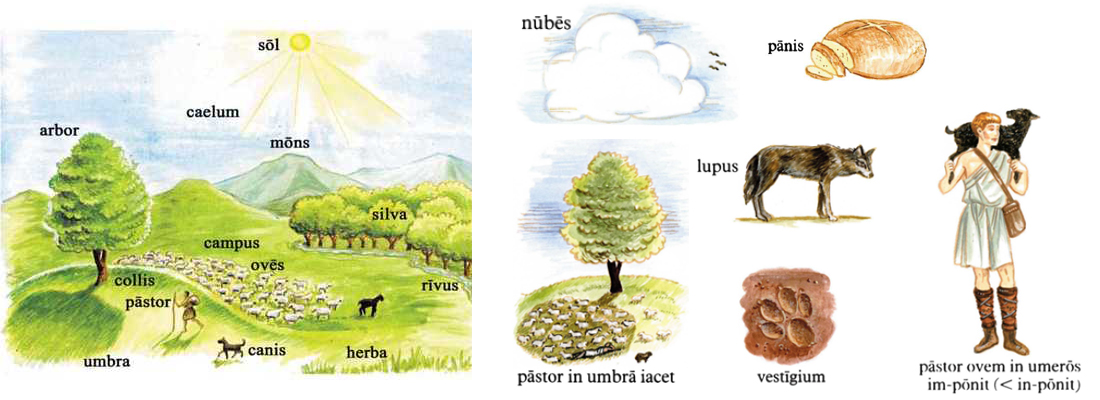
Hic vir, qui in campo ambulat, pastor Iulii est. Pastor non solus est in campo, nam canis niger cum eo est et centum oves: una ovis nigra et undecentum oves albae. Pastor unam ovem nigram et multas oves albas habet. Is est dominus ovis nigrae et ovium albarum. Pastor ovi nigrae et ovibus albis aquam et cibum dat. Cum una ove nigra et undecentum ovibus albis pastor in campo est.
Cibus ovium est herba, quae in campo est. In rivo est aqua. Oves in campo herbam edunt, et aquam bibunt e rivo, qui inter campum et silvam est. Canis herbam non est, neque pastor herbam est. Cibus pastoris est panis, qui inest in sacco. Iulius pastori suo panem dat. Pastor cani suo cibum dat: canis a pastore cibum accipit. Itaque canis pastorem amat.
In Italia sunt multi pastores. Qui via Appia Roma Brundisium it multos pastores videt in campis. Numerus pastorum magnus est. Domini pastoribus suis cibum dant. Canes a pastoribus cibum accipiunt.
Post campum montes sunt. Inter montes sunt valles. In campo est collis. (Collis est mons parvus.) In colle arbor est. In silva multae arbores sunt. Oves non in silva neque in monte, sed in campo sunt. In silva est lupus. Pastor et oves lupum timent, nam lupus oves est. In silvis et in montibus lupi sunt, in vallibus nulli sunt lupi.
Sol in caelo est supra campum. In caelo nulla nubes videtur. Caelum est supra terram. Montes et valles, campi silvaeque sunt in terra. In caelo sol et nubes sunt, sed supra hunc campum caelum sine nubibus est. Itaque sol lucet in campo.
Pastor in sole ambulat. Sub arbore autem umbra est. Pastor, qui nullam nubem videt in caelo, cum cane et ovibus ad arborem adit. Pastor umbram petit. Etiam oves umbram petunt: post pastorem ad arborem adeunt. Pastor oves suas ad arborem ducit.
Ecce pastor in umbra arboris iacet cum cane et ovibus. Arbor pastori et cani et ovibus umbram dat; sed ovis nigra cum paucis aliis in sole iacet. Pastor, qui fessus est, oculos claudit et dormit. Canis non dormit.
This man, who is walking in the field, is Julius's shepherd. The shepherd is not alone in the field, for a black dog and one hundred sheep are with him: one black sheep and ninety-nine white sheep. The shepherd has one black sheep and many white sheep. He is the master of the black sheep and the white sheep. The shepherd gives water and food to the black sheep and to the white sheep. The shepherd is in the field with one black sheep and ninety-nine white sheep.
The food of sheep is grass, which is in the field. In the river there is water. The sheep eat the grass in the field, and drink water from the river, which is between the field and the forest. The dog does not eat grass, nor does the shepherd eat grass. The shepherd's food is bread, which is in his bag. Julius gives bread to his shepherd. The shepherd gives bread to his dog: the dog receives bread from the shepherd. Therefore the dog loves the shepherd.
In Italy there are many shepherds. He who goes the Appia road from Rome to Brundisia sees many shepherds in the fields. The number of shepherds is large. Masters give food to their shepherds. Dogs receive food from the shepherds.
Behind the field there are mountains. Between the mountains are valleys. In the field there is a hill. (A hill is a small mountain.) On the hill there is a tree. In the forest there are many trees. The sheep are not in the forest nor on the mountain, but in the field. In the forest is a wolf. The shepherd and sheep fear the wolf, for the wolf eats sheep. There are wolves in the forest and in the mountains, in the valleys there are no wolves.
The Sun is in the sky above the field. In the sky no clouds are seen. The sky is above the land. Mountains, valleys, fields and forests are on the land. The Sun and clouds are in the sky, but above this field the sky is without clouds. Therefore the Sun shines on the field.
The shepherd in the Sun. But under the tree is shade. The shepherd, who sees no cloud in the sky, goes to the tree with the dog and sheep. The shepherd seeks shade. Even the sheep seeking shade: go to the tree behind the shepherd. The shepherd leads his sheep to the tree.
Behold the shepherd lying in the shade of the trees with the dog and sheep. The tree gives shade to the shepherd, dogs and sheep; but the black sheep lies down in the Sun with a few others. The shepherd, who is tired, closes his eyes adn sleeps. The dog does not sleep.
II
Dum pastor in herba dormit, ovis nigra ab ovibus albis abit et ad rivum currit. Ovis nigra oves albas relinquit et rivum currit. Ovis nigra oves albas relinquit et rivum petit; aquam bibit e rivo, et in silvam intrat!
Canis latrat: “Baubau!” Pastor oculos aperit, oves aspicit, ovem nigram non videt. Pastor oves numerat: “Una, duae, tres, quattuor, quinque..... Undecentum.” Numerus ovium est undecentum, non centum. Nullae oves albae absunt, sed abest ovis nigra. Pastor et canis oves albas relinquunt et silvam petunt. Pastor saccum cum pane in colle relinquit.
Dum ceterae oves a pastore numerantur, ovis nigra in magna silva, ubi via nulla est, errat. Ovis, quae iam procul a pastore ceterisque ovibus abest, neque caelum neque solem supra se videt. Sub arboribus sol non lucet. Ovis nigra in umbra est.
In terra inter arbores sunt vestifia lupi. Ubi est lupus ipse? Non procul abest. Ovis vestigia lupi in terra videt, neque lupum ipsum videt. Itaque ovis lupum non timet. Parva ovis sine timore inter arbores errat.
Lupus autem prope ovem est. Pastor et canis procul ab ea sunt. Lupus, qui cibum non habet, per silvam errat. Lupus in silva cibum quaerit, dum pastor et canis ovem nigram quaerunt.
Pastor: “Ubi est ovis nigra? Age! quaere ovem, canis, et reperi eam!” Canis ovem quaerit et vestigia eius in terra reperit, neque ovem ipsam reperit. Canis latrat.
Pastor: “Ecce vestigia ovis. Ubi est ovis ipsa? Duc me ad eam, canis!” Canis dominum suum per silvam ducit ad ovem, sed ovis procul abest.
Lupus ululat: “Uhu!” Et ovis et canis lupum audiunt. Canis currit. Ovis balat: “Baba!”
Ecce lupus qui ante ovem est! Iam ovis lupum ipsum ante se videt. Oculi lupi in umbra lucent ut gemmae et dentes ut margaritae. Parva ovis oculos claudit et dentes lupi exspectat. Lupus collum ovis petit dentibus...
Sed ecce canis accurrit! Lupus se ab ove vertit ad canem, qui ante lupum consistit et dentes ostendit. Lupus ululat. Canis latrat. Ovis balat.
Pastor, qui iam prope est, clamat: “Pete lupum!” Canis clamorem pastoris audit, et sine timore lupum petit. Lupus autem ovem relinquit et montes petit.
Pastor quoque accurrit et ovem suam, quae in terra iacet, aspicit. In collo eius sunt vestigia dentium lupi! Ovis oculos aperit et ad pastorem suum balat.
Pastor laetus ovem in umeros imponit eamque portat ad ceteras oves, quae sine pastore in campo errant.
Procul in monte lupus ululat.
While the shepherd sleeps in the grass, the black sheep goes away from the white sheep and runs to the river. The black sheep leaves the white sheep and runs to the river. The black sheep leaves the white sheep and seeks the river; it drinks water from the river, and enters into the forest!
The dog barking: "Bark!" The shepherd opens his eyes, looking at the sheep, he does not see the black sheep. The shepherd counts the sheep: "One, two, three, four, five... ninety-nine." The number of sheep is ninety-nine, not one hundred. No white sheep are away, but the black sheep is away. The shepherd and the dog leave the white sheep and seek the forest. The shepherd leaves the bag with the bread on the hill.
While the other sheep are counted by the shepherd, the black sheep wanders into the large forest, where there is no road. The sheep, who is now far away from the shepherd and the other sheep, sees neither the sky nor the Sun above. Below the trees the Sun does not shine. The black sheep is in the shade.
On the ground between the trees there are footprints of the wolf. Where is the wolf itself? It is not far away. The sheep sees the wolf's footprint on the ground, but does not see the wolf itself. Therefore the sheep is not afraid. The little sheep wanders without fear between the trees.
But the wolf is near the sheep. The shepherd and dog are far away from it. The wolf, who does not have food, wanders through the forest. The wolf seeks food in the forest, while the shepherd and dog look for the black sheep.
Shepherd: "Where is the black sheep? Go! Seek the sheep, dog, and find it!" The dog seeks the sheep and finds it's footprints on the ground, but does not find the sheep itself. The dog barks.
Shepherd: "Behold the sheep's footprint. Where is the sheep itself? Lead me to it dog!" The dog leads the master through the forest to the sheep, but the sheep is far away.
The wolf howls: "Uhu!" Both the sheep and the dog hear the wolf. The dog runs. The sheep bleats: "Baaa!"
Behold the wolf who is in front of the sheep! Now the sheep sees the wolf itself in front of it. The wolf's eyes shine in the shade like gems and it's teeth like pearls. The little sheep closes it's eyes and waits for the wolf's teeth. The seeks the sheep's neck with it's teeth...
But behold the dog comes running! The wolf turns itself from the sheep to the dog, who stops in front of the wolf and shows it's teeth. The wolf howls. The dog barks. The sheep bleats.
The shepherd, who is now near, shouts: "Attack the wolf!" The dog hears the shouts of the shepherd, and attacks the wolf without fear. But the wolf leaves the sheep and seeks the mountains.
The shepherd also comes running and sees his sheep who is lying on the ground. On it's neck are wolf's tooth prints! The sheep opens it's eyes and bleats to it's shepherd.
The happy shepherd places the sheep on his back and carries it to the other sheep, who wander in the field without the shepherd.
Far away on the mountain the wolf howls.
GRAMMATICA LATINA
Declinatio vocabulorum
[I] Declinatio prima
| Vocabulum 'insula' declinatur hoc modo: | ||
| Singularis | Pluralis | |
| Nominativus | insul|a | insul|ae |
| Accusativus | insul|am | insul|as |
| Genetivus | insul|ae | insul|arum |
| Dativus | insul|ae | insul|is |
| Ablativus | insul|a | insul|is |
Hoc modo declinantur multa vocabula feminina. Exempla: femina, puella, filia, domina, ancilla, familia, littera, pecunia, mensa, villa, aqua, via, silva, terra, cet.
LATIN GRAMMAR
The declension of the words
[I] First declension
| The word 'island' is declined this way: | ||
| Singular | Plural | |
| Nominative | island | islands |
| Accusative | island | islands |
| Genetive | island's | islands' |
| Dative | to the island | to the islands |
| Ablative | with the island | with the islands |
Many feminine words are declined this way. Examples: woman, girl, daughter, mistress, handmaid, family, dispatch, money, table, villa, water, road, forest, land, etc.
[II] Declinatio secunda
| Sing. | Plur. | Sing. | Plur. | |||
| Nom. | [A] | serv|us | serv|i | [B] | verb|um | verb|a |
| Acc. | serv|um | serv|os | verb|um | verb|a | ||
| Gen. | serv|i | serv|orum | verb|i | verb|orum | ||
| Dat. | serv|o | serv|is | verb|o | verb|is | ||
| Abl. | serv|o | serv|is | verb|o | verb|is |
[A] Ut 'servus' declinantur vocabula masculina: filius, dominus, fluvius, numerus, nummus, hortus, nasus, murus, equus, saccus, umerus, amicus, oculus, campus, rivus, lupus, cet.; puer, vir, liber (nom. sing. sine -us).
[B] Ut 'verbum” declinantur vocabula neutra: oppidum, exemplum, baculum, ostium, cubiculum, speculum, malum, ornamentum, collum, pretium, caelum, vestigium, cet.
[II] Second declension
| Sing. | Plur. | Sing. | Plur. | |||
| Nom. | [A] | slave | slaves | [B] | word | words |
| Acc. | slave | slaves | word | word | ||
| Gen. | slaves's | slaves' | word's | words' | ||
| Dat. | to the slave | to the slaves | to the word | to the words | ||
| Abl. | with the slave | with the slaves | with the word | with the words |
[A] Masculine words declined like slave: son, master, river, number, coin, garden, nose, wall, horse, bag, back, friend, eye, field, river, wolf, etc. boy, man, book (nom. sing. without -us).
[B] Neuter words declined like word: town, example, staff, door, room, mirror, apple, jewelry, neck, price, sky, footprint, etc.
[III] Declinatio tertia
| Sing. | Plur. | Sing. | Plur. | |||
| Nom. | [A] | pastor | pastor|es | [B] | ov|is | ov|es |
| Acc. | pastor|em | pastor|es | ov|em | ov|es | ||
| Gen. | pastor|is | pastor|um | ov|is | ov|ium | ||
| Dat. | pastor|i | pastor|ibus | ov|i | ov||ibus | ||
| Abl. | pastor|e | pastor|ibus | ov|e | ov|ibus |
[A] Ut 'pastor' declinantur haec vocabula: sol solis, timor -oris, clamor -oris (masc.); arbor -oris (fem.); cet.
[B] Ut 'ovis' declinantur haec vocabula: panis, collis, vallis, canis (gen. plur. canum); nubes -is (nom. sing. -es); mons montis, dens dentis (nom. sing. -s < -ts); et alia multa. Feminina sunt: ovis, vallis, nubes; masculina: panis, collis, mons, dens.
[III] Third declension
| Sing. | Plur. | Sing. | Plur. | |||
| Nom. | [A] | shepherd | shepherds | [B] | sheep | sheep |
| Acc. | shepherd | shepherds | sheep | sheep | ||
| Gen. | shepherd's | shepherds' | sheep's | sheeps' | ||
| Dat. | to the shepherd | to the shepherds | to the sheep | to the sheep | ||
| Abl. | with the shepherd | with the shepherds | with the sheep | with the sheep |
[A] These words are declined like shepherd: Sun, fear, shout, tree
[B] These words are declined like sheep: bread, hill, valley, dog, cloud, mountain, teeth, and many others, Feminine are: sheep, valley, cloud; masculine: bread, hill, mountain, teeth.
VOCABVLA
campus, i m.
pastor, pastoris m.
canis, canis m or f.
ovis, ovis f.
cibus, i m.
herba, ae f.
rivus, i m.
panis, panis m.
mons, montis m.
vallis, vallis f.
collis, collis m.
arbor, arboris f.
silva, ae f.
lupus, lupi m.
sol, solis m.
caelum, i n.
terra, ae f.
nubes, nubis f.
umbra, ae f.
vestigium, i n.
timor, timoris m.
dens, dentis f.
clamor, clamoris m.
modus, i m.
niger, nigra, nigrum
albus, a, um
undecentum
est / edunt
bibit
lucet
petit
ducit
iacet
relinquit
latrat
errat
quaerit
reperit
ululat
balat
accurrit
imponit
ipse
procul
supra
sub
dum
ut
VOCABULARY
field, plain
shepherd, herdsman
dog, hound
sheep
food
herb, grass
creek, stream
bread
mountain
valley
hill
tree
forest
wolf
sun
heaven, sky
earth, land, ground, country
cloud
shade
footprint
fear
tooth
shout
manner, mode, way
black
white
ninety - nine
he, she, or it eats / they eat
he, she, or it drinks
he, she, or it shines
he, she, or it aims for
he, she, or it leads
he, she, or it lies down
he, she, or it leaves behind
he, she, or it barks
he, she, or it wanders, errs
he, she, or it seeks
he, she, or it finds
he, she, or it howls
he, she, or it bleats
he, she, or it runs to
he, she, or it puts/places in/on
himself, herself, itself
at a distance, far off
above, over
under, up to
while
like, as, how