CAPITVLVM TRICESIMVMTHIRTIETH CHAPTER
CONVIVIVMTHE DINNER PARTY
I
Ex agris reversus Iulius continuo balneum petit, atque primum aqua calida, tum frigida lavatur. Dum ille post balneum vestem novam induit, Cornelius et Orontes, amici et hospites eius, cum uxoribus Fabia et Paula adveniunt. (Hospites sunt amici quorum alter alterum semper bene recipit domum suam, etiam si inexspectatus venit.)
Hodie autem hospites Iulii exspectati veniunt, nam Iulius eos vocavit ad cenam. (Cena est cibus quem Romani circiter hora nona vel decima sumunt.)
Aemilia atrium intrans hospites salutat et maritum suum tardum excusat: “Iulius tarde ex agris revertit hodie, quod nimis diu ambulavit. Ergo nondum exiit e balneo. Sed brevi lautus erit.”
Tum Iulius lautus et nova veste indutus intrat et amicos salvere iubet: “Salvete, amici! Gaudeo vos omnes iam adesse. Quam ob rem tam raro te video, mi Corneli?”
Cornelius: “Nonnumquam te visere volui, nec prius urbem relinquere potui prae multis et magnis negotiis meis. Nunc demum, postquam heri ad villam Tusculanam redii, paulum requiescere possum et amicos visere. Post tanta negotia magis quam umquam otio fruor.”
Iulius: “Tune quoque Roma venis, Orontes?”
Orontes: “Nuper longum iter feci in Graeciam. Idibus Maiis demum ex itinere Romam reverti, unde hodie venio.”
Iulius: “Ergo vos mihi aliquid de rebus urbanis novissimis nuntiabitis.”
Cornelius” Et tu nos docebis de rebus rusticis, ut agricola studiosus et diligens.”
Iulius frontem contrahit et “Agricola” inquit “ipse non sum, sed multis agricolis praesum ac diligenter curo ut coloni agros meos bene colant.”
Orontes, qui vita rustica non fruitur, “Prudenter facis” inquit “quod agros ipse non colis. Si necesse est in agris laborare, vita rustica non iucunda, sed molesta est. Ego numquam instrumento rustico usus sum.”
Returning from the fields, Julius immediately seeks a bath, and washes first with hot water, then cold. While he puts on new clothes after the bath, Cornelius and Orontes, his friends and guests, arrives with their wives Fabia and Paula. (Guests are friends one of which is always received well in thier home, even if he comes unexpected.)
But today Julius's guests come expected, for Julius called them to dinner. (Dinner is food that Romans eat around the ninth or tenth hour.)
Emilia entering the atrium greets the guests and excuses her late husband: "Julius is late returning from the fields today, because he walked for too long. Therefore he is not yet out of the bath. But he will be washed shortly."
Then Julius washed and wearing new clothes enters and gives greetings to his friends: "Hail friends! I am happy you all have now come. Why do I see you so rarely my Cornelius?
Cornelius: "Sometimes I wanted to visit you, but I was not able to leave the city before because of my many and important business. Now finally, after returning to my Tusculam villa yesterday, I can rest a little and see friends. After so much work, I enjoy leisure even more.
Julius: "Orontes, did you also come from Rome?"
Orontes: "I recently made a long journey to Greece. Finally on the ides of May I returned from my journey to Rome, I came from there today."
Julius: "Therefore you shall tell me something of the newest city matters"
Cornelius: "And you will teach us of country matters as an interested and diligent farmer."
Julius wrinkles his brow and says, "I am not a farmer but I am in charge of many farmers and diligently take care that the farmers cultivate my fields well."
Orontes, who does not enjoy country life says, "You do it wisely because you do not cultivate the fields yourself. If it is necessary to work in the fields, country life is not pleasant, but a painful. I've never used a rustic tool."
II
Iulius: “De rebus rusticis et urbanis colloquemur inter cenam. Primum omnium cenabimus. Sex horae iam sunt cum cibum non sumpsi. Venter mihi contrahitur propter famem.”
Cornelius: “Sex horae nihil est. Homo sex dies cibo carere potest, nec tamen fame moritur.”
Iulius: “Dubito num ego tam diu famem ferre possim. Sex horas cibo caruisse iam molestum est. Magnum malum est fames.”
Cornelius: “Id non nego, sed multo molestior est sitis. Sine cibo diu vivere possumus, sine aqua paulisper tantum.”
Orontes ridens “Equidem” inquit “sine aqua iucunde vivere possum, sine vino non item! Magnum bonum est vinum.”
Cornelius: “Nemo negat vinum aqua iucundius esse, sed tamen aquam bibere malo quam sitim pati. Num tu sitim perferre mavis quam aquam bibere?”
Orontes: “Melius quidem est aquam bibere quam siti perire. Ex malis minimum eligere oportet. Nec vero iucunde vivo nisi cotidie bono vino fruor. Vinum vita est.”
Cornelius: “Non vivimus, ut bibamus, sed bibimus, ut vivamus.”
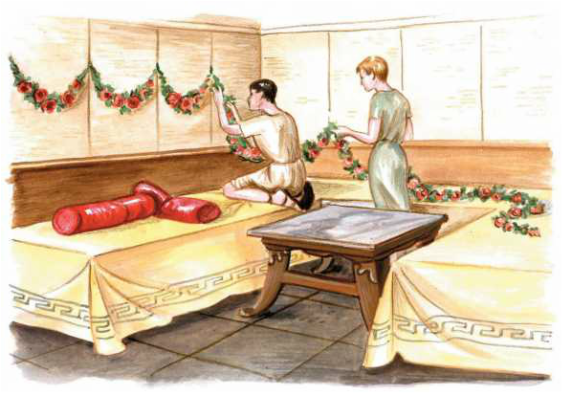
Hic Amelia “Necesse est” inquit “paulisper famem et sitim ferre, dum cibus coquitur et triclinium exornatur.”
(Servus cuius negotium est cibum coquere atque cenam parare in culina, cocus appellatur. Alii servi, ministri qui vocantur, cibum paratum e culina in triclinium portant. In triclinio sunt tres lecti, lectus summus, medius, imus, et mensa in medio. Ante convivium triclinium floribus exornatur et vestis pretiosa super lectos sternitur. Neque enim sedentes cenant Romani, sed in lectis cubantes. Quot convivae in singulis lectis accubant? In singulis lectis aut singuli aut bini aut terni convivae accuvare solent. Cum igitur paucissimi sunt convivae, non pauciores sunt quam tres, cum plurimi, non plures quam novem - nam ter terni sunt novem.)
Iulius: “Hora decima est. Cenam iam pridem paratam esse oportuit! Nimis tardus est iste cocus!”
Aemilia: “Tuumne hoc negotium est an meum? Uter nostrum in culina praest? Nondum hora decima est. Patienter exspecta, dum servi lectos sternunt. Cenabimus cum primum cocus cenam paraverit et servi triclinium ornaverint. Brevi cena parata et triclinium ornatum erit.”
Julius: "We will talk of country and city matters during dinner. First we shall all dine. It is already six hours that I have been without food. My stomach contracts from hunger."
Cornelius: "Six hours is nothing. A man can lack food six days, and neverthless not die from hunger."
Julius: "I doubt whether I can bear hunger so long. Lacking food for six hours is already painful. Hunger is a great evil."
Cornelius: "I do not deny that, but it is more painful to thirst, We can live without food for a long time, without water for much shorter time."
Orontes laughing says, "I can live pleasntly without water, not likewise without wine! Wine is a great good."
Cornelius: "No one denies that wine is more pleasant than water, but nevertheless I prefer to drink water than to suffer thirst. You don't prefer thirst more than drinking water do you?"
Orontes: "Certainly it is better to drink water than to suffer thirst. It is fitting to choose the lesser of evils. But I do not live pleasantly unless I enjoy good wine every day. Wine is life."
Cornelus: "We do not live to drink, but we drink to live."
Here Emilia says, "It is necessary to bear hunger and thirst a little longer, while the food is cooked and the dining-room is decorated."
(The slave whose job is to cook the food and prepare dinner in the kitchen, is called the cook. Other servants, who are called attendants, carry the prepared food from the kitchen into the dining-room. In the dining-room there are three couches, the highest couch, the middle, the lowest, and a table in the middle. Before the party the dining-room is decorated with flowers and beautiful coverings are spread out on top of the couches. For Romans do not dine sitting, but lie down on couches. How many guests lie on each couch? On each couch guests are accustomed to lie either one by one or two by two or three by three . Therefore when there are very few guests, there are no fewer than three, when very man, no more than nine - for three times three is nine.)
Julius: "It is the tenth hour. Dinner should be ready well before now! The cook is too slow!"
Emilia: "Is this your job or mine? Which of us is in charge of the kitchen? It is not yet the tenth hour. Wait patiently, while the servants decorate the couches. We will dine when first prepares dinner and the servants have decorated the dining-room. Dinner will be prepared and the dining room decorated shortly."
III
Tandem puer 'cenam paratam esse' nuntiat. “Triclinium intremus!” inquit Iulius, atque convivae laeti trclinium floribus exornatum et veste pulcherrima stratum intrant. Rosae et lilia et alia multa florum genera in mensa sparsa sunt inter vasa et pocula argentea; nec enim quidquam nisi argentur mensam decet viri nobilis. (Argentum quidem minoris pretii est quam aurum, nec vero quisquam ex vasis aureis cenat nisi homines divitissimi atque gloriosi, ut reges Orientis.)
Iulius, dominus convivii, cum Aemilia in lecto medio accumbit; in aliis duobus lectis bini convivae accumbunt: Cornelius et Fabia in lecto summo ad sinistram Iulii, Orontes et Paula ad dextram Aemiliae in lecto imo. Tum demum incipit cena.
Primum ova convivis apponuntur; deinde pisces cum holeribus; sequitur caput cenae: porcus quem Iulius ipse e grege elegit; postremo mensa secunda: nuces, uvae, varia genere malorum. Cibus optimus est atque convivis placet, maxime vero laudatur caro porci, quam minister cultro acuto secat convivis spectantibus.
“Haec caro valde mihi placet” inquit Fabia cum primum carnem gustavit, “Cocus iste sane negotium suum scit.”
“Ego cocum non laudo” inquit Orontes et salem carni aspergit, “qui sale non utitur! Optima quidem est caro, sed sale caret.” Orontes cibum sale aspergere solet, ut sitim augeat! (Sal est materia alba quae in mari et sub terra invenitur.)
Iam ministri vinum et calidam in pocula fundunt. Romani vinum cum aqua miscent neque vinum merum bibere solent. Solus Orontes, cui non placet vinum mistum, merum potat, sed is Graecus est atque libertinus. (Libertinus est qui servus fuit et liberatus est; in lecto imo accubant libertini.)
Iulius poculum tollens “Ergo bibamus!” inquit, “Hoc vinum factum est ex optimis uvis mearum vinearum. Nec vinum meum peius esse mihi videtur quam vinum illud Falernum quod vinum Italiae optimum habetur.” (Falernum est vinum ex agro Falerno, regione Campaniae.)
Statim Cornelius “Sane optimum” inquit “vinume st tuum, etiam melius quam Falernum”, itemque Fabia “Sane ita est” inquit, nam ea omnibus de rebus idem sentit quod maritus.
At Paula vinum gustans “Hoc vinum” inquit “nimis acerbum est: os mihi contrahitur. Ego vinum dulce amo; semper mel vino misceo.” Statim minister mel apportat, quod Paula in poculum suum fundit. (Mel est quod apes ex floribus quaerunt; nihil melle dulcius est.)
Iulius: “Idem non omnibus placet. Sed quidnam tu sentis, Orontes? Utrum vini genus melius esse tibi videtur, Falernum an Albanum?”
“Equidem” inquit Orontes “sententiam meam non ante dicam quam utrumque gustavero.”
Ad hoc Iulius “Recte me mones” inquit “unum vini genus parum esse in bona mensa. Profecto utrumque gustabis. Age, puer, profer Falernum quod optimum habeo! Tum demum hoc vinum cum illo comparare poterimus, cum utrumque gustaverimus. Ergo pocula exhaurite, amici! Cum primum meum vinum potaveritis, Falernum potabitis!”
Poculum Orontis primum Falerno completur, nam is iam pridem poculum suum exhausit. Deinde ministri Falernum in cetera pocula fundunt. Omnes, postquam vinum gustaverunt, idem sentiunt: vinum Falernum multo melius esse vino Albano! Cornelius et Orontes inter se aspiciunt. Neuter eorum sententiam suam aperte dicere audet.
Tum Orontes sic incipit: “Nescio equidem utrum melius sit. Dulcius quidem est Falernum, nec vero tuum vinum nimis acerbum esse censeo...”
At Cornelius prudenter “Utrumque” inquit “aeque bonum est. Neutrum melius esse mihi videtur.”
Finally a boy announces that dinner is prepared. "Let us enter the dining room!" Julius says, and the happy guests enter the dining room decorated with flowers and strewn with beautiful coverings. Roses, lillies, and many other types of flowers are spread out on the table among the silver bowls and cups; for nothing besides silver is fitting for a noble man. (Silver indeed is less valuable than gold, but no one dines on gold vessels except the very rich and glorious like the kings of the East.)
Julius, master of the party, lies with Emilia in the middle couch; in the other two couches the guests lie two by two: Cornelius and Fabia on the highest couch to Julius's left, Orontes and Paula to Emilia's right on the lowest couch. Then at last dinner begins.
First grapes are placed before the guests; then fish with vegetables; the chief part of the dinner follows: a pig which Julius himself chose from the herd; finally the second table: nuts, grapes, different kinds of apples. It is the best food and pleases the guests, but the greatest praise is of the meat of the pig, that the attendant cuts with a sharp knife with the guests watching.
"This meat pleases me greatly," Fabia says when she first tasted the meat, "The cook certainly knows his job."
"I do not praise a cook," Orontes says and sprinkles salt on the meat, "who does not use salt! It is certainly very great meat, but it lacks salt." Orontes is accustomed to sprinkle salt on his food, that he may increase his thirst! (Salt is a white substance that is found in the seas and under the ground.)
Now the attendants pour wine and hot water into cups. Romans mix wine with water and are not accustomed to drink wine unmixed. Orontes alone, who is not pleased with mixed wine, drinks unmixed, but he is Greek and a freedman. (A freedman is he who was a slave and was freed; freedmen lie on the lowest couch.)
Julius taking up his cup says, "Therefore let us drink! This wine was made from the best grapes of my vinyard. But my wine does not seem to me to be better than the Falernus wine that is held to be the best wine of Italy." (Falernus is wine from the fields of Falernus, in the Compania region.)
Immediately Cornelis says, "Certainly your wine is the best, even better than Falernus," and likewise Fabia says, "It certainly is", for she thinks the same of all things that her husband does.
But Paula tasting the wine says, "This wine is too bitter: my mouth is contracting. I love sweet wine; I always mix honey with wine." Immediately an attendant brings honey, that Paula pours into her cup. (Honey is that which bees make from flowers; nothing is sweeter than honey.)
Julius: "The same thing is not pleasing to everyone. But what do you think Orontes? Which kind of wine seems to be better to you, Falernus or Alban?"
Orontes says, "Indeed before I will give you my thought, I will taste each of them."
At this Julius says, "You advise me rightly that one kind of wine is too little on a good table. Certainly you will taste each of them. Go boy, bring out the best Falernian that I have! Then at last we can compare this wine with that one, when he have tasted both. Therefore pour out your cups friends! When first you will drink my wine, then you will drink Falernian!"
Orontes's cup was first filled with Falernian, for he had already poured out his cup. Then the attendant pours Falernian in another cup. After everyone tasted the wine, they thought the same: the Falernian wine is much better than the Alban wine! Cornelius and Orontes looked at each other. Neither of them dared to say their thoughts openly.
Then Orontes begins thus: "I do not know which is better. The Falernian is certainly sweet, but I think your wine it too bitter..."
But Cornelius carefully says, "Each is equally good. Neither seem to be better to me."
GRAMMATICA LATINA
Verbi tempora
Futurum perfectum
[A] Activum
Dux militem laudabit, si fortiter pungaverit.
'Laudabit' tempus futurum est. 'Pugnaverit' est tempus futurum perfectum. Futurum perfectum desinit in -erit (pers. III sing.), quod ad infinitivum perfecti sine -isse adicitur.
Exempla: [1] recitav|erit; [2] paru|erit; [3] scrips|erit; [4]audiv|erit.
Discipulus laudabitur si magistro paruerit et industrius fuerit: si recte scripserit, bene recitaverit et attente audiverit.
Magister: "Te laudabo si mihi parueris et industrius fueris."
Discipulus: "Quid mihi facies si piger fuero nec tibi paruero?"
Magister: "Si prave scripseris et male recitaveris nec attente audiveris, te verberabo!" Discipulus: "Ergo me laudabis si recte scripsero, bene recitavero et attente audivero."
Discipuli laudabuntur si magistro paruerint et industrii fuerint: si recte scripserint, bene recitaverint et attente audiverint.
Magister: "Vos laudabo si mihi parueritis et industrii fueritis." Discipuli: "Quod nobis facies si pigri fuerimus nec tibi paruerimus?" Magister: "Si prave scripseritis et male recitaveritis nec attente audiveritis, vos verberabo!" Discipuli: "Ergo nos laudabis si recte scripserimus, bene recitaverimus et attente audiverimus."
| Singularis | Pluralis | |
| Persona prima | -ero | -erimus |
| Persona secunda | -eris | -eritis |
| Persona tertia | -erit | -erint |
[B] Passivum
Pater gaudebit si filius a magistro laudatus erit (= si magister filium laudaverit).
Pater gaudebit si filii a magistro laudati erunt (= si magister filios laudaverit).
Pater: "Gaudebo, fili mi, si laudatus eris." Filius: "Quid mihi dabis si laudatus ero?"
Pater: "Gaudebo, filii mei, si laudati eritis." Filii: "Quid nobis dabis si laudati erimus?"
| Singularis | Pluralis | |
| Persona prima | laudatus ero | laudati erimus |
| Persona secunda | laudatus eris | laudati eritis |
| Persona tertia | laudatus erit | laudati erunt |
LATIN GRAMMAR
The times of verbs
Future perfect
[A] Active
A leader will praise a soldier if he will have fought bravely.
'Laudabit' is the future time. 'Pugnaverit' is the future perfect time. Future perfect ends in -erit (3rd pers. sing.), which is added to the perfect infinitive without -isse.
Examples: [1] He will have recited; [2] obeyed; [3] written; [4] heard.
A student will be praised if he will have obeyed the teacher and been diligent: if he will have written correctly, recited well and listened attentatively.
Teacher: "I will praise you if you will have obeyed me and been diligent."
Student: "What will you do to me if I will be lazy and not obeyed you?"
Teacher: "If you will have written incorrectly and recited poorly and not listened attentively, I will beat you!" Student: "Therefore you will praise me if I will have written correctly, recited well and listened attentively."
Students will be praised if they will have obeyed the teacher and been diligent: if they will have written correctly, recited well and listened attentively.
Teacher: "I will praise you if you will have obeyed me and been diligent." Students: "What will you do to us if we will have been lazy and not obeyed you?" Teacher: "If you will have written incorrectly and recited poorly and not listened attentively, I will beat you!" Students: "Therefore you will praise us if we will have written correctly, recited well and listened attentively."
| Singular | Plural | |
| First person | -ero | -erimus |
| Second Person | -eris | -eritis |
| Third person | -erit | -erint |
[B] Passive
A father will rejoice if his son will have been praised by the teacher (= if the teacher will praise his son).
A father will rejoice if his sons will have been praised by the teacher (= if the teacher will praise his sons).
Father: "I will rejoice, my son, if you will have been praised." Son: "What will you give to me if I will be praised?"
Father: "I will rejoice, my sons, if you will have been praised." Sons: "What will you give us if we are praised?"
| Singular | Plural | |
| First person | I will have been praised | We will have been praised |
| Second person | You will have been praised | You will have been praised |
| Third person | He will have been praised | They will have been praised |
VOCABVLA
balneum, balnei n.
hospes, hospitis m.
cena, cenae f.
iter, itineris n.
fames, famis f.
sitis, sitis f.
bonum, boni n.
triclinium, triclini n.
culina, culinae f.
cocus, coci m.
minister, minstri m.
medium, medi n.
convivium, convivi n.
conviva, convivae c.
genus, generis n.
vas, vasis n.
argentum, argenti n.
holus, holeris n.
nux, nucis f.
caro, carnis f.
sal, salis m.
calida, calidae f.
merum, meri n.
libertinus, libertini m.
mel, mellis n.
inexspectatus, a, um
tardus, a, um
diligens, diligentis
iucundus, a, um
molestus, a, um
imus, a, um
argenteus, a, um
gloriosus, a, um
acutus, a, um
merus, a, um
acerbus, a, um
dulcis, dulce
recipio, -cipere, cepi, -ceptum
salvere iubere
viso, visere, visi, visum
requiesco, -ere, -quievi, quietum
fruor, frui, fructus sum
nuntio, -are, -avi, -atus
contraho, -ere, -traxi, -tractum
praesum, -esse, -fui,
ceno, -are, -avi, cenatum
perfero, -ferre, -tuli, -latum
eligo, eligere, elegi, electum
coquo, -quere, coxi, coctum
exorno, -are, -avi, -atum
paro, -are, -avi, paratum
sterno, -nere, stravi, stratum
accubo, -cubare, -cubui, -cubitum
accumbo, -ere, -mbui, -mbitum
placeo, -cere, -cui, -citum
gusto, -are, -avi, gustatum
aspergo, -gere, -ersi, -ersum
fundo, -dere, fudi, fusum
misceo, -cere, -cui, mixtum
poto, -are, -avi, potum
libero, -are, -avi, liberatum
apporto, -are, -avi, -atum
profero, -ferre, -tuli, -latum
exhaurio, -aurire, -ausi, -austum
compleo, -ere, -evi, -etum
singuli, ae, a
bini, ae, a
terni, ae, a
circiter
diu, diutius, diutissime
paulisper
demum
pridem
equidem
sane
VOCABULARY
bath, bathroom
guest, visitor, host
dinner/supper
journey, road
hunger, famine, want
thirst
good thing
dining couch
kitchen
cook
servant, waiter
center, middle
banquet, dinner party
guest, table companion
origin, family, kind
vase, vessel, dish
silver, money
vegetables, greens
nut
meat
salt, wit
hot water, warm water
wine without water
freedman
honey, sweetness
unforeseen
slow, late
careful, industrious
delightful, pleasing
annoying, troublesome
deepest, last
silvery, made of silver
glorious, famous
sharp, sharpened
unmixed wine
bitter, sour
sweet, pleasant
to accept, to take in
to greet, to wish well
to go see, to visit
to rest, to quiet down
to delight in (+ABL)
announce, bring word
to draw together
be in charge of (+DAT)
dine, have dinner with
to carry through, suffer
to pick out, to choose
to cook
to adorn, to embellish
to prepare, to produce
to spread, to lay out
to recline at table
take a place at the table
give pleasure to (+DAT)
to taste, to sip
to sprinkle on
to pour, to scatter
to mix, to mingle
to drink, to swallow
to free, to acquit
to carry to, to import
to bring forward
to drain, to drink up
to fill up, to satisfy
one by one
two by two
three by three
around, about
long since, all day
for a short time
finally, at last, only
some time ago
for my part, truly
reasonably, certainly