CAPITVLVM VICESIMVMTWENTIETH CHAPTER
PARENTESPARENTS
I
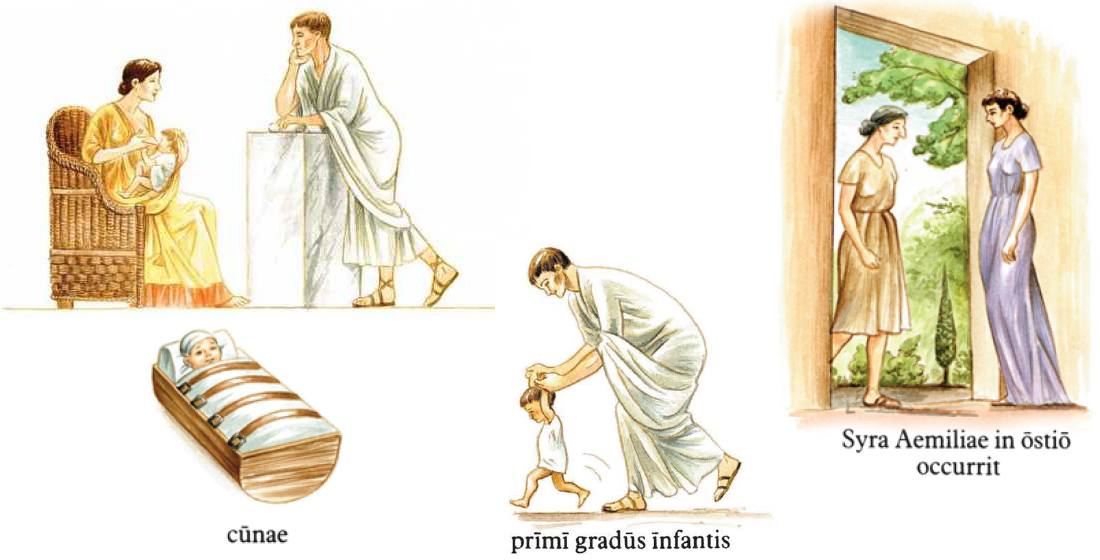
Pueri parvuli qui nondum fari possunt infantes dicuntur. Parvulus infans in cunis cubare solet. Cunae sunt lectulus infantis. Infans multas horas dormit non solum nocte, sed etiam die; nam longus somnus infanti tam necessarius est quam cibus. Infans neque somno neque cibo carere potest. Quomodo infans, qui fari non potest, cibum postulat? Infans qui cibo caret magna voce vagit. Ita parvulus infans cibum postulat. Tum mater accurrit atque infantem ad pectus suum apponit. Infans lac matris bibit. Parvulus infans, cui dentes nulli sunt, non pane, sed lacte vivit.
Si mater infantem suum ipsa alere non potest sive non vult, infans ab alia muliere alitur, quae ei in loco matris est. Mulier quae alienum infantem alit nutrix vocatur. Multi infantes Romani non a matribus suis, sed a nutricibus aluntur. Multae matres infantes suos ipsae alere nolunt.
Ante quinque annos Iulia parvula infans erat. Tunc infantem in cunis habebat Aemilia. Nunc ea parvulo infante caret: cunae vacuae sunt.
Sed post paucos menses novus infans in cunis erit. Aemilia rursus parvulum infantem habebit neque cunae vacuae erunt. Tum Iulius et Aemilia quattuor liberos habebunt. Aemilia laeta cunas movebit et parva voce cantabit: “Lalla”. Pater infantem suum in manibus portabit infantem suum aeque amabunt.
Anno post pater et mater ab infante suo appellabuntur. Aemilia autem 'mamma' appellabitur, non 'mater', neque Iulius 'pater', sed 'tata' appellabitur; neque enim infans ipsa nomina 'patris' et 'matris' dicere poterit. Infans igitur parentibus suis dicet: “Mamma! Tata!” Neque solum prima verba, sed etiam primos gradus faciet infans. Initio pater eum sustinebit ac manu ducet, mox vero infans solus ambulare incipiet neque a parentibus laetis laudabitur. Simul infans plura verba discet et mox recte loqui sciet. Utra infantem Aemiliae alet, materne an nutrix? Infans a matre aletur. Aemilia ipsa infantem vagientem ad pactus suum apponet. Infans lac matris bibet, non nutricis. Tum mater infantem in cunas in cubiculum parentum portabunt atque ante lectum eorum ponent. Si infans bene dormiet nec vagiet, parentes quoque bene dormient neque ab infante vagiente e somno excitabuntur. -
Small children who can not yet speak are called infants. Little infants are accustomed to lie down in cradles. Cradles are beds for infants. Infants sleep many hours not only at night, but also the day; for infants a long sleep is as necessary as food. Infants can neither be without sleep nor food. How can infants, who cannot speak, demand food? infants who lack food cry with loud voice. Thus small infants demand food. Then the mother comes running and places the infant at her breast. infants drink mothers milk. Small infants, who don't have teeth, live not on bread but milk.
If a mother cannot or does not wish to feed her infant herself, the infant is fed by another woman, who is in place of the mother. The woman who feeds another's infant is called a nurse. Many Roman infants are fed not by their mothers but by nurses. Many mothers do not wish to feed their infants themselves.
Five years earlier Julia was a small infant. Then Emilia had her infant in the cradle. Now lacking that little infant: the cradles are empty.
But after a few months a new infant will be in the cradle. Emilia will again have a little infant and there will not be empty cradles. Then Julius and Emilia will have four children. Emilia will happily rock the cradle and sing with a low voice: "Lalla." The father will carry his infant in his hands and will equally love his infant.
A year after they will be called father and mother by their infant. But Emilia will be called 'mama', not 'mother', Julius will be called not 'father' but 'tata'; for a infant cannot say the names 'father' and 'mother' themselves. Therefore infants call their parents: "Mama! Tata!" Not only their first words, but infants also make their first steps. In the beginning the father will sustain him and lead with his hand. At the same time infants with say more words and soon learn to speak correctly. Will Amelia's infant be fed by mother or a nurse? The infant will be fed by its mother. Emilia herself will place the crying infant to her breast. Then the mother will carry the infant into the parent's room and place it in the cradle in front of their bed. If the infant sleeps well and does not cry, the parents will also sleep well and not be roused from sleep by a crying infant.
II
Iulius adhuc in peristylo cum uxore colloquitur. Aemilia fessa in sella considit. Maritus et uxor iam non de tempore praeterito colloquuntur, sed de tempore futuro. Sermo eorum est de rebus futuris.
Iulius, qui iam intellegit Aemiliam novum infantem exspectare, “O Aemilia!” inquit, “Mox parvulum filium habebimus.”
Aemilia: “Filium? Iam duos filios habemus. Ego alteram filiam habere volo, plures quam duos filios nolo! Cur tu filium habere vis, Iuli? Nonne laetus eris, si filiolam habebis? Num parvulam filiam minus amabis quam filium?”
Iulius: “Profecto laetus ero, si alteram filiam habebo. Neminem magis amabo quam parvulum filiam.”
Aemilia: “Iam filios tuos magis amas quam tuam Iuliam filiolam: Marcum et Quintum saepe laudas, sed Iuliam raro laudas, quamquam proba est puella. Vos viri filios modo habere vultis, filias non amatis! Aemilia surgit atque gradum adversus ostium facit.
Iulius: “Mane hic apud me, Aemilia!” Aemilia alterum gradum ad ostium versus facit, tum incerta consistit.
Iulius: “Noli abire! Tecum colloqui volo.”
Aemilia non abit, sed apud maritimum manet. Coniuges colloqui pergunt. Ecce colloquium eorum:
Iulius: “Nos viri non filios tantum, sed etiam filias habere volumus, nec filias minus amamus quam filios. Certe mulieres rarius a liberis suis discedunt...”
Aemilia: “Multae matres infantes suos apud nutrices relinquunt, ego vero manebo apud infantem meum: numquam ab eo discedam! Si aegererit, ipsa eum curabo totamque noctem apud eum vigilabo; nemo infantem aegrum tam bene curare potest quam mater ipsa.”
Iulius: “Nonne ab infante sano discedes?”
Aemilia: “Minime! Bona mater semper apud infantem suum manere debet. Sive infans valet sive aegrotat, mater ipsa eum curare et alere debet - hoc est matris officium!”
Iulius: “Tune ipsa infantem tuum lacte tuo ales?”
Aemilia: “Profecto infantem meum ipsa alam. Ego faciam officium meum! Neque solum die, sed etiam nocte apud infantem ero: semper cum eo dormiam.”
Iulius: “Quid? Nos et infans in eodem cubiculo dormiemus? Vix unam horam dormire poterimus, si infans vagiet. Si tu et infans tuus in cubiculo nostro dormietis, ego profecto in alio cubiculo dormiam, ubi ab infante vagiente non excitabor!”
Aemilia: “O Iuli! Ita loquitur homo qui officium suum nescit!”
Iulius: “Meum officium est pecuniam facere ac magnam familiam alere, non cum infante vagiente cubare! Somnus viro industrio necessarius est!”
Aemilia irata “Noli pergere!” inquit, “Plura te audire nolo!” atque iterum ad ostium versus ire incipit.
“Mane, Aemilia!” inquit Iulius, “Noli ita me relinquere!” sed illa adversus ostium ire pergit.
Julius is now in the courtyard speaking with his wife. Emilia is tired sitting in the chair. Husband and wife are now speaking not of the past, but of the future. Their talk is of future things.
Julius, who now understands Emilia is expecting a new infant says, "O Emilia soon we will have a little son."
Emilia: "A son? We already have two sons. I want to have another daughter, I do not want more than two sons! Why do you wish for a son Julius? Will you not be happy if you have a little daughter? Surely you will not love a little daughter less than a son will you?"
Julius: "I will certainly be happy, if I have another daughter. I will love no one more than my little daughter."
Emilia: "Now you love your two sons more than your little daughter Julia: you often praise Marcus and Quintus, but you rarely praise Julia, even though she is a good girl. You men only want to have sons, you do not love daughters! Emilia stands up and makes a step toward the door."
Julius: "Remain here with me Emilia!" Emilia makes another step to the door, then stops uncertain.
Julius: "Do not leave! I want talk with you."
Emilia does not leave, but remains with her husband, The spouses continue to talk. Here is their conversation:
Julius: "We men don't only want to have sons, but also daughters, we do not love daughters less than sons. Certainly women leave their children more rarely..."
Emilia: "Many mothers leave their infants with nurses, but I will remain with my infant: I will never depart from it! If it is sick, I will take care of it and I will wake the whole night with it; no one can take care of a sick infant better than the mother herself."
Julius: "Will you not depart from a healthy infant?"
Emilia: "Certainly not! A good mother ought to always remain with her infant. With either a healthy or sick infant, a mother herself ought to take care of and feed it - this is a mothers duty!"
Julius: "Will you yourself feed your infant your milk?"
Emilia: "Certainly I will feed my infant myself. I will do my duty! Not only at the day but also at night I will be with my infant: I will always sleep with it."
Julius: "What? We and the infant will sleep in the same room? We can sleep barely one hour if the infant is crying. If you and the infant sleep in our room, I will certainly sleep in another room, where I will not be woken up from an crying infant!"
Emilia: "O Julius! Thus is spoken of a man who doesn't know his duty!"
Julius: "My duty is to make money and feed a large family, not to take care of a crying infant! Sleep is necessary for a working man!"
Emilia angry says, "Do not continue! I don't want to hear more from you!" and again she turns to the door to go.
"Remain Emilia!" says Julius, "Do not leave me thusly!" but she continues to go toward the door.
III
Tum vero Syra, quae eo ipso tempore peristylum intrat una cum Iulia, dominae in ostio occurrit.
Aemilia ante Syram et Iuliam consistens “Quid vultis?” inquit, “Cur non manetis in horto?”
Syra: “Quia mox imbrem habebimus: ecce caelum nubibus atris operitur. Si in horto manebimus, umidae erimus. Vos quoque umidi eritis, domini, si hic in peristylo manebitis.”
Iulius caelum spectans “Recte dicis” inquit, “Illae nubes imbrem afferent. Venite mecum in atrium! Mox sol rursus lucebit.”
Iulius atrium intrat; Aemilia eum sequitur una cum Iulia et Syra. In atrio Iulius et Aemilia silentes imbrem in impluvium cadentem aspiciunt. Iulia silentium parentum animadvertit, et “Quid siletis?” inquit, “Estisne tristes? Ego vos consolabor!”
Aemilia: “Cogitamus de... miseris nautis, quorum officium est navigare, sive mare tranquillum sive turbidum est. Multi nautae nunc in mare merguntur, dum res necessarias ex terris alienis in Italiam advehere conantur. O, miseros nautas, qui numquam domum revertentur! O, miseros liberos nautarum, qui post hanc tempestatem patre suos non videbunt!”
Iulia: “Ego laetor quod pater meus nauta non est et domi apud nos manere potest.”
Iulius, qui cras Romam ibit, “Non semper” inquit “mihi licet apud vos manere, Iulia. Necesse est mihi cras rursus a vobis discedere, nec vero in terras alienas ibo, ut nauta.”
Iulia: “Quo ibis, tata? Quando reverteris? Ego et mamma te sequemur!”
Iulius: “Quare me sequemini? Romam proficiscar, unde tertio quoque die revertar, si potero.”
Iulia: “Noli a nobis discedere! Vel si necesse erit domo abire, non modo tertio quoque die, sed cotidie ad nos reverti debes. Hoc postulo a te! Nolo te carere, tata. Cotidie tibi occurram.”
Iulius: “Audisne, Aemilia? Iulia dicit 'se patre suo carere nolle', ergo me non minus diligit quam te. Atque ego profecto filiam meam aeque diligo ac filios, nec alteram filiam minus diligam.”
Iulia: “Quam 'alteram filiam' dicis? Mihi soror non est.”
Iulio silente, Aemilia “Nonne gaudebis, Iuliola” inquit, “si parvulam sororem habebis?”
Iulia: “Sororem habere nolo! Nam si sororem habebo, ea sola a vobis amabitur, ego non amabor!”
Aemilia: “Certe tu non minus a nobis amaberis: tu et parvula soror aeque amabimini.”
Iulia: “Si aeque amabimur, laeto ero. Sed multo magis laetabor, si fratrem habebo, mamma! Nonne tu quoque laetaberis, tata, si filiolum habebis?”
Iulius silet. Aemilia vero, antequam Iulia silentium patris animadvertit, “Noli dicere 'tatam' et 'mammam', Iuliola!” inquit, “Ea nomina a te audire nolumus. Ita loquuntur parvuli infantes, nec sermo infantium te decet. 'Patrem' et 'matrem' dicere oportet.”
Iulia: “Si infans non sum, nolite me 'Iuliolam' vocare! Id nomen me non decet. Mihi nomen est 'Iulia'.”
Aemilia: “Recte dicis, Iulia. Tu igitur a nobis 'Iulia' vocaberis, et nos a te 'pater' et 'mater' vocabimur.”
Iulia: “Ita semper a me vocabimini, tata et mamma!”
But then Syra who enters the courtyard at that time together with Julia, meets the mistress at the door.
Emilia stops in from of Syra and Julius saying, "What do you want? Why are you not staying in the garden?"
Syra: "Because we will soon have rain: behold the black clouds rising in the sky. If we remain in the garden, we will be wet. You will also be wet mistress, if you remain here in the courtyard."
Julius looking at the sky says, "You speak correctly. Those clouds will bring rain. Come with me into the atrium! Soon the Sun will shine again."
Julius enters the atrium; Emilia follows him together with Julia and Syra. In the atrium Julius and Emilia silently watch the rain fall into the pool. Julia notices her parents silence and says, "Why are you silent? Are you sad? I will console you!"
Emilia: "I am thinking of... poor sailors, ,whose job it is to sail, in either calm or stormy seas. Many sailors are drowned in the sea, while trying to carry necessary things from foreign lands into Italy. O, the poor sailors, who never return home! O, the poor children of sailors, who will not see their fathers after these storms!"
Julia: "I am happy because my father is not a sailor can remain home with us."
Julius, who leaves for Rome tomorrow says, "It is not right for me to always remain with you Julia. It is necessary for me to leave from you again tomorrow, but I will not be going into a foreign land like a sailor."
Julia: "Where are you going papa? When will you return? Mama and I will follow you!"
Julius: "Why will you follow me? I am setting out for Rome, from where I will also return on the third day if I can."
Julia: "I don't want you to leave from us! Or if it will be necessary to leave your home, you ought to return to us not only on the third day too but everyday. This I demand from you! I don't want to be without you papa. I will meet you everyday."
Julius: "Do you hear Emilia? Julia says 'she does not want to be away from her father,' therefore she does not love me less than you. And I certainly love my daughter and sons equally, nor will I love another daughter less."
Julia: "What 'other daughter' are you speaking of? I do not have a sister."
With Julius silent, Emilia says, "Will you not rejoice little Julia is you will have a little sister?"
Julia: "I don't want to have a sister! For if I have a sister, she alone will be loved by you, I will not be loved!"
Emilia: "You will certainly not be loved less by us: we will love you and a little sister equally."
Julia: "If we are loved equally, I will be happy. But much happier if I have a brother mama! Will you not also be happy if you have a little son papa?"
Julius is silent. But Emilia, before Julia notices the silence of her father says, "Do not say 'papa' and 'mama' little Julia! We don't want to hear that name from you. That is the talk of little infants, infant talk is not fitting for you. It is right to say 'father' and 'mother'."
Julia: "If I am not a infant do not call me 'little Julia'! That name is not fitting for me. My name is 'Julia'."
Emilia: "You speak correctly Julia. You will therefore be called 'Julia' by us, and we will be called 'father' and 'mother' by you."
Julia: "Thus you will always be called 'mama' and 'papa' by me."
GRAMMATICA LATINA
Verbi tempora
Tempus futurum
Tempus praesens: Dies est. Sol lucet. Omnes vigilant. Nemo dormit. Aves canunt.
Tempus futurum: Mox nox erit. Sol non lucebit, sed stellae lucebunt. Omnes dormient. Nemo vigilabit. Nulla avis canet.
Futurum (pers. II): singularis -bit -et, pluralis -bunt -ent.
[A] Activum.
Exempla: [1] computa|re: computa|bit; [2] pare|re: pare|bit; [3] scrib|ere: scrib|et; [4] dormi|re: dormi|et
Malus discipulus: “Ab hoc die bonus discipulus ero, magister: numquam in ludo dormiam, semper tibi parebo, bene computabo et pulchre scribam!” Magister: “Quid? Tune bonus discipulus eris? Id fieri non potest! Cras rursus in ludo dormies, male computabis, foede scribes, nec mihi parebis!” Cras discipulus tam malus erit quam hodie est: in ludo dormiet, male computabit, foede scribet, nec magistro paarebit.
Mali discipuli: “Ab hoc die boni discipuli erimus, magister:
numquam in ludo dormiemus, semper tibi parebimus, bene
computabimus et pulchre scribemus!” Magister: “Quid? Vosne boni discipuli eritis? Id fieri non potest! Cras rursus in
ludo dormietis, male computabitis, foede seribetis, nec mihi
parebitis!” Cras discipuli tam improbi erunt quam hodie sunt:
in ludo dormient, male computabunt, foede scribent, nec magistro parebunt.
| Sing. | Plur. | Sing. | Plur. | |
| Persona prima | -bo | -bimus | -am | -emus |
| Persona secunda | -bis | -bitis | -es | -etis |
| Persona tertia | -bit | -bunt | -et | -ent |
[B] Passivum.
Filius: “Ab hoc die bonus discipulus ero. Ergo a magistro laudabor, non reprehendar.” Pater: “Tu non laudaberis, sed reprehenderis a magistro!” Cras discipulus rursus a magistro reprehendetur, non laudabitur.
Filis: “Ab hoc die boni discipuli erimus. Ergo a magistro laudabimur, non reprehendemur.” Pater: “Vos non laudabimini, sed reprehendemini a magistro!” Cras discipuli rursus a magistro reprehendentur, non laudabuntur.
| Sing. | Plur. | Sing. | Plur. | |
| Persona prima | -bor | -bimur | -ar | -emur |
| Persona secunda | -beris | -bimini | -eris | -emini |
| Persona tertia | -bitur | -buntur | -etur | -entur |
LATIN GRAMMAR
The time of the verb
Future time
Past time: It is day. The Sun shines. Everyone is awake. No one sleeps. Birds sing.
Future time: Night will be soon. The Sun will not shine, but stars will shine. Everyone will sleep. No one will be awake. No bird will sing.
Future (2 pers.): singular: -bit -et, plural -bunt -ent.
[A] Active.
Examples: [1] calculating: he will calculate, [2] obeying: he will obey; [3] writing: he will write, [4] sleeping: he will sleep
Bad student: "Teacher, from this day I will be a good student: I will never sleep in school, I will always obey you, I will calculate well and write beautifully!" Teacher: "What? You will be a good student? That cannot be done! Tomorrow you will sleep in school again, calculate poorly, write ugly, and not obey me!" Tomorrow the student will be as bad as he is today: he will sleep in school, calculate poorly, write ugly, and not obey the teacher.
Bad students: "Teacher, from this day we will be good students: we will never sleep in school, we will always obey you, calculate well and write beautifully!" Teacher: "What? You will be good students? That cannot be done! Tomorrow you will sleep in school again, calculate poorly, write ugly, and not obey me!" Tomorrow the students will be as bad as they are today: they will sleep in school, calculate poorly, write ugly, and not obey the teacher.
| Sing. | Plur. | Sing. | Plur. | |
| First person | -bo | -bimus | -am | -emus |
| Second person | -bis | -bitis | -es | -etis |
| Third Person | -bit | -bunt | -et | -ent |
[B] Passive.
Son: "From this day I will be a good student. Therefore I will be praised by the teacher, no rebuked." Father: "You will not be praised by the teacher, but rebuked!" Tomorrow the student will again be rebuked by the teacher, not praised.
Sons: "From this day we will be good students. Therefore we will be praised by the teacher, not rebuked." Father: "You will not be praised, but rebuked by the teacher!" Tomorrow the students will again be rebuked by the teacher, not praised.
| Sing. | Plur. | Sing. | Plur. | |
| First person | -bor | -bimur | -ar | -emur |
| Second person | -beris | -bimini | -eris | -emini |
| Third person | -bitur | -buntur | -etur | -entur |
VOCABVLA
infans, infantis c.
cunae, cunarum f.
somnus, somni m.
lac, lactis n.
mulier, mulieris f.
nutrix, nutricis f.
gradus, gradus m.
sermo, sermonis m.
filiola, ae f.
filiolus, i m.
colloquium, ii n.
officium, ii n.
silentium, ii n.
parvulus, a, um
necessarius, a, um
alienus, a, um
futurus, a, um (esse)
umidus, a, um
fari, fatus sum
careo, carere, carui, caritus
postulo, are, avi, atus
vagio, ire, ivi
alo, alere, alui, alitus
colloquor, colloqui, colloctus sum
volo
vis
volumus
vultis
maneo, manere, mansi, mansus
pergo, pergere, perrexi, perrectus
curo, curare, curavi, curatus
debeo, debere, debui, debitus
occurro, -rrere, -rri, occursus
sileo, silere, silui
adveho, -vehere, -vexi, -vectus
reverto, revertere, reverti
diligo, diligere, dilexi, dilectus
decet
nolo, nolle, nolui
domo
mox
magis
raro
cras
adversus
ad... versus
noli nolite
sive... sive
profecto
minime
una cum
VOCABULARY
infant
cradle
sleep
milk
woman, wife
nurse
step
conversation
little daughter
little son
talk, conversation
duty
silence
very small, tiny
necessary
foreign, someone else
about to be, future
damp, wet
speak, talk
to be without, lack
demand
wail, squall
feed, nourish
talk, converse
I want
you want
we want
you (pl.) want
remain, stay
to go on, proceed
to care for, attend to
to owe, to be indebted
to run to meet, meet
to be silent
to carry, to bring
to turn back, go back
love, be fond of
it is fitting, right
to wish not to, unwilling
at home
soon, next
more
rarely, seldom
tomorrow
toward
toward
do not
either... or
indeed, certainly
no, by no means
together with