CAPITVLVM SEXTVMSIXTH CHAPTER
VIA LATINALATIN ROAD
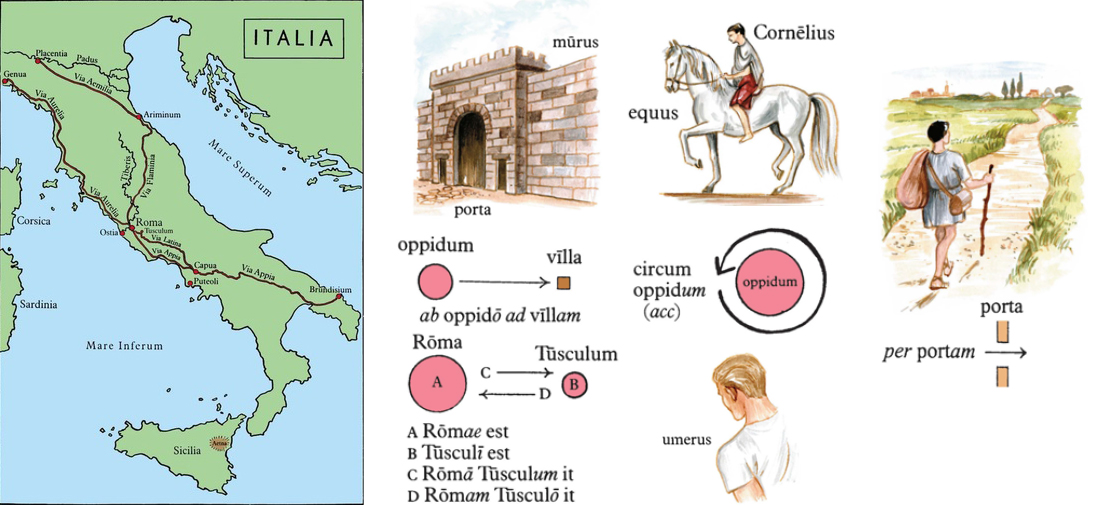
I
In Italia multae et magnae viae sunt: via Appia, via Latina, via Flaminia, via Aurelia, via Aemilia. Via Appia est inter Romam et Brundisium; via Latina inter Romam et Capuam; via Flaminia inter Romam et Ariminum; via Aurelia inter Romam et Genuam; via Aemilia inter Ariminum et Placentiam. Brundisium, Capua, Ariminum, Genua, Placentia, Ostia magna oppida sunt. Ubi est Ostia? Ostia est prope Romam. Tusculum quoque prope Romam est Brundisium non est prope Romam, sed procul ab Roma: via Appia longa est. Via Latina non tam longa est quam via Appia. Quam longa est via Flaminia? Neque ea tam longa est quam via Appia. Tiberius fluvius non tam longus est quam fluvius Padus.
Circum oppida muri sunt. Circum Romam est murus antiquus. In muro Romano duodecim portae sunt. Porta prima Romana est porta Capena. Circum oppidum Tusculum murus non tam longus est quam circum Romam.
Villa Iulii est prope Tusculum. Ab oppido Tusculo ad villam Iulii non longa via est. Ecce Iulius et quattuor servi in via. Iulius ab oppido ad villam suam it. Dominus et servi ab oppido ad villam eunt. Dominus in lectica est. Duo servi lecticam cum domino portant. Servi qui lecticam portam sunt Ursus et Davus. Iulius non in via ambulat, servi eum portant. Syrus et Leander ambulant. Syrus saccum portat et Leander quoque saccum portat: Syrus et Leander duos saccos in umeris portant. Sacci quos Syrus et Leander portant magni sunt, sed saccus quem Syrus portat non tam magnus est quam saccus Leandri. Quattuor servi dominum et duos saccos ab oppido ad villam vehunt.
Iulius in lectica est inter Ursum et Davum. Ursus est ante Iulium, Davus post eum est. Syrus et Leander non ante lecticam, sed post lecticam ambulant. Venitne Iulius a villa? Non a villa venit. Unde venit Iulius? Ab oppido venit. Quo it Iulius? Ad villam it. Post eum Tusculum est, ante eum est villa.
Iulius solus non est, nam quattuor servi apud eum sunt. Medus non est apud dominum, nam is dominum iratum timet. Medus est malus servus qui nummos domini in sacculo suo habet. Dominus servos malos baculo verberat; itaque servi mali dominum et baculum eius timent. Davus autem bonus servus est, neque is Medum amat. Davus amicus Medi non est, nam servus bonus et servus malus non amici, sed inimici sunt. Medus est inimicus Davi. Ursus autem amicus Davi est.
In Italy there are many and great roads; the Appia road, Latin road, Flaminia roda, Aurelia road, Emilia road. The Appia road is between Rome and Brundisium; the Latin road between Rome and Capua; Flaminia road between Rome and Ariminum; Aurelia road betwen Rome and Genua; Emilia road between Ariminum and Placentiam. Brundisium, Capua, Ariminum, Genua, Placentia, Ostia are large towns. Where is Ostia? Ostia is near Rome. Tusculum is also near Rome. Brundisium is not near Rome, but far from Rome: the Appia road is long. The Latin road is not as long as the Appia road. How long is the Flaminia road? It is not as long as the Appia road. The Tiber river is not as long as the Padus river.
Around the towns there are many walls. Around Rome is an old wall. On the Roman wall there are twelve gates. The first gate is the Capena gate. The wall around the town Tusculum is not as long as that which is around Rome.
Julius's villa is near Tusculum. It is not a long way from the town of Tusculum to Julius's villa. Behold Julius and four slaves on the road. Julius is going from town to his villa. Master and slave are going from town to the villa. The master is in the sedan. Two slaves are carrying the sedan with their master. The slaves who are carrying the sedam are Ursus and Davus. Julius is not walking on the road, the slaves are carrying him. Syrus and Leander are walking. Syrus carries a bag and Leander also carries a bag: Syrus and Leander carry two bags on their backs. The bags which Syrus and Leander are carrying are large, but the bag which Syrus carries is not as large as Leander's bag. Four slaves carry the master and two bags from the town to the villa.
Julius is in the sedan between Ursus amd Davus. Ursus is in front of Julius, Davus is behind him. Syrus and Leander walk not in front of the sedan, but behind the sedan. Is Julius coming from the villa? He is not coming from the villa. From where does Julius come? He comes from the town. Where is Julius going? He is going to the villa. Behind him is Tusculum, in front of him is the villa.
Julius is not alone, for four slaves are with him. Medus is not with the master, for he fears the angry master. Medus is a bad slave who has the master's coins in his bag. The master beats bad slaves with a rod; therefore bad slaves fear the master and his rod. Davus however is a good slave, he does not love Medus. Davus is not a friend of Medus, for a good slave and a bad slave are not friends, but are enemies. Medus is Davus's enemy. Ursus however is Davus's friend.
II
Medus abest a domino suo. Estne in oppido Tusculo? Medus Tusculi non est; neque Romae est Medus, sed in via Latina inter Romam et Tusculum. Unde venit Medus? Tusculo venit, neque is ad villam Iulii it. Quo it Medus? Romam it. Tusculum post eum est, ante eum est Roma. Medus via Latina Tusculo Romam ambulat.
Etiam Cornelius, amicus Iulii, in via Latina est inter Romam et Tusculum. Unde venit Cornelius? Is non Tusculo, sed Roma venit. Quo it? Cornelius non Romam, sed Tusculum it. Rome post eum, ante eum Tusculum est. Cornelius in equo est. Equus qui Cornelium vehit pulcher est. Iulius et Cornelius ad villas suas eunt. Villa ubi Iulius habitat prope Tusculum est. Ubi habitat Cornelius? Is Tusculi habitat.
Iam Iulius prope villam suam est. Servi qui lecticam portant fessi sunt. Dominus autem fessus non est, nam is non ambulat. Iulius ab Urso et Davo portatur, itaque is fessus non est. Fessi sunt Syrus et Leander, nam ii duos magnos saccos umeris portant, neque vacui sunt sacci! Sacci qui a Syro et Leandro portantur magni sunt, sed saccus quem Syrus portat non tam magnus est quam saccus qui a Leandro portatur. Itaque Syrus non tam fessus est quam Leander. Cornelius non est fessus, nam is equo vehitur. Iulius lectica vehitur. Servi ambulant. Domini vehuntur. Medus ambulat, nam is servus est neque equum habet.
Iulius prope villam suam est. Medus autem, qui dominum iratum timet, procul a villa Iulii abest. Dominus a servo malo timetur. Medus prope Romam est; iam muri Romani ab eo videntur et porta Capena. (Is qui via Latina venit per portam Capenam Romam intrat). Cur Romam it Medus? Romam it, quia Lydia Romae habitat, nam Lydia amica eius est: Medus Lydiam amat et ab ea amatur. Medus Romam vocatur ab amica sua, quae femina est pulchra et proba. Itaque is fessus non est et laetus cantat:
Non via longa est Romam, ubi amica habitat mea pulchra. Sed id quod Medus cantat a Lydia non auditur!
Iam Iulius in villa est et ab Aemilia liberisque laetis salutatur. Cornelius Tusculi est. Medus autem Romae est ante ostium Lydiae. Medus ostium pulsat.
Lydia imperat: “Intra!”
Medus per ostium intrat et amicam suam salutat: “Salve, mea Lydia! Ecce amicus tuus qui solus Romam ad te venit.”
Lydia verbis Medi delectatur eumque salutat: “O amice, salve! Ubi est dominus tuus?”
Medus: “Iulius in villa est apud servos suos - neque is iam meus dominus est!
Verba Medi a Lydia laeta audiuntur.
Medus is away from his master. Is he in the town of Tusculum? Medus is not in Tusculum; nor is Medus in Rome, but on the Latin road between Rome and Tusculum. Where is Medus going? He comes to Tusculum, he is not going to Julius's to villa. Where is Medus going? He is going to Rome. Tusculum is behind his, Rome is in front of him. Medus walks on the Latin road from Tusculum to Rome.
Meanwhile, Cornelius, Julius's friend, is on the Latin Road between Rome and Tusculum. From where is Cornelius coming? He is not coming from Tusculum, but Rome. Where is he going? Cornelius is not going to Rome, but Tusculum. Rome is behind him, Tusculum in front of him. Cornelius is on a horse. The horse which carries Cornelius is beautiful. Julius and Cornelius are going to their villas. The villa where Julius lives is near Tusculum.Where does Cornelius live? He lives in Tusculum.
Now Julius is near his villa. The slaves who carry the sedan are tired. But the master is not tired, for he is not walking. Julius is carried by Ursus and Davus, therefore he is not tired. Syrus and Leander are tied, for they are carrying two large bags on their backs, their bags are not empty! The bags which are carried by Syrus and Leander are large, but the bag that Syrus carries is not as large as that bag which is carried by Leander. Therefore Syrus is not as tired as Leander. Cornelius is not tired, for he is carried by a horse. Julius is carried by the sedan. The slaves are walking. The master is carried. Medus is walking, for he is a slave and does not have a horse.
Julius is near his villa. But Medus, who fears his angry master, is far away from Julius's villa. The master is feared by the bad slave. Medus is near Rome; now the Roman walls and the Capena gate are seen by him. (He that enters Rome comes on the Latin road through the Capena gate). Why is Medus going to Rome? He goes to Rome, because Lydia lives in Rome, for Lydia is his girlfriend: Medus loves Lydia and is loved by him. Medus is called to Rome by his girlfriend, because she is a beautiful and good woman. Therefore he is not tired and is happy singing:
It is not a long way to Rome, where my beautiful girlfriend lives. But that which Medus sings is not heard by Lydia!
Now Julius is in the villa and is happily greeted by Emilia and the children. Cornelius is in Tusculum. But Medus is in Rome in front of Lydia's door. Medus knocks on the door.
Lydia commands: "Enter!"
Medus enters through the door and greets his girlfriend: "Hail, my Lydia! Behold your boyfriend who comes alone to Rome to you"
Lydia is delighted by the words of Medus and greets him: "O hail friend! Where is your master?"
Medus: "Julius is in the villa with his slaves - he is not my master now!"
The words of Medus are heard by a happy Lydia.
GRAMMATICA LATINA
Praepositiones
Iulius ad villam it; ad oppidum; ad ancillas.
Ursus ante Illium est; ante eum; ante villam.
Davus post Iulium est; post eum; post villam.
Via inter Romam et Capuam; inter servos.
Ostia est prope Romam; prope villam; prope eam.
Circum oppidum murus est; circum mensam.
Medus est apud amicam suam, non apud dominum.
Medus per portam Capenam Romam intrat; per ostium.
Ab, ad, ex, cet. sunt praepositiones. Praepositiones cum accusativo: ad, ante, post, inter, prope, circum, apud, per, cet.; praepositiones cum ablativo: ab/a, cum, ex, in, sine, cet. (vide cap. v).
Quo it Medus? Medus Romam it. Quo it Cornelius?
Is Tusculum it.
Unde venit Cornelius? Cornelius Roma venit. Unde venit Medus? Is Tusculo venit.
Ubi habitat Lydia? Lydia Romae habitat. Ubi habitat Cornelius? Is Tusculi habitat.
Accusativus: Romam, Tusculum, Capuam, Brundisium, Ostiam = ad oppidum -am/-um.
Ablativus: Roma, Tusculo, Capua, Brundisio, Ostia = ab oppido -a/-o.
Locativus (= genetivus): Romae, Tusculi, Capuae, Brundisii, Ostiae = in oppido -a/-o.
Verbum activum et passivum
Servus saccum portat
= Saccus portatur a servo
Servi saccos portant
= Sacci portantur a servis
'Portat portant' verbum activum est. 'Portatur portantur' est verbum passivum. Activum: -t -nt. Passivum: -tur -ntur.
Exempla:
[1] -atur -antur: Aemilia Iulium amat et ab eo amatur. Pater et mater liberos amant et ab iis amantur. Lydia verbis Medi delectatur.
[2] -etur -entur: Iulia pueros non videt neque ab iis videtur. Pueri Iuliam non vident neque ab ea videntur.
[3] -itur -untur: Davus sacculum in mensa ponit = sacculus in mensa ponitur a Davo. Pueri rosas in aqua ponunt = rosae a pueris in aqua ponuntur. Cornelius equo vehitur.
[4] -itur -iuntur: Iulia pueros audit neque ab iis auditur = pueri a Iulia audiuntur neque eam audiunt.
LATIN GRAMMAR
Prepositions
Julius goes to the villa; to the town; to the handmaids.
Ursus is in front of Julius; in front of him; in front of the villa.
Davus is behind Julius; behind him; behind the villa.
The road between Rome and Capua; between the slaves.
Ostia is near Rome; near the villa; near it.
The wall is around the town; around the table.
Medus is with his girlfirend, not with his master.
Medus enters Rome through the Capen gate; through the door.
From, to, out of, are prepositions. Prepositions with the accusative: to, in front of, behind, between, near, around, with, through; prepositions with the ablative: from, with, out of, in, without (see ch. 5)
Where is Medus going? Medus goes to Rome. Where is Cornelius going?
He is going to Tusculum.
From where is Cornelius coming? Cornelius comes from Rome. From where is Medus coming? He is coming from Tusculum.
Where does Lydia live? Lydia lives in Rome. Where does Cornelius live? He lives in Tusculum.
Accusative: Romam, Tusculum, Capuam, Brundisium, Ostiam = to the town -am/-um.
Ablative: Roma, Tusculo, Capua, Brundisio, Ostia = from the town -a/-o.
Locative: (- genetive): Romae, Tusculi, Capuae, Brundisii, Ostiae = in the town -a/-o.
Active and passive verb
The slave carries the bag
= The bag is carried by the slave
The slaves carry the bags
= The bags are carried by the slaves
'Portat portant' is an active verb. 'Portatur portantur' is a passive verb. Active: -t -nt. Passive: -tur -ntur.
Examples:
[1] -atur -antur. Emilia loves Julius and is loved by him. Father and mother love the children and are loved by them. Lydia is delighted by Medus's words.
[2] -etur -entur: Julia does not see the boys nor is she seen by them. The boys do not see Julia nor are they seen by her.
[3] -itur -untur: Davus places the bag on the table = the bag is placed on the table by Davus. The boys place the roses in water = the roses are placed in water by the boys. Cornelius is carried by a horse.
[4] -itur -iuntur: Julia hears the boys but is not heard by them = the boys are heard by Julia but they do not hear her.
VOCABVLA
via, ae f.
murus, i m.
porta, ae m.
lectica, ae f.
saccus, i m.
umerus, i m.
amicus, i m.
inimicus, i m.
equus, i m.
amica, ae f.
longus, a, um
malus, a, um
fessus, a, um
duodecim
it
eunt
portat
ambulat
vehit
timet
tam
quam
inter
prope
procul ab
circum
ad
ante
post
a
apud
per
nam
itaque
autem
unde?
quo?
praeposito
locativus
activum
passivum
VOCABULARY
road; way
wall
door; gate
sedan chair
sack; bag
shoulder
friend (masculine)
enemy
horse
friend (feminine)
long
bad; evil
tired
twelve
he, she, or it goes
they go
he, she, or it carries
he, she, or it walks
he, she, or it rides; carries
he, she, or it fears
so, so much as; as
how; than
between; among; during
near
far away, far away from
around
to, toward
before, in front of
behind, after
by, from
beside, near, by
through, by means of
for
therefore
but, however
from where
where (to)?
preposition
locative
active
passive