CAPITVLVM VICESIMVM QVINTVMTWENTY-FIFTH CHAPTER
THESEVS ET MINOTAVRVSTHESEUS AND THE MINOTAUR
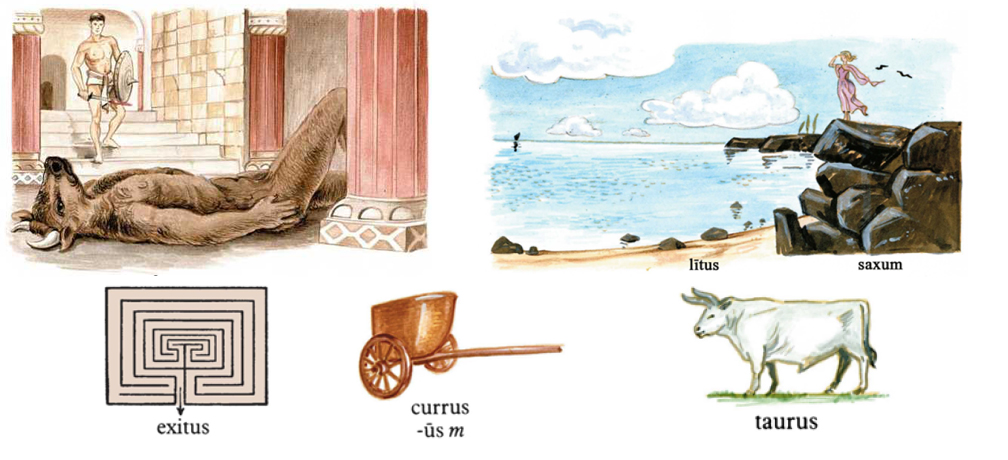
I
Syra, postquam facta Marci narravit, abire vult, sed Quintus “Noli” inquit “me relinquere! Te hic manere volo. Narra mihi aliquam fabulam!
Syra: “Quam fabulam me tibi narrare vis? Fabulamne de lupo et et agno qui forte ad eundem rivum venerunt? an fabulam de puero qui cupivit regere equos qui currum Solis per caelum trahunt?”
Tacente Quinto, Syra pergit: “An cupis audire fabulam de Achille, duce Graecorum, qui Hectorem, ducem Troianum, interfecit atque corpus eius mortuum post currum suum traxit circum moenia urbis Troiae? an fabulam de Romulo, qui prima moenia Romana aedificavit...”
Quintus:”...et Remum fratrem interfecit quia moenia humilia deridebat! Omnes istas fabulas antiquas saepe audivi. Iam vero nec de hominibus nec de bestiis audire cupio. narra mihi fabulam de aliquo feroci monstro, cui caput bestiae et corpus hominis est et quod homines vivos vorat! Talem fabulam audire cupio.”
Syra: “At tale monstrum te terrebit, Quinte.”
Quintus: “Noli putare me puerum timidum esse! Timor monstrorum puerum Romanum non decet!”
“Narrabo tibi fabulam de Theseo et Minotauro” inquit Syra, et sic narrare incipit:
“In insula Creta olim vivebat monstrum terribile, nomine Minotaurus, cui caput tauri, corpus viri erat. Minotaurus in magno labyrintho habitabat.”
Quintus: “Quid est labyrinthus?”
Syra: “Est magnum aedificium quod frequentibus muris in plurimas partes dividitur. Nemo qui tale aedificium semel intravit rursus illinc exire potest, etsi ianua patet. Labyrinthus ille in quo Minotaurus inclusus tenebatur, a Daedalo, viro Atheniensi, aedificatus erat. Qui iam antequam ex urbe Athenis in Cretam venit, complures res mirabiles fecerat.
“Minotaurus nihil praeter homines vivos edebat. Itaque complures adulescentes virginesque quotannis Athenis in Cretam mittebantur, qui omnes in labyrintho a monstro illo saevo vorabantur. Navis qua Athenienses illuc vehebantur vela atra gerebat, nam eo colore significatur mors.”
Syra after telling the deeds of Marcus, wanted to leave, but Quintus says "Do not leave me! I want you to remain here. Tell another story to me!"
Syra: "What tale do you want me to tell to you? The tale of the wolf and lamb who by chance came to the same river? or the tale of the boy who was eager to guide the horses who pulled the chariot of the Sun through the sky?"
With Quintus silent, Syra continues: "Or are you eager to hear the take of Achilles, leader of the Greeks, who killed Hector, leader of the Trojans, and dragged his dead body behind his chariot around the walls of the city of Troy? or the tale of Romulus who built the first Roman walls..."
Quintus: "... and his brother Remus killed because he mocked his low walls! I've heard all of these old tales often. But now I am eager to hear neither of men or of beasts, tell me a tale of some ferocious monster with the head of a beast and the body of a man and that devours men alive! I am eager to hear such a tale."
Syra: "But such a monster will terrify you Quintus."
Quintus: "Do not think me to be a timid boy! Fear of monsters is not fitting for a Roman boy!"
"I will tell you the tale of Theseus and the Minotaur," says Syra, and she begins to tell thus:
"On the island of Crete long ago lived a terrible monster named the minotaur, whose head was a bull and ate the body of men. The Minotaur lived in a large labyrinth."
Quintus: "What is a labyrinth?"
Syra: "It is a large building which is divided into many parts by many walls. No one who entered such a building once could get out of there again, even if the door is open. The labyrinth in which the Minotaur was held locked in, was built by Daedalus, a man of Athens. Before he came out of the city of Athens to Crete, he had already made many incredible things."
The Minotaur ate noting except living men. Therefore many young men and maidens were sent from Athens to Crete every year, who all were devoured by that ferocious monster in the labyrinth. The ship that carried those Athenians bore black sails for that color signified death."
II
Quintus: “Quam ob rem tot Athenienses ad mortem certam mittebantur?”
Syra: “Rex Minos, qui tunc Cretam regebat, paucis annis ante urbem Athenas bello expugnaverat. Post expugnationem urbis Minos, cupidus auri atque sanguinis, non modo magnam pecuniam, sed etiam homines vivos ab Atheniensibus postulaverat. Rex enim Atheniensibus male volebat, quod filius eius paulo ante ab iis necatus erat.
“Eo tempore Theseus, vir patriae amans atque gloriae cupidus, Athenis vivebat. Qui nuper Athenas venerat neque ibi fuerat cum urbs a rege Minoe expugnata est. Theseus, qui patrem Minotauri, taurum album, iam necaverat, novam gloriam quaerens Minotaurum ipsum quoque interficere constituit. Itaque una cum ceteris Atheniensibus navem velis atris ornatam conscendit et in Cretam profectus est. Ibi continuo regem Minoem adiit, qui eum a militibus in labyrinthum duci iussit.
“Minos autem filiam virginem habebat, cui nomen erat Ariadna. Quae cum primum Theseum conspexit, eum amare coepit constituitque eum servare.
“Ariadna igitur, antequam Theseus labyrinthum intravit, ad eum accessit et sic loqui coepit: “Contra Minotaurum ego tibi auxilium ferre non possum...” “Dei” inquit Theseus “mihi auxilium ferent contra illum. Hodie certe Minotaurum occidam atque cives meos a montro illo terribili servabo. Bonum gladium gero. Ad pugnam paratus sum.” Tum Ariadna “Hoc non dubito” inquit, “sed quomodo exitum labyrinthi postea reperies? Nemo adhuc per se viam e labyrintho ferentem repperit. Ego vero tibi auxilium feram: ecce filum a Daedalo factum quod tibi viam monstrabit. Auxilio huius fili huc ad me redibis.” Haec locuta, Ariadna Theseo filum longum dedit; atque ille “Opperire me” inquit “hic ad ianuam! Noli timere! Ego mortem non timeo. Sine timore mortis contra hostem eo. Brevi huc redibo, neque sine te, Ariadna, in patriam revertar. Illuc te mecum ducam neque umquam te relinquam. Hoc tibi polliceor.”
“Tum Theseus, filum Ariadnae post se trahens, labyrinthum intravit ac sine mora Minotaurum in medio labyrintho exspectantem petivit, quem post brevem pugnam gladio occidit. Minotauro occiso, Theseus filum Ariadnae secutus exitum labyrinthi facile repperit. Ita Theseus ob amorem patriae cives suos a monstro saevissimo servavit.
“Haec sunt quae narrantur de nece Minotauri.”
Quintus: "Why were all those Athenians sent to certain death?"
Syra: "King Minos, who ruled Crete then, conquered the city of Athens by war a few years before. After conquering the city Minos, eager for gold and blood, demanded not only a lot of money but even living men from Athens. For the kind wished evil to the Athenians because his son was killed by them a little before.
"At that time Theseus, a man eager for love and glory for his fatherland, lived in Athens. Who recently came to Athens but was not there when the city was conquered by King Minos. Theseus, who already killed the Minotaur's father, a white bull, sought new glory decided to also kill the Minotaur itself. Therefore together with other Athenians he boarded a ship adorned with black sails and set out to Crete. There immediately he went to King Minos who ordered him to be led into the labyrinth by soldiers.
"But Minos had a maiden daughter whose name was Ariadne. Who when she first caught sight of Theseus, began to love him and decided to save him.
"Therefore Ariadne, before Theseus entered the labyrinth, came up to him and thus began to say: "Against the Minotaur I cannot bring help to you..." Theseus says, "The gods will bring help to me against it. I will certainly kill the Minotaur today and save my citizens from that terrible monster. I carry a good sword. I am prepared to fight." Then Ariadne says, "I do not doubt this but how will you find the way out of the labyrinth afterwards? No one by themselves has yet has found a way out of the labyrinth. But I will help you: behold a thread made by Daedalus which will show you the way. With the help of this thread you will return to me." Saying these things, Ariadne gave a long thread to Theseus: and says to him "Wait for me here at the door! Do not fear! I do not fear death. I go against the enemy without fear of death. I will return here shortly, and not return to my fatherland without you Ariadne. I will lead you there with me and never leave you. This I promise to you."
"Then Theseus, dragging Ariadne's thread behind him, entered the labyrinth and without delay sought the Minotaur waiting in the middle of the labyrinth, who he killed after short fight with his sword. Having killed the Minotaur, Theseus easily found the way out of the labyrinth following Ariadne's thread. Thus Theseus, from love of his fatherland, saved his citizens from the very ferocious monster.
"These are the things which are told of the death of the Minotaur."
III
Hic Quintus “Perge” inquit “narrare de Theseo et Ariadna! Nonne illa Theseum secuta est?”
Syra: “Theseus e labyrintho exiens “Minotaurus necatus est” inquit, “Laetamini, cives mei! Intuemini gladium meum cruentum! Sequimini me ad portum! Ibi navis mea parata est ad navigandum.” Tum Ariadnam conspiciens “Et tu” inquit “sequere me! Proficiscere mecum Athenas!” Ariadna, quae nihil magis cupiebat, “Parata sum ad fugiendum” inquit, atque sine mora navem Thesei conscendit. Theseus navem solvit et cum filia regis navigavit Naxum; ibi vero nocte silenti Ariadnam dormientem reliquit atque ipse Naxo profectus est. Mane Ariadna e somno excitata amicum in litore quaesivit neque eum repperit. Puella misera ab humili litore in altum saxum ascendit, unde prospiciens navem Thesei procul in mari vidit. Tum, etsi vox eius a nullo audiri poterat, Ariadna amicum suum fugientem vocavit: “Theseu! Theseu! Revertere ad me!” neque ullum responsum ei redditum est praeter vocem ispius quam dura saxa reddiderunt. Brevi navis e conspectu eius abiit neque iam ullum velum in mari cernebatur. Ariadna igitur in litus descendit atque huc et illuc currens multis cum lacrimis capillum et vestem scindebat, ut homines qui maerent agere solent - ita maerebat virgo miserrima, quae a viro quem ante omnes amabat sola relicta erat inter feras insulae sicut agnus timidus inter saevos lupos.”
Quintus: “Cur Theseus amicam suam ita deseruit?”
Syra: “Tales sunt viri, mi puer. Montes auri feminis pollicentur, tum promissa obliviscuntur ac feminas sine nummo deserunt! Quis tam facile promissum obliviscitur quam vir qui feminam amavit? Ego quoque olim deserta sum ab amico pecunioso qui mihi magnas res pollicitus erat. Noli vero putare me ob cupiditatem pecuniae amavisse eum, ego eum amabam quia eum probum virum esse credebam. Etiam nunc maereo ob amorem illius viri.”
Quintus: “Obliviscere illius viri improbi qui te tam turpiter deseruit!”
Syra: “Non facile est amoris antiqui oblivisci. Sed hoc tu nondum intellegis, mi Quinte. Redeo ad narrationem fabulae, quam prope oblita sum, dum de aliis rebus loquor.
“Ariadna Naxi relicta, Theseus ad patriam suam navigabat. Interim pater eius Aegeus, rex Atheniensium, ab alto saxo in mare prospiciebat. Brevi navis filii in conspectum venit, sed navi rediens eadem vela atra gerebat quae abiens gesserat: Theseus enim post necem Minotauri vela mutare oblitus erat! Itaque Aegeus, arbitratus mortem filii eo colore significari, sine mora de saxo se iecit in mare, quod a nomine eius etiam nunc 'mare Aegaeum' vocatur.
“Post mortem regis Aegei filius eius Theseus rex Atheniensium factus est. Qui multos annos Athenas magna cum gloria rexit.”
His verbis Syra finem narrationis facit.
Here Quintus says, "Continue to tell of Theseus and Ariadne! Does she not follow Theseus?"
Syra: "Theseus going out from the labyrinth says, "The Minotaur is dead. Rejoice my citizens! Look at my bloody sword! Follow me to the harbor! There my ship is prepared to sail." Then looking at Ariadne he says "And you follow me! Depart with me to Athens!" Ariadne who desired nothing more says, "I am prepared to flee" and without delay she boarded Theseus's ship. Theseus untied his ship and sailed to Naxos with the king's daughter; but there in the silence of night left the sleeping Ariadne and set out from Naxos. In the morning Ariadne waking up from sleep sought her boyfriend on the shore but did not find him. The wretched girl climbed up from the low ground of the shore to the high rocks, looking out from there she sees Theseus's ship far away on the sea. Then, even though her voice can be heard by no one, Ariadne calls her fleeing boyfriend: "Theseus! Theseus! Return to me!" but no other answer returns to her except her own voice which returns from the hard rocks. Soon the ship went out from her sight and now nothing other than the sail on the sea was discerned. Therefore Ariadne climbed down to the shore and running here and there with many tears tore her hair and clothes, that grieving people are accustomed to do - thus the wretched grieving maiden, who by a man she loved before all others was left alone among the wild islands as a timid lamb among ferocious wolves."
Quintus: "Why did Theseus abandon his girlfriend thus?"
Syra: "Such are men my boy. Mountains of gold are promised to women, then the promises are forgotten and the women are abandoned without money! Who can forget a promise as easily as a man who loved a woman? I also long ago was left by a wealthy boyfriend who promised many things to me. But do not think that I had loved him from desire of money, I loved him because I believed him to be a good man. Even now I grieve from love of that man."
Quintus: "Forget that bad man who abandoned you so shamefully!"
Syra: "Forgetting old love is not easy. But this do not yet understand my Quintus. I will return to telling the tale, which I nearly forgot while speaking of other things."
"Leaving Ariadne at Naxus, Theseus sailed to his fatherland. Meanwhile his father Aegeus, king of the Athenians, looked out from the high rocks to the sea. Soon his son's ship came into view, but the returning ship bore the same black sales it bore when it left: for Theseus forgot to change sails after killing the Minotaur! Therefore Aegeus, thought his son's death was signified by that color, without delay threw himself from the rocks into the sea, which even now is called by his name 'The Aegean Sea'."
"After the death of king Aegeus his son Theseus was made king. Who ruled Athens for many years with great glory."
With these words Syra made an end to her telling.
GRAMMATICA LATINA
Verba deponentia
lmperativus.
| Laeta|re! = gaude! | Laeta|mini! = gaudete! |
| Intue|re! = specta! | Intue|mini! = spectate! |
| Revert|ere! = redi! | Revert|imini! = redite! |
| Parti|re! = divide! | Parti|mini! = dividite! |
“Laetare laetamini” et cetera sunt imperativi verborum deponentium. Imperativus verbi deponentis: singularis -re, pluralis -mini
LATIN GRAMMAR
Deponent verbs
Imperative
| Rejoice! | Rejoice! |
| Look! | Look! |
| Return! | Return! |
| Divide! | Divide! |
“Laetare laetamini” and others are imperative deponent verbs. Imperative deponent verbs: singular -re, plural -mini
VOCABVLA
fabula, fabulae f.
agnus, agni m.
currus, currus m.
moene, moenis n.
monstrum, monstri n.
taurus, tauri m.
labyrinthus, labyrinthi m.
aedificium, aedifici n.
mors, mortis
rex, regis m.
expugnatio, expugnationis f.
gloria, gloriae f.
auxilium, auxili n.
civis, civis c.
exitus, exitus m.
filum, fili m.
mora, morae f.
nex, necis f.
litus, litoris n.
saxum, saxi n.
conspectus, conspectus m.
cupiditas, cupiditatis f.
narratio, narrationis f.
humilis, humile
timidus, a, um
terribilis, terribile
mirabilis, mirabile
saevus, a, um
cupidus, a, um
paratus, a, um
rego, regere, rexi, rectum
traho, trahere, traxi, tractum
interfi -ere, interfeci, interfectum
aedifico, -are, -avi, aedificatum
voro, vorare, voravi, voratum
pateo, patere, patui
neco, necare, necavi, necatum
constituo, -ere, constitui, constitutum
occido, occidere, occidi, occisum
polliceor, polliceri, pollicitus sum
prospicio, -ere, prospexi, prospectum
descendo, -ere, descendi, descensum
maereo, maerere
desero, deserere, deserui, desertum
obliviscor, oblivisci, oblitus sum
coepio, coepere, coepi, coeptum
complus, compluris m.
fors, fortis f.
quotannis
olim
ibi
illuc
huc
brevi
VOCABULARY
story, tale
lamb
chariot, cart
walls, fortifications
monster
bull
labyrinth, maze
building, structure
death, corpse
king
storming, assault
glory, fame
help, assistance
fellow citizen, Roman
exit, departure, outlet
thread, string, fiber
delay, hindrance
death, murder
shore, seashore
stone
appearance, view
passion
narrative, story
low, lowly, small
timid, cowardly
frightful, terrible
wonderful, marvelous
fierce, savage
love, passion
prepared, ready
to rule, to guide
to draw, to drag
to kill, to destroy
to build, to construct
to swallow, to devour
to stand open, extend
to destroy, to kill
to set up, to place
to kill, to murder
promise
to foresee, to watch for
to descend, to go down
to grieve, to be sad
to leave, to depart
to forget
to begin, to commence
several people
fortune
every year, yearly
formerly, once
there, in that place
there, to that place
here, to this place
in a short time, shortly