CAPITVLVM UNVM ET VICESIMVMTWENTY-FIRST CHAPTER
PVGNA DISCIPVLORVMTHE STUDENT'S FIGHT
I
Ecce puer qui e ludo domum revertitur. Quis est hic puer? Marcus est, sed difficile est eum cognoscere, nam sordidus est et sanguis de naso eius fluit. Hodie mane vestimenta Marci munda erant atque tam candida quam nix nova, nunc vero sordida et umida sunt. Cur vestis Marci umida est? Vestis umida est, quod Marcus per imbrem ambulavit. Nec modo Marcus, sed etiam Titus et Sextus per imbrem ambulaverunt. Omnes discipuli vestimentis umidis domum revertuntur.
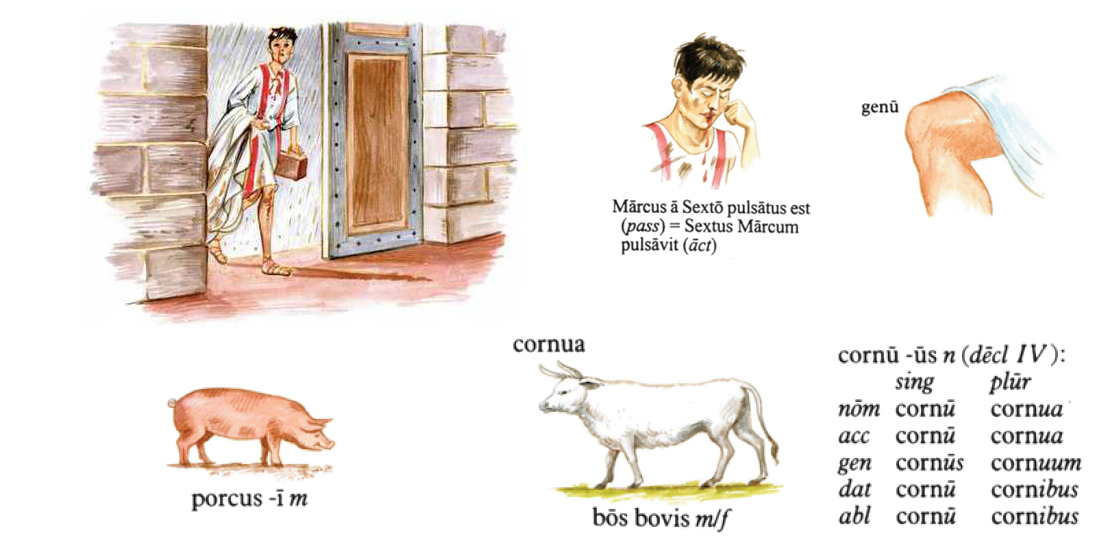
Sed cur sanguis de naso fluit Marco? Sanguis ei de naso fluit, quod Marcus a Sexto pulsatus est. Nonne Marcus Sextum pulsavit? Primum Sextus os Marci
pugno pulsavit, deinde Marcus et Titus Sextum pulsaverunt. Sextus, qui maior est quam ceteri discipuli, cum Marco et Tito pugnavit et ab iis pulsatus est. Pueri pugnaverunt in via angusta quae Tusculo ad villam Iulii fert.
Non modo vestis, sed etiam facies et manus et genua Marci sordida sunt. Cur tam sordidus est puer? Sordidus est quod humi iacuit; humus enim propter imbrem umida et sordida est. Et Marcus et Sextus humi iacuerunt. Primum Marcus iacuit sub Sexto. Titus vero Marcum vocare audivit ac Sextum oppugnavit. Mox Sextus ipse humi iacens a duobus pueris pulsatus est; magna voce patrem et matrem vocavit, nec vero parentes eum audiverunt: vox Sexti a nullo praeter pueros audita est.
Behold a boy who returns home from school. Who is this boy? It is Marcus, but it is difficult to recognize him, for he is dirty and blood flows from his nose. This morning Marcus's clothes were clean and as white as new snow, but now they are dirty and wet. Why are Marcus's clothes wet? His clothers are wet because Marcus walked through the rain. Not only Marcus,but also Titus and Sextus walked through the rain. All the students return home with wet clothes.
But why is blood flowing from Marcus's nose? Blood flows from his nose because Marcus was punched by Sextus. Did Marcus not punch Sextus? First Sextus punched Marcus's mouth with his fist, then Marcus and Titus punched Sextus. Sextus, who is bigger than the other students, fought with Marcus and Titus and was hit by them. The boys fought on the narrow road which leads from Tusculum to Julius's villa.
Not only his clothes, but also Marcus's face, hands, and knees are dirty. Why is the boy so dirty? He is dirty because he fell to the ground; for the ground is wet and dirty because of the rain. Both Marcus and Sextus fell to the ground. First Marcus fell under Sextus. But Titus Titus heard Marcus calling and attacked Sextus. Soon Sextus himself falling to the ground was hit by the two boys; called his father and mother with a loud voice, but his parents did not hear him: Sextus's voice was heard by no one except the boys.
II
Marcus atrium intrans non statim a patre suo cognoscitur, sed cum primum filius patrem salutavit, Iulius vocem filii cognoscit. Tum cruorem in facie eius conspiciens exclamat pater: “O mi fili! Quis te pulsavit?”
Marcus: “Bos iratus cornu me pulsavit!”
Iulius: “Id verum non est! Is qui te pulsavit cornua non gerit. A quo pulsatus es?”
Marcus: “A Sexto pulsatus sum.”
Iulius: “Intellegebam te non cornibus, sed pugnis pulsatum esse. At cur tu pulsatus es? Certe non sine causa Sextus te pulsavit. Incipe ab initio: ille primum a te pulsatus est!”
Marcus: “Minime! Primum ille me pugno pulsavit sine causa, deinde ego illum pulsavi!”
Iulius: “Tune solus Sextum pulsavisti?”
Marcus: “Ego et Titus eum pulsavimus.”
Iulius: “Quid? Vos duo unum pulsavistis? Duo cum uno pugnavistis?”
Marcus se et Titum excusare conatur: “At pugnavimus cum puero maiore. Solus Sextum vincere non possum, nam is multo maior ac validior est quam ego. Sextus tam validus est quam bos!”
Iulius: “Et tu tam sordidus es quam porcus! Cur sordida est vestis tua nova? Humine iacuisti?”
Marcus: “Humi iacui: Sextus me tenuit. Sed is quoque humi iacuit: nos eum tenuimus!”
Iulius: “Iam satis audivi de pugna vestra indigna. Nam certe non decet pulsare puerum minorem, sed duos pueros cum uno pugnare indignissimum est - hoc nullo modo excusari potest! Noli mihi plus narrare de hac re! Age, i in cubiculum tuum ac muta vestimenta! Davus tibi alia vestimenta dabit.”
Marcus Davum sequitur in cubiculum, ubi cruorem et sordes e facie, manibus, genibus lavat ac vestimenta mutat. Puer vestem sordidam ponit aliamque vestem mundam et candidam induit.
Interim Aemilia atrium intrat. Mater familias statim sordes et vestigia Marci in solo conspicit et “Sordidum est hoc solum!” inquit, “Aliquis pedibus sordidis in solo mundo ambulavit! Quis per ostium intravit? aliquis e familia nostra?”
“Porcus intravit!” ait Iulius.
Aemilia: “Quid ais?”
Iulius: “Porcum intravisse aio.”
Aemilia: “Ain' tu? Porcusne atrium intravit?”
Iulius: “'Porcus' qui intravit est tuus Marcus filius!” Iulius 'Marcum intravisse' dicit, at non dicit 'eum a Sexto pulsatum esse et humi iacuisse.'
Aemilia, quae iam intellegit puerum sordidum a patre 'porcum' appellatum esse, “Ubi est Marcus?” inquit, “Cur nondum me salutavit?”
Iulius: “Marcus lavatur et vestem mutat.”
Marcus entering the atrium is not immediately recognized by his father, but when the first son greets his father, Julius recognizes his son's voice. Then seeing the blood on his face the father shouts: "O my son! Who hit you?"
Marcus: "An angry ox's horn hit me!"
Julius: "That is not the truth! That which hit you did not bear a horn. By what were you hit?"
Marcus: "I was hit by Sextus."
Julius: "I knew you were not hit by horns but by a fit. But why were you hit? Certainly Sextus did not hit you without a reason. Begin from the beginning: he was first hit by you!"
Marcus: "Certainly not! First he hit me with his fist without a reason, then I hit him!"
Julius: "Did you alone hit Sextus?"
Marcus: "Titus and I hit him!"
Julius: "What? You two hit one? Two fought with one?"
Marcus trying to excuse himself and Titus: "But we fought with a larger boy. Alone I cannot overcome Sextus, for he is much bigger and stronger than I am. Sextus is as strong as an ox!"
Julius: "And you are as dirty as a pig! Why are your new clothes dirty? Did you fall on the ground?"
Marcus: "I fell to the ground: Sextus held me down. But he also fell to the ground: we held him down!"
Julius: "Now I have heard enough of your unworthy fight. For it is certainly not decent to fight a smaller boy, but two boys fighting with one is very unworthy - there can be no excuse for this! Do not tell more of this matter to me! Now, go to your room and change clothes! Davus will give other clothers to you."
Marcus follows Davus into this room, where he washes blood and dirt from his face, hands, knees and changes clothes. The boy puts down his dirty clothes and puts on other clean and white clothes.
Meanwhile Emilia enters the atrium. The families mother immediately sees only the dirt and foot prints of Marcus and says, "this floor is dirty! Someone walked with dirty feet on the clean floor! Who entered through the door? Someone from our family?"
"A pig entered!" said Julius.
Emilia: "What did you say?"
Julius: "I said a pig had entered."
Emilia: "What are you saying? Did a pig enter the atrium?"
Julius: "The 'pig' who entered was your son Marcus!" Julius says 'Marcus had entered,' but did not say that 'he had been hit by Sextus and had fallen to the ground'."
Emilia, who now understands that the dirty boy to be called a 'pig' by his father says, "Where is Marcus? Why did he not greet me yet?"
Julius: "Marcus is bathing and changing clothes."
III
Marcus, postquam vestem mutavit, mundus redit et matrem salutat.
“Salve, mi fili!” inquit mater, “Bonus es puer, quod statim vestem mutavisti. In ludone quoque bonus puer fuisti?”
Marcus: “Profecto bonus puer fui, mater. Laudatus sum a magistro.” Marcus dicit 'se bonum puerum fuisse et laudatum esse', quamquam puer improbus fuit et a magistro verberatus est. Quod dicit non verum, sed falsum est: Marcus mentitur.
Iulius: “Quid magister vos docuit hodie?”
Marcus: “Multa nos docuit: legere et scribere et computare et cetera. Primum magister nobis aliquid recitavit, nescio quid: nihil enim audivi praeter initium!” Marcus dicit 'se nihil audivisse praeter initium', id quod verum est.
Aemilia: “Qua de causa non omnia audivisti?”
Iulius: “Hahae! Magistro recitante, Marcus dormivit!” Iulius 'Marcum dormivisse' dicit, nec vero mater id credit.
Aemilia: “Audisne, Marce? Pater dicit 'te in ludo dormivisse'! Nonne falsum est quod dicit pater? Num tu vere in ludo dormivisti?”
Marcus: “Ita est ut dicit pater. Nec vero ego solus dormivi: omnes dormivimus!”
Aemilia: “Ain' vero? In ludo domivistis? Mali discipuli fuistis! Nonne puniti estis a magistro?”
Marcus: “Certe mali discipuli fuimus ac puniti sumus: omnes verberati sumus a magistro. Adhuc mihi dolet tergum. Sed paulo post magister litteras meas laudavit. Tabellam, vobis ostendam. Ecce tabella mea.”
Marcus parentibus non suam, sed alienam tabellam ostendit. Cuius est ea tabella? Sexti est: Marcus enim tabellas eorum mutavit inter pugnam! Non Marcus, sed Sextus scripsit litteras quae in ea tabella leguntur. Aemilia vero, quae tabellam Marci esse credit, a filio suo improbo fallitur. Non difficile est matrem Marci fallere!
Aemilia: “Tune ipse has litteras pulcherrimas scipsisti?”
Marcus: “Ipse scripsi profecto. Mihi crede!”
Marcus mentitur; nam id quod Marcus 'se ipsum scripsisse' dicit, a Sexto scriptum est. Sed Aemilia, quae litteras a Marco scriptas esse credit, “Aspice, Iuli!” inquit, “Marcus ipse haec scripsit et a magistro laudatus est. Quid dixit magister, Marce? Narra nobis omnia!”
Marcus iterum mentitur: “Dixit 'me pulcherrime et rectissime scripsisse'.” (Nos vero scimus magistrum aliud dixisse!)
Iulius, qui Marcum discipulum pigerrimum esse scit, iam de verbis eius dubitare incipit. Aemilia vero nihil dubitat, sed omnia credit!
Aemilia: “Ceteri discipuli nonne recte scripserunt?”
Marcus: “Minime! Titus et Sextus prave scripserunt et mali discipuli fuerunt, nec a magistro laudati sunt. Ego solus laudatus sum!”
Iulius: “Vosne omnes eadem vocabula scripsistis?”
Marcus: “Omnes eadem scripsimus, sed ego solus recte scripsi - ut iam vobis dixi.”
Iam Iulius, qui Sextum disicpulum industrium ac prudentem esse scit, Marco non credit. Marcus patrem suum fallere non potest. Ergo Iulius, qui interim tabellam in manus sumpsit, “Mentiris, Marce!” inquit, “hoc tua manu scriptum non est. Falsa sunt omnia quae nobis narravisti!”
Aemilia vero “Qua de causa” inquit “eum falsa dixisse putas? Cur non credis filio tuo?”
Sed antequam Iulius ad haec respondere potest, aliquis ianuam pulsat. Quis pulsat? Vide capitulum quod sequitur!
Marcus, after he changed his clothes, returns clean and greets his mother.
"Hail my son!", mother says, "You are a good boy, because you immediately changed clothes. Were you also a good boy in school?"
Marcus: "Certainly I was a good boy mother. I was praised by the teacher." Marcus says 'that he had been a good boy and was praised', even though he was a bad boy and was beaten by the teacher. What he says is not the truth, but it is false: Marcus is lying.
Julius: "What did the teacher teach you today?"
Marcus: "He taught us a lot: to read and write and calculate and other things. First the teacher recited something to us, I don't know what: for I heard nothing besides the beginning!" Marcus says 'he had nothing besides the beginning', but that is not true.
Emilia: "For what reason did you not hear it all?"
Julius: "Haha! Reciting by the teacher, Marcus slept!" Julius says 'Marcus had slept', but his mother does not believe it.
Emilia: "Did you hear Marcus? Your father says that 'you had slept in school'! Is not what your father says false? Surely you did not truly sleep in school did you?"
Marcus: "It is thus as father says. But not only I slept: we all slept!"
Emilia: "You speak the truth? You slept in school? You were bad students! Were you not punished by the teacher?"
Marcus: "Certainly we were bad students and we were punished: we were all beaten by the teacher. And now my backside is hurting. But a little after the teacher praised my letters. I will show my tablet to you. Here is my tablet."
Marcus does not show his but another's tablet to his parents. Whose tablet is it? It is Sextus's: for Marcus changed tablets during their fight! It was not Marcus, but Sextus who wrote the letters which they are reading on that tablet. But Emilia, who believes that to be Marcus's tablet, is deceived by her bad son. It is not difficult to deceive Marcus's mother!
Emilia: "Did you write these very beautiful letters yourself?"
Marcus: "I cetrainty wrote them myself. Believe me!"
Marcus is lying; for that which Marcus says that 'he had written it himself,' was written by Sextus. But Emilia, who believes the letters to be written by Marcus says, "Look Julius! Marcus wrote these himself and was praised by the teacher. What did the teacher say Marcus? Tell us everything!"
Marcus lies again: "He said 'I had written very beautifully and correctly'" (We know the truth that the teacher had said other things!)
Julius, who knows Marcus to be a very lazy student, now begins to doubt his words. But Emiulia doubts nothing, but believes everything!
Emilia: "Did the other students not write correctly?"
Marcus: "Certainly not! Titus and Sextus wrote incorrectly and were bad students, and they were nto praised by the teacher. I alone was praised!"
Julius: "Did you all write the same words?"
Marcus: "We all wrote the same, but I alone wrote correctly - as I already said to you."
Now Julius, who knows Sextus to be industrious and prudent, does not believe Marcus. Marcus cannot deceive his father. Therefore Julius, who took the tablet in his hands says, "You are lying Marcus! This was not written by your hand. Everything which you have told to us is false!"
But Emilia says, "For what reason do you think what he has said is false? Why don't you believe your son?"
But before Julius can give answer to this, someonee knocks on the door. Who is knocking? See the chapter that follows!
GRAMMATICA LATINA
Verbi tempora
Praeteritum perfectum et imperfectum
Nox obscura erat: nulla luna caelum illustrabat, caelum neque luna neque stellis illustrabatur.
Tum fulgur caelum illustravit; caelum obscurum fulgure clarissimo illustratum est.
“Illustrabat, illustribatur” est praeteritum imperfectum. “Illustravit, illustratum est” praeteritum perfectum est.
Perfectum
[A] Activum.
Marcus dicit “se Sextum pulsavisse”: “Ego Sextum pulsavi.” Iulius: “Tune solus eum pulsavisi?” Marcus: “Ego et Titus eum pulsavimus.” Iulius: “Vosne unum pulsavistis?” Primum Marcum pulsavit Sextus, tum Marcus et Titus eum pulsaverunt.
lnfinitivus perfecti: pulsav|isse.
| Singularis | Pluralis | |
| Persona prima | pulsav|i | pulsav|imus |
| Persona secunda | pulsav|isti | pulsav|istis |
| Persona tertia | pulsav|it | pulsav|erunt |
Exempla: [1] recita|re: recitav|isse; [2] pare|re: paru|isse; [3] scrib|ere: scrips|isse; [4] audi|re: audiv|isse
Marcus malus discipulus fuit: male recitavit, foede seripsit,
in ludo dormivit, nec magistro paruit. Sed Marcus dicit “se
bonum discipulum fuisse, bene recitavisse, pulchre scripsisse,
magistro paruisse, nec in ludo dormivisse”: “Ego bonus discipulus fui, bene recitavi, pulchre scripsi, magistro parui, nec
in ludo dormivi” Iulius: “Mentiris, Marce! Tu malus discipulus fuisti, male recitavisti, foede scripsisti, in ludo dormivisti, nec magistro paruisti!”
Marcus et Titus mali discipuli fuerunt, male recitaverunt,
foede scripserunt, in ludo dormiverunt, nec magistro paruerunt. Marcus et Titus: “Nos boni discipuli fuimus, bene recitavimus, pulchre scripsimus, magistro paruimus, nec in ludo
dormivimus!” Iulius: “Mentimini, pueri! Vos mali discipuli
fuistis, male recitavistis, foede seripsistis, in ludo dormivistis,
nec magistro paruistis!”
[B] Passivum.
Pater filium/filiam laudavit = filius laudatus est/filia laudata est a patre. Filius laudatus/filia laudata gaudet.
Pater filios/filias laudavit = filii laudati sunt/filiae laudatae sunt a patre. Filii laudati/filiae laudatae gaudent.
“Laudat|us -a -um” est participium perfecti. Participium perfecti est adiectivum declinationis I/II. Alia participia perfecti: pulsat|us, appellat|us, verberat|us, script|us, audit|us, punit|us. Cum participium perfecti cum tempore praesenti verbi 'esse' coniungitur, fit perfectum passivi.
Discipulus dicit “se laudatum esse”: “A magistro laudatus sum.” Pater: “Tune laudatus es?”
Discipuli dicunt “se laudatos esse”: “A magistro laudati sumus.” Pater: “Vosne laudati estis?”
Infinitivus: laudatum esse
| Singularis | Pluralis | |
| Persona prima | laudatatus sum | laudatatus sumus |
| Persona secunda | laudatatus es | laudatatus estis |
| Persona tertia | laudatatus est | laudatatus sunt |
LATIN GRAMMAR
Time of the verb
Perfect and imperfect past
It was a dark night: the moon was not illuminating the sky, neither the moon nor stars were illuminating the sky.
Then lightning illuminated the sky; the dark sky was illuminated by very bright lightning.
"Was illuminating. was being illuminated" is imperfect past. "Illuminated, was illuminated" is perfect past.
Perfect
[A] Active.
Marcus saying "he had hit Sextus": "I hit Sextus." Julius: "Did you alone hit him?" Marcus: "I and Titus hit him." Julius: "You hit one?" First Sextus hit Marcus, then Marcus and Titus hit him.
Perfect infinitive: to have hit
| Singular | Plural | |
| First person | I hit | we hit |
| Second person | you hit | you hit |
| Third person | he hit | they hit |
Examples: [1] recite: to have recited; [2] obey: to have obeyed; [3] write: to have written; [4] hear: to have heard
Marcus was a bad student: he recited poorly, wrote ugly, slept in school, did not obey the teacher. But Marcus says "he had been a good student, had recited well, had written beautifully, had obeyed the teacher, had not slept in school": "I was a good student, I recited well, wrote beautifully, obeyed the teacher, did not sleep in school" Julius: "You are lying Marcus! To had been a bad student, had recited poorly, had written ugly, had slept in school, had not obeyed the teacher!"
Marcus and Titus were bad students, they recited poorly, they wrote ugly, they slept in school, they did not obey the teacher. Marcus and Titus: "We were good students, we recited well, we wrote beautifully, we obeyed the teacher, we did not sleep in school!" Julius: "You are lying boys! You were bad students, you recited poorly, you wrote poorly, you slept in school, you did not obey the teacher!"
[B] Passive.
Father praised his son/daughter = son/daughter was praised by the father. The praised son/daughter rejoices.
Father praised his sons/daughters = sons/daughters are praised by the father. The praised sons/daughters rejoice.
“Laudat|us -a -um” is a perfect participle. Perfect participle is an adjective of the declension 1/2. Some perfect participles: hit, called, beaten, written, heard, punished. When a perfect participle is joined with the present tense of the verb 'esse', a perfect passive is made.
The student says "he was praised": "I was praised by the teacher." Father: "Were you praised?"
The students say "they were praised": "We were prasied by the teacher." Father: "Were you praised?
Infinitive: to have been praised
| Singular | Plural | |
| First Person | I was praised | We were praised |
| Second Person | You were praised | You were praised |
| Third Person | He was praised | They were praised |
VOCABVLA
vestis, vestis f.
genu, genus n.
humus, humi f.
cruor, cruoris m.
bos, bovis c.
cornu, cornus n.
causa, causae f.
porcus, porci m.
pugna, pugnae f.
sordes, sordis f.
solum, soli n.
tabella, tabellae f.
mundus, a, um
candidus, a, um
angustus, a, um
validus, a, um
indignus, a, um
falsus, a, um
cognosco, -ere, -ovi, cognitus
conspicio, -cere, -spexi, -spectus
excuso, -are, -avi, -atus
vinco, -ere, vici, victus
narro, -are, -avi, -atus
muto, -are, -avi, -atus
mentior, mentiri, mentitus sum
credo, -ere, credidi, creditus
fallo, fallere, fefelli, falsus
dubito, -are, -avi, dubitatus
fuisse
aio, ais, ait, aiunt
ainʼ
aliquis
aliquid
humi
interim
postquam
perfectum
imperfectum
VOCABULARY
clothes, clothing
knee
ground, soil, earth
blood-stained, bloody
ox, bull, cow
horn
cause, reason
pig, hog
battle, fight
filth, dirt
floor
small board, tablet
clean, nice, neat
bright, clean
narrow, steep, close
strong, powerful
unworthy, undeserving
wrong, false
to recognize
to observe, see, watch
to excuse
to conquer, to defeat
to tell
to change
to lie, to deceive
to trust, entrust
to deceive
to doubt
to be, exist
to say
really?
someone, anyone
something
on the ground
meanwhile
after, since
complete, finished
incomplete, unfinished