CAPITVLVM DVODETRICESIMVMTWENTY-EIGHTH CHAPTER
PERICVLA MARISDANGERS OF THE SEA
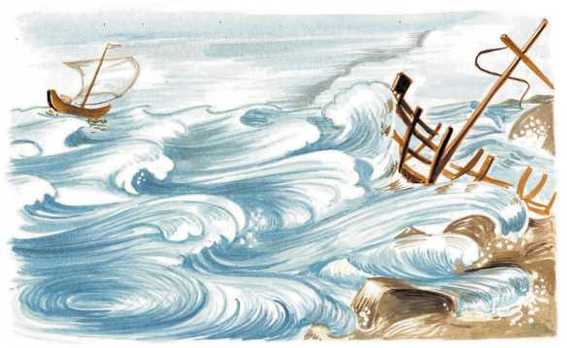
I
Interim Medus et Lydia vento secundo per mare Inferum navigare pergunt ad fretum Siculum (id est fretum angustum quo Sicilia ab Italia disiungitur). Gaudent omnes qui ea nave vehuntur praeter mercatorem cuius merces necesse fuit e nave eicere.
Medus vero multum cogitat de verbis Lydiae et de tempestate quae tam subito cessavit, postquam Lydia dominum suum invocavit. Ut tempestas mare tranquillum turbavit, ita verba Lydiae animum Medi turbaverunt.
Lydia amicum suum colorem mutavisse animadvertit et “Quid palles?” inquit, “Utrum aegrotas an territus es?”
“Non aegroto,” inquit Medus, “Corpus quidem sanum est mihi, animus vero turbatus. Quis est ille dominus tuus cui mare et venti oboedire videntur?”
Lydia: “Non meus tantum, sed omnium hominum est dominus, et Romanorum et Graecorum et barbarorum.”
Medus: “Utrum homo an deus est?”
Lydia: “Christus est Dei filius qui homo factus est. In oppido Bethlehem natus est in Iudaea, patria Iudaeorum, quae inter Syriam et Aegyptum sita est. Eo venerunt reges, qui stellam eius viderant in oriente, et invenerunt puerum cum Maria, matre eius, et adoraverunt eum velut deum. Postea Christus ipse plane demonstravit se esse filium Dei, nam discipulos docebat, quorum magna turba eum sequebatur, aegros sanabat...”
Medus: “Omnis medicus id facit.”
Lydia: "Qui medicus verbis solis potest facere ut homines caeci videant, surdi audiant, muti loquantur, claudi ambulent?"
Medus: "Potestne dominus tuus haec facere?"
Lydia: "Profecto potest. In Iudaea Iesus non solum faciebat ut caeci viderent, surdi audirent, muti loquerentur, verum etiam verbis efficiebat ut mortui surgerent et ambularent. Ex universa Iudaea homines aegri, qui famam de factis eius mirabilibus audiverant, ad eum conveniebant. Postremo tamen Iesus Christus ab improbis hominibus necatus est."
Medus: “Quid? Non vivit dominus tuus?”
Meanwhile Medus and Lydia continue sailing through the Lower Sea wtih a following wind to the straight of Sicily (that is a narrow straight which divides Sicily from Italy). Everyone rejoices who is carried by the ship except the merchant whose cargo was necessdary to throw from the ship.
But Medus is thinking much of Lydia's words and on the storm that stopped so suddenly, after Lydia called her lord. Like the storm disturbed the calm sea, thus Lydia's words disturbed the mind of Medus.
Lydia notices her boyfriend's color had changed and says, "Why are you pale? Are you sick or afraid?"
"I am not sick," says Medus, "My body is healthy, but my mind is disturbed. Who is your lord who the sea and wind seem to obey?"
Lydia: "He is not mine only, but is the lord of all men, both of Romans, Greeks, and barbarians."
Medus: "Is he man or god?"
Lydia: "Christ is the son of God made man. He was born in the town of Bethlehem in Judea, fatherland of the Jews, which sits between Syria and Egypt. Kings came to him, who saw his star in the east, and found the boy with Mary, his mother, and worshiped him as a god. Afterward Christ showed planely that he was the son of God, for he taught disciples, of whom a great multitude followed him, healing the sick..."
Medus: "All doctors can do that."
Lydia: "What doctor can with words alone make the blind see, the deaf hear, the mute speak, the lame walk?"
Medus: "Can your lord do these things?"
Lydia: "He certainly can. In Judea Jesus not only made the blind seem, the deaf hear, the mute speak, but with words even made the dead stand up and walk. From all of Judea sick mean, who heard of the fame of his amazing deeds, came to him. Ultimately Jesus Christ was nevertheless killed by wicked men."
Medus: "What? Your lord is not living?"
Lydia: “Immo vero vivit, nam tertio die Iesus surrexit a mortuis et quadragesimo die post in caelum ascendit. Immortalis est filius Dei sicut pater eius, Deus vivus. Homines mortales nascuntur ac moriuntur, Deus immortalis semper vivit. Sed ipsa male narro: ex hoc libello recitabo tibi aliquid.”
Lydia libellum, quem adhuc intra vestem occultavit, promit et Medo ostendit. Qui manum extendes libellum apprehendit et “Qui liber est iste?” inquit.
Lydia: “Scriptus est a quodam Iudaeo, nomine Mattheo, qui simul cum Christo vixit et discipulus eius fuit. In hoc libro Mattheus, qui suis oculis auribusque dominum nostrum viderat et audiverat, dicta et facta eius memorat.”
Lydia: "On the contrary he lives, for on the third day he rose from the dead and after forty days he ascended into heaven. He is the immortal Son of God as his Father, the living God. Mortal men live and die, immortal God always lives. But I tell this poorly: I will recite something from this little book for you."
Lydia takes out her little book, which until now she hid in her clothes, and shows Medus. He holds out his hand takes the book and says "What book is this?"
Lydia: "It was written by a certain Jew named Matthew, who lived at the same time with Christ and was his disciple. In this book Matthew, who with his own eyes and ears had seen and heard our master, relates his sayings and deeds."
II
Medus, qui legere non didicit, Lydiae librum reddit eamque rogat ut aliquid sibi legat; quae continuo librum evolvit et “Legam tibi” inquit “de viro claudo cui Iesus imperavit ut surgeret et tolleret lectum suum et domum ambularet.”
Medus: “Modo dixisti 'Christum etiam mortuis imperavisse ut surgent et ambularent.' Plura de ea re audire cupio.”
Lydia: “Audi igitur quod scriptum est de Iairo, principe quodam Iudaeorum, qui Iesum rogavit ut filiam suam mortuam suscitaret:
Ecce princeps unus accessit, nomine Iairus, et adorabat eum dicens: “Filia mea modo mortua est, sed veni, impone manum tuam super illam, et vivet.” Et surgens Iesus sequebatur eum cum discipulis suis. - Et veniens Iesus in domum principis, videns tibicines et turbam tumultuantem, dicebat: “Discedite! Non enim mortua est puella, sed dormit.” Et deridebant eum. Et, eiecta turba, intravit et tenuit manum eius dixit: “Puella, surge!” Et surrexit puella. Et exiit fama haec in universam terram illam.
Medus, who did not know how to read, returns the book to Lydia and asks her to read something to him; immediately she opens the book and says, "I will read to you of the crippled man who Jesus commanded to get up, take his bed and walk home."
Medus: "You just said 'Christ had even commanded the dead to stand up and walk.' I am eager to hear more of that matter."
Lydia: "Therefore listen to what was written of Jairus, a certain leading man of the Jews, who asked Jesus to revive his dead daughter:
Behold one chief came, named Jairus, and was adoring him saying: "My daughter just died, but come, place your hand upon her, and she will live." And getting up Jesus followed him with his disciples. - And Jesus coming into the chief's house, seeing the flute-players and the crowd making an uproar, said: "Depart! For the girl is not dead, but sleeping." And they mocked him. And ejecting the crowd, he entered, held her hand and said: "Stand up girl!" And the girl stood up. And this report went out into all the land.
Medus: “Per deos immortales! Si hoc verum est, princeps omnium deorum est deus tuus; neque enim ullus deus Romanus hominem mortalem ab Inferis suscitare potest - ne Iuppiter quidem tantam potestatem habet, etsi ille deus maximus habetur.”
Lydia: “Est ut dicis; nec solum deus princeps, sed Deus unus et solus est ille. Totus mundus in potestate Dei est, et caelum et terra et mare.”
Hic gubernator, qui sermonem eorum exaudivit, “Tanta” inquit, “unius dei potestas non est. Nam tres dii, Neptunus, Iuppiter, Pluto, mundum universum ita inter se diviserunt, ut Iuppiter rex caeli esset, rex maris esset Neptunus, Pluto autem regnaret apud Inferos, ubi animae mortuorum velut umbrae versari dicuntur.”
Medus: “Num quis tam stultus est ut ista vera esse credat? Perge legere e libello tuo, Lydia!”
Lydia iterum librum evolvit et “Ecce” inquit “quod narratur de Christo super mare ambulante:
Navicula autem in medio mari iactabatur fluctibus, erat enim ventus contrarius. Quarta autem vigilia noctis venit ad eos Iesus ambulans super mare. Discipuli autem videntes eum super mare ambulantem turbati sunt dicentes: “Phantasma est!” et prae timore clamaverunt. Statimque Iesus locutus est eis dicens: “Constantes estote! Ego sum. Nolite timere!” Respondens autem ei Petrus dixit: “Domine, si tu es, iube me ad te venire super aquam!” At ipse ait: “Veni!” Et discendens Petrus de navicula ambulabat super aquam, ut veniret ad Iesum. Videns vero ventum validum timuit, et incipiens mergi clamavit dicens: “Domine! Salvum me fac!” Et continuo Iesus extendens manum apprehendit eum, et ait illi: “Quare dubitasti?” Et ascendentibus eis in naviculam, cessavit ventus. Qui autem in navicula erant venerunt et adoraverunt eum dicentes: “Vere filius Dei es.”
Medus: "By the immortal gods! If this is true, your god is the leader of all the gods; for no Roman god can revive the dead from Inferno - not even Jupter has such power, even though that god is the greatest."
Lydia: "It is as you say; not only leader the chief god, but he is the one and only God. All the world is in God's power, the sky, land, and sea."
Here the steersman, who overhead their conversation says, "Such power is not one god's. For three gods, Neptune, Jupiter, and Pluto, divide the whole world among themselves. that Jupiter is king of the sky, Nepture is king of the sea, but Pluto rules among Inferno, where the souls of the dead are said to live as shadows."
Medus: "Surely you are not so stupid that you believe that to be true? Continue reading from your book Lydia!"
Lydia again opens the book and says, "Behold what is told of Christ walking upon the sea:
But the little ship was being tossed about by waves in the middle of the sea, for there was an unfavorable wind. At the fourth watch of night Jesus walked to them on top of the sea. His disciples seeing him walking upon the sea were disturbed saying: "It is a ghost!" and they cried out from fear. And Jesus immediately spoke to them saying: "Be steady! It is I. Do not be afraid!" But Peter answered and said to him: "Lord, if it is you, command me to come to you upon the water!" And he said to him: "Come!" And coming down from the boat Peter was walking upon the water, that he might come to Jesus. But he was afraid seeing the strong wind, and began sinking crying out saying: "Lord! Save me!" And immediately Jesus held out his hand taking him, and said to him: "Why do you doubt?" And climbing into the boat with them, the wind stopped. But they who were in the boat came and they were adoring him saying: "Truly you are the Son of God."
III
Gubernator, qui Medum attentum videt, “Num tu” inquit “tam stultus es ut haec credas? Mihi nemo persuadebit hominem super mare ambulare posse!”
Lydia: “Christus non est homo, sed filius Dei, qui omnia facere potest. Ipse dixit: “Data est mihi omnis potestas in caelo et in terra.” Modo nos e tempestate servavit, nonne id tibi persuasit eum habere potestatem maris et ventorum? Audi igitur quod in eodem libro narratur de potestate Christi:
Et ascendente eo in naviculam, secuti sunt eum discipuli eius. Et ecce tempestas magna facta est in mari, ita ut navicula operiretur fluctibus - ipse vero dormiebat! Et accesserunt ad eum discipuli eius et suscitaverunt eum dicentes: “Domine, salva nos! Perimus!” Ait illis Iesus: “Quid timidi estis?” Tunc surgens imperavit ventis et mari, et facta est tranquillitas magna. Homines autem mirati sunt dicentes: “Qualis est hic, quod venti et mare oboediunt ei?”
The steersman, who sees Medus attentative says, "Surely you are not so stupid to believe these things? No one will persaude me that a man can walk upon the sea!"
Lydia: "Christ is not a man, but the Son of God, who can do all things. He said himself: "All power was given to me in heaven and on earth." He just saved us from the storm, does that not persuade you that he has power of the sea and the wind? Therefore listen to what is told in the same book of the power of Christ:
And climbing into the boat, his disciples followed him. And behold a great storm was occurring on the sea that the shipped was covered by the waves - but he was sleeping! And his disciples came to him and woke him saying: "Lord save us! We will die!" Jesus said to them: "What do you fear?" Then standing up he commanded the wind and sea, and there was a great calm. And the men marvelled saying: "What is this, that the wind and sea obey him?"
Gubernator: “Mare et venti nemini oboediunt nisi Neptuno. Ille curavit ut nos e tempestate servaremue neve mergeremur - vel potius nos ipsi qui merces eiecimus. Nolite vero censere nos iam extra periculum esse. Tempestas quidem desiit, sed multa alia pericula nobis impendent, ut saxa quibus naves franguntur, voragines in quas naves merguntur, praedones maritimi qui naves persequuntur, ut merces et pecuniam rapiant nautasque occidant. Semper in periculo versamur.”
Medus: “Sed hic tuti sumus a praedonibus.”
Gubernator: “Nullum mare tutum est a praedonibus, ne mare Inferum quidem, quamquam rari huc perveniunt. Nec tuti sumus a ceteris periculis quae modo memoravi. Brevi navigabimus per fretum Siculum, ubi ab utraque parte magnum periculum impendet nautis: ab ora Italiae saxa periculosa quibus Scylla nomen est, ab ora Siciliae vorago terribilis quae Charybdis vocatur. Multae naves quae Scyllam iam vitaverant, deinde in Charybdim mersae sunt. At bonum animum habete! Ego, ut gubernator constans, curabo ut omnia pericula vitemus ac salvi in Graeciam eamus.”
Medus: “Omnes id futurum esse speramus. Quomodo eo perveniemus?”
Gubernator: “Intra sex dies, ut spero, vel potius octo. Sed cur cupidus es in Graeciam eundi? Ego Romae vivere malo quam in Graecia.”
Medus: “Num Romae mavis servire quam liber esse in Graecia?”
Gubernator: “Nos cives Romani mori malumus quam servire!”
Medus: “Noli putare me servire malle, nam ego quoque liber natus sum, nec quisquam qui liber fuit libertatem sperare desinit. In Italia domino severo serviebam, qui a me postulabat ut opus sordidum facerem nec mihi peculium dabat. Si quid prave feceram, dominus imperabat ut ego ab aliis servis tenerer et verbararer. Sed heri e villa fugi, ut verbera vitarem, atque ut amicam meam viderem ac semper cum ea essem. Multis promissis ei persuasi ut mecum ex Italia proficisceretur, Lydia enim Romae vivere mavult quam in Graecia. Ostia igitur hanc navem conscendimus, ut in Graeciam navigaremus.”
Gubernator Lydiam interrogat: “Tune quoque domino Romano serviebas?”
Steersman: "The sea and wind obey no one except Neptune. He took care that we were saved from the storm and not drowned - or rather we who throw over the cargo. But do not think us to be out of danger already. The storm has certainly stopped, but many other dangers await us, like the rocks which break ships, whirlpools in which ships sink, sea pirates who follow ships in order to carry off cargo and money and kill the sailors. We are always in danger."
Medus: "But we are safe here from pirates."
Steersman: "No sea is safe from pirates, not even the lower sea, even though they rarely come through here. But we are not sage from other dangers which I just remembered. Shortly we will sail through the straight of Sicily, where from one of two dangerous parts await ships: by the coast of Italy dangerous rocks which is named Scylla, by the coast of Sicily a terrible whirlpool that is called Charybdis. Many ships that have avoided Scylla, then are submerged in Charybdis. But have a good spirit! I, as a steady steersman, will take care that we avoid all dangers and arrive save in Greece."
Medus: "We all hope it's going to be. When will we arrive?"
Steersman: "Within six days or rather eight I hope. But why are you eager to go to Greece? I want to live in Rome more than in Greece."
Medus: "Would you rather be a slave in Rome that be free in Greece?"
Steersman: "We citizens of Rome would rather be dead than be slaves!"
Medus: "Do not think that I want to be a slave, for I was also born free, and no one who was free stops hoping for freedom. In Italy I served a strict master, who demanded from me that I do the dirty work but he did not give me money. If I did that incorrectly, the master commanded that I be held and beaten by other slaves. But yesterday I fled from the villa, in order that I avoid the beatings, and that I see my girl friend and that I always be with her. I made many promises to her to persuade her to depart from Italy with me, for Lydia wants to live in Rome more than in Greece. Therefore we boarded his ship in Ostia in order that we may sail to Greece."
The steersman asks Lydia: "Were you also a slave to a Roman master?"
Lydia: “Minime vero. Ego nemini servio nisi domino nostro qui est in caelis. Nemo potest duobus dominis servire. Certe non laeto animo Roma profecta sum, et difficile fuit mihi persuadere ut amicas meas Romanas desererem. Nec promissis solis Medus mihi persuasit ut secum venirem, sed etiam dono pulcherrimo. Ecce anulus aureus gemmatus quem amicus meus prope centum sestertiis emit mihi.” Lydia manum extendens digitum anulo aureo ornatum gubernatori ostendit.
Gubernator anulum tam pulchrum admiratur, tum conversus ad Medum “Profecto” inquit “dives esse videris, ut servus! Num dominus ille severus, qui tibi imperabat ut opus sordidum faceres, tantum peculium tibi dabat pro opere sordido?”
Medus rubens nescit quid respondeat, et velut homo surdus mutusque ante eos stat.
Lydia: “Quin respondes? Sacculum prompsisti pecuniae plenum - nonne tua erat ista pecunia?”
Medus turbatus, dum oculos Lydiae vitare conatur, mercatorem celeriter accedere videt.
Lydia: "Certainly not. I serve no one besides our lord who is in Heaven. No one can serve two masters. Certainly I am not happy departing from Rome, and it was difficult to persuade me to leave my Roman friends. But Medus persuaded me to come with then not with promisses alone, but also with a very beautiful gift. Behold the gold gemmed ring that my botfriend bought for me for almost a hundred sestertii." Lydia holds out her hand showing the steersman the gold ring decorating her finger.
The steersman marvels at such a beatiful ring, then turning to Medus days, "You certainly seem to be rich for a slave! Surely that strict master, who commanded you to do dirty work, gave you a lot of money for that dirty work didn't he?"
Medus red does not know how to answer, and stands like and deaf and mute man before them.
Lydia: "Why don't you answer? That bag you picked up was full of money - was that money not yours?"
Medus disturbed, while trying to avoid the eyes of Lydia, sees the merchant quickly approaching.
GRAMMATICA LATINA
Coniunctivus
Tempus imperfectum
[A] Activum
Dominus servum monet ut sibi pareat
Dominus servum monebat/monuit ut sibi pareret
'Pareat' est coniunctivus praesentis. 'Pateret' coniunctivus imperfecti est. Coniunctivus imperfecti (pers. III sing.) -ret.
Exempla: '[I] recita|re: recita|ret; [2] tace|re: tace|ret; [3] scrib|ere: scrib|eret; [4] audi|re: audi|ret.
Magister discipulum monuit ut taceret et audiret et studiosus esset. Tum ei imperavit ut scriberet et recitaret.
Pater: "Nonne magister tibi imperavit, fili, ut scriberes et recitares?" Filius: "Primum me monuit ut tacerem et audirem et studiosus essem, tum mihi imperavit ut scriberem et recitarem." Pater: "Num necesse erat te monere ut taceres et audires et studiosus esses?"
Magister discipulos monuit ut tacerent et audirent et studiosi essent. Tum imperavit ut scriberent et recitarent.
Pater: "Nonne magister vobis imperavit, filii, ut scriberetis et recitaretis?" Filii: "Primum nos monuit ut taceremus et audiremus et studiosi essemus, tum nobis imperavit ut scriberemus et recitaremus." Pater: "Num necesse erat vos monere ut taceretis et audiretis et studiosi essetis?"
| Singularis | Pluralis | |
| Persona prima | -rem | -remus |
| Persona secunda | -res | -retis |
| Persona tertia | -ret | -rent |
[B] Passivum
Dominus imperavit ut servus teneretur et verberaretur, deinde ut vinciretur et includeretur.
Dominus imperavit ut servi tenerentur et verberarentur, deinde ut vincirentur et includerentur.
Medus: "Salvus sum. Neptunus curavit ut ego e periculo servarer neve in mare mergerer." Lydia: "Noli putare Neptunum curavisse ut tu servareris neve mergereris. Nemo nisi Christus curavit ut nos e periculo servaremur neve in mare mergeremur." Gubernator: "Ego bene gubernando cflravi ut vos servaremini neve mergeremini"
| Singularis | Pluralis | |
| Persona prima | -rer | -remur |
| Persona secunda | -reris | -remini |
| Persona tertia | -retur | -rentur |
LATIN GRAMMAR
VOCABVLA
fretum, freti n.
animus, animi m.
turba, turbae f.
fama, famae f.
libellus, libelli m.
dictum, dicti n.
princeps, principis m.
tibicen, tibicinis c.
potestas, potestatis f.
mundus, mundi m.
navicula, naviculae f.
vigilia, vigiliae f.
phantasma, phantasmatis n.
tranquillitas, tranquillitatis f.
vorago, voraginis f.
periculum, periculi n.
praedo, praedonis m.
peculium, peculim n.
caecus, a, um
surdus, a, um
mutus, a, um
claudus, a, um
universus, a, um
mortalis, mortale
immortalis, immortale
constans, constantis
salvus, a, um
attentus, a, um
tutus, a, um
periculosus, a, um
quadragesimus, a, um
disiungo, -gere, -iunxi, disiunctum
eicio, eicere, eici, eictum
cesso, -are, -avi, cessatum
oboedio, -dire, -divi, oboeditum
adoro, -are, -avi, adoratum
nascor, nasci, natus sum
morior, mori, mortuus sum
extendo, -dere, -di, extentum
apprehendo, -ere, -i, apprehensum
memoro, -are, -avi, memoratum
rogo, rogare, rogavi, rogatum
evolvo, -vere, evolvi, evolutum
suscito, -are, -avi, suscitatum
tumultuor, -ari, tumultuatus sum
habeo, habere, habui, habitum
regno, -are, regnavi, regnatum
versor, versari, versatus sum
persuadeo, -suadere, -suasi, persuasum
salvo, salvare, salvavi, salvatum
pereo, perire, perivi, peritum
salvo, salvare, salvavi, salvatum
pereo, perire, perivi, peritum
impendeo, impendere, -, -
pervenio, -venire, -veni, perventum
vito, vitare, vitavi, vitatum
spero, -are, -avi, speratum
servio, servire, servivi, servitum
malo, malle, malui, -
admiror, admirari, admiratus sum
potius
utrum
velut
VOCABULARY
straight
courage, soul, mind
crowd, mob
reputation, rumor
small book
saying, maxim
foremost, chief
flute player
power, strength
universe, world
small ship
4th watch of the night
ghost, spirit
stillness, tranquility
deep hole (in the water)
danger, risk
pirate
small savings
blind, unseeing
deaf, muffled
mute, silent
lame, crippled
all, whole, entire
mortal, human
immortal, imperishable
steady, stable
saved, safe
attentive, heedful
safe, secure
dangerous, hazardous
fortieth
divide, separate
to throw out
to be remiss, cease
to obey, to be subject
to honor, to adore
to be born, to be alive
to die, to decay
to extend, to stretch out
to seize, to grasp
to mention, to remind
to ask for, to invite
to unfold, to open
to rouse, to kindle
to make a commotion
to think, to consider
to be king, to reign
to move about
to persuade, convince
save
to die, to be ruined
save
to die, to be ruined
to threaten, to impend
to reach, to arrive
to avoid, to shun
to hope, to trust
serve
to prefer
to admire, to respect
rather
...or...? whether...or
like, as