CAPITVLVM DVODEVICESIMVMEIGHTEENTH CHAPTER
LITTERAE LATINAETHE LATIN LETTERS
I
Discipuli non modo numeros, sed etiam litteras discunt. Parvi discipuli, ut Marcus et Titus et Sextus, litteras Latinas discunt. Magni discipuli litteras Graecas et linguam Graecam discunt. Lingua Graeca difficilis est.
Ecce omnes litterae Latinae, quarum numerus est viginti tres, ab A usque ad Z: A, B, C, D, E, F, G, H, I, K, L, M, N, O, P, Q, R, S, T, V, X, Y, Z. Litterae sunt aut vocales aut consonantes: vocales sunt A, E, I, O, V, Y; ceterae sunt consonantes (Etiam I et V consonantes sunt in vocabulis IAM, VEL, VOS, QVAM, cet.)
Litterae Y et Z in vocabulis Graecis modo reperiuntur (ut in hoc vocabulo zephyrus, id est nomen venti qui ab occidente flat). Y et Z igitur litterae rarae sunt in lingua Latina, in lingua Graeca frequentes. K littera, quae frequens est in lingua Graeca, littera Latina rarissima est, nam K in uno vocabulo Latino tantum reperitur, id est kalendae (itemque in praenomine Kaeso, quod praenomen Romanorum rarissimum est).
Hoc vocabulum amica quinque litteras habet et tres syllabas: a-mi-ca. Quaeque syllaba vocalem habet, ergo numerus syllabarum et vocalium idem est. In prima et in postrema syllaba huius vocabuli eadem vocalis est: a. Vocalis est littera quae per se syllabam facere potest, ut a syllabam primam facit in vocabulo amica. Sine vocali syllaba fieri non potest. Consonans per se syllabam non facit, sed semper cum vocali in eadem syllaba iungitur. In exemplo nostro m cum i iungitur in syllaba secunda mi, et c cum a in syllaba tertia ca.
Cum syllabae iuguntur, vocabula fiunt. Cum vocabula coniunguntur, sententiae fiunt. Ecce duae sententiae: Lingua in ore inest et Lingua Latina difficilis est. Vocabulum primum utriusque sententiae idem est, sed hoc idem vocabulum duas res varias significat. Item varia vocabula eandem rem vel eundem hominem significare possunt, ut ostium et ianua, dominus et erus (sed erus est vocabulum multo rarius quam dominus).
Qui litteras nescit legere non potest. Magister, qui pueros legere docet, ipse et libros Latinos et Graecos legere potest, nam is utramque linguam scit. Quomodo parvus discipulus hanc sententiam legit: Miles Romanus fortiter pugnat? Discipulus quamque littram cuiusque vocabuli sic legit: “M-I mi, L-E-S les: mi-les, R-O Ro, M-A ma, Ro-ma-, N-V-S nus: Ro-ma-nus...” Ita quodque vocabulum cuiusque sententiae a discipulo legitur. (In hac sententia vocabulum fortiter novum est, sed qui vocabulum fortis scit, hoc vocabulum quoque intellegit, nam miles fortis est miles qui fortiter pugnat.)
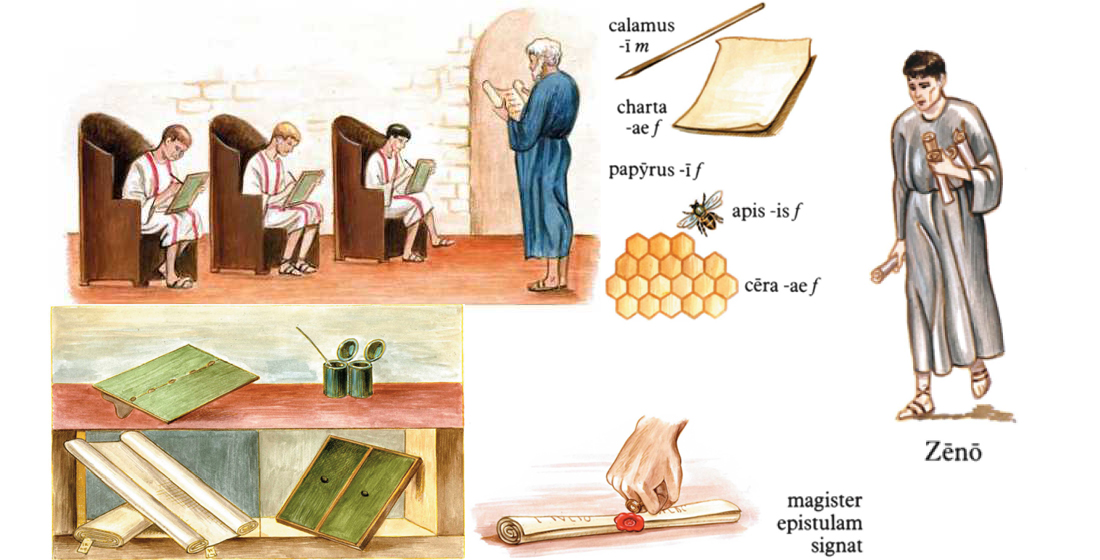
In ludo pueri non modo legere, sed etiam scribere discunt. Quisque discipulus in tabula sua scribit eas sententias quas magister ei dictat. Ita pueri scribere discunt.
Magister discipulis imperat: “Promite regulas vestras et lineas rectas ducite in tabulis. Tum scribite hanc sententiam: Homo oculos et nasum habet.”
Quisque puer stilum et regulam promit et ducit lineam rectam in tabula sua; tum scribere incipit. Discipuli eandem sententiam non eodem modo, sed variis modis scribunt. Sextus unus ex tribus pueris recte scribit: HOMO OCVLOS ET NASVM HABET. Titus sic scribit: HOMO HOCVLOS ET NASVM HABET. Marcus vero sic: OMO OCLOS ET NASV ABET.
Students learn not only numbers, but also letters. Little students, like Marcus, Titus, and Sextus, learn Latin letters. Big students learn Greek letters and the Greek language. The Greek language is difficult.
Here are the Latin letters, of which the number is thirty, from A all the way to Z: A, B, C, D, E, F, G, H, I, K, L, M, N, O, P, Q, R, S, T, V, X, Y, Z. Letters are either vowels or consonants: the vowels are A, E, I, O, V, Y; the others are consonants (Also I and V are consonants in the words NOW, OR, YOU, WHAT, etc).
Letters Y and Z are only found in Greek words (like in this word zephyrus, that is the name of the wind which blows from the west). Y and Z are therefore rare letters in the Latin language, frequent in the Greek language. The letter K, which is frequent in the Greek language, is the most rare among Latin letters, for K is only found in one Latin word, that is Kalends (likewise in the praenomen Kaeso, which is the rarest Roman praenomen).
This word 'amica' has five letters and three syllables: a-mi-ca. Each syllable has a vowel, there the number of vowels and syllables is the same. In the first and last syllable of this word is the same vowel: a. A vowel is the letter by which through it a can make a syllable, like from the first syllable is made in the word 'amica'. Without vowels syllables cannot be made. Consonants do not make syllables through them, but is always joined with the vowels in the same syllable. In our example m is joined with i in the second syllable mi, c with a in the third syllable ca.
When syllables are joined, words are made. When words are joined together, sentences are made. Here are two sentences: The tongue is in the mouth and Lingua Latina is difficult. The first word is both sentences is the same, but this same word has two different meanings. Likewise in different words the same thing or same person can be meant, like door and door, master and master )but 'erus' is a much more rare word than 'dominus'.
He who does not know letters cannot read. A teacher, who teachers boys to read, himself can read Latin and Greek books, for he knows both languages. How does a little student read this sentence: A Roman soldier fights bravely? The student reads each letter of the words thusly: "M-I mi, L-E-S les: mi-les, R-O Ro, M-A ma, Ro-ma-, N-V-S nus: Ro-ma-nus..." Thus each word of the sentence is read by the student. (In this sentence bravely is a new word, but he who knows the word brave, can also understand this word, for a soldier is brave who fights bravely).
In school boys not only learn to read, but also to write. Each student writes in his tablet the sentences which the teacher dictates to him. Thus boys learn to write.
The teacher commands the students: "Take out your rulers and draw a straight line on your tablets. Then write this sentence: A man has eyes and a nose."
Each boy takes out a pencil and ruler and draws a straight line on his tablet; then begins to write. The students write the same sentence not the same way, but different ways. Sextus is the one that writes correctly of the three boys: HOMO OCVLOS ET NASVM HABET. Titus writes thus: HOMO HOCVLOS ET NASVM HABET. But Marcus thus: OMO OCLOS ET NASV ABET.
II
Magister: “Date mihi tabulas, pueri!”
Discipuli magistro tabulas suas dant. Is tabulam cuiusque pueri in manus sumit litterasque eorum aspicit. Quales sunt litterae Sexti? Pulchrae sunt. Quales sunt litterae Marci et Titi? Litterae eorum foedae sunt ac vix legi possunt. Magister suam cuique discipulo tabulam reddit, primum Sexto, tum Tito, postremo Marco, atque “Pulchre et recte scribis, Sexte” inquit, “Facile est tales litteras legere. At litterae vestrae, Tite et Marce, legi non possunt! Foede scribitis, pigri discipuli!” Magister Titum et Marcum severe reprehendit.
Titus: “Certe pulcherrimae sunt litterae Sexti, sed meae litterae pulchriores sunt quam Marci.”
Magister: “Reddite mihi tabulas, Tite et Marce!”
Titus et Marcus tabulas suas reddunt magistro, qui eas simul aspicit. Magister litteras Titi comparat cum litteris Marci, et “Litterae vestrae” inquit “aeque foedae sunt: tu, Tite, neque pulchrius neque foedius scribis quam Marcus.”
Titus: “At certe rectius scribo quam Marcus.”
Magister: “Facile est rectius quam Marcus scribere, nemo enim pravius scribit quam ille! Non oportet se comparare cum discipulo pigerrimo ac stultissimo! Compara te cum Sexto, qui rectissime et pulcherrime scribit.” Tum se vertens ad Marcum: “Tu non modo foedissime, sed etiam pravissime scribis, Marce! Nescis Latine scribere! Puer pigerrimus es atque stultissimus!” Iam Marcus multo severius reprehenditur quam Titus.
Marcus (parva voce ad Titum): “Magister dicit 'me prave scribere': ergo litteras meas legere potest.”
At magister, qui verba Marci exaudit, “Litteras tuas turpes” inquit “legere non possum, sed numerare possum: quattuor litteras deesse cerno. Aspice: in vocabulo primo et in vocabulo postremo eadem littera H deest.”
Marcus: “At semper dico 'omo abet'.”
Magister: “Non semper idem dicimus atque scribimus. In vocabulo secundo V deest, in quarto M. Quid significant haec vocabula turpia oclos et nasu? Talia verba Latina non sunt! Nullum rectum est vocabulum praeter unum et, atque id vocabulum est frequentissimum et facillimum! Quattuor menda in quinque vocabulis! Nemo alter in tam brevi sententia tot menda facit!”
Magister stilo suo addit litteras quae desunt; ita menda corrigit. Tum vero “Nec solum” inquit “prave et turpiter, sed etiam nimis leviter scribis. Has lineas tenues vix cernere possum. Necesse est te stilum gravius in ceram premere.” (Discipuli in cera scribunt, nam tabulae eorum cera operiuntur. Cera est materia mollis quam apes, bestiolae industriae, faciunt.)
Marcus: “Stilum graviter premo, sed cera nimis dura est. Aliam tabulam da mihi! Haec cera prope tam dura est quam ferrum.” (Ferrum est materia dura ex qua cultri, gladii, stili aliaeque res multae efficiuntur.)
Magister Marco eandem tabulam reddit et “Cera tua” inquit “tam mollis est quam Sexti, et facile est eius litteras legere. Sume tabulam tuam et scribe H litteram decies!”
Teacher: "Give your tablets to me boys!"
The students give their tablets to the teacher. He takes the tablet of each boy in his hand and looks at their letters. What type of letters are Sextus's? They are beautiful. What type of letters are Marcus's and Titus's? Their letters are ugly and barely able to be read. The teacher returns the tablet to each student, first Sextus, then Titus, last Marcus, and says, "You write beautiful and correct Sextus. It is easy to read such letters. But your letters, Titus and Marcus, cannot be read! You write ugly, lazy students!" The teacher rebukes Titus and Marcus sternly.
Titus: "Certainly Sextus's letters are very beautiful, but my letters are more beautiful than Marcus's."
Teacher: "Return the tablets to me Titus and Marcus!"
Titus and Marcus return their tablets to the teacher, who looks at them together. The teacher compares Titus's letters with Marcus's letters, and says, "Your letters are equally ugly: you Titus, write neither more beautiful nor uglier than Marcus."
Titus: "But certainly I write more correctly than Marcus."
Teacher: "It is east to write more correctly than Marcus, for no one writes more wrong than him! It is not right to compare oneself with the laziest and most stupid student! Compare yourself with Sextus, who writes the most correct and most beautiful." Then turning to Marcus: "You not only write very ugly, but even very incorrectly Marcus! You cannot write Latin! You are a very lazy and very stupid boy!" Now Marcus is being rebuked more severely than Titus.
Marcus (in a low voice to Titus): "The teacher says 'I am writing incorrectly': therefore my letters can be read."
But the teacher who heard the words of Marcus says, "I cannot read your ugly letters, but I can count: I discern that four letters are missing. Look: in the first word and the last word the same letter H is missing."
Marcus: "But I always say 'omo abet.'"
Teacher: "We do not always speak and write the same. In the second word V is missing, in the fourth M. What do these ugly words mean 'oclos' and 'nasu'?" Such words are not Latin! None of the words is correct except one 'et', and that is the most frequent and easier word! Four mistakes in five words! No one else makes so many mistakes in such a short sentence!
The teacher with his pencil adds the letters which are missing; thus correcting the mistakes. But then says, "Not only wrong and ugly but also you write too light. These lines can barely be perceived. It is necessary to press your pencil hard in the wax." (Students write in wax, for their tablets are covered in wax. Wax is a soft material which bees, diligent animals, make).
Marcus: "I press my pencil hard, but the wax is too hard. Give another tablet to me! This wax is almost as hard as iron." (Iron is a hard material from which knives, swords, pencils, and many other things are made).
The teacher returns the same tablet to Marcus and says, "Your wax is as soft as Sextus's, and his letters are easily read. Pick up your tablet and write the letter H ten times!"
III
Marcus decies H scribit: H H H H H H H H H H. Tum magister eum V sexies scribere iubet, et Marcus, qui eandem litteram toties scribere non vult, V V V V scribit. Quoties Marcus V scribit? Marcus, ut piger discipulus, quater tantum V scribit. Deinde magister eum totum vocabulum NASVM quinquies scribere iubet, et Marcus scribit NASVM NASVM NASVM NASV NASV. Marcus ter recte et bis prave scribit.
Tum Titus, qui duas litteras deesse videt, sic incipit: “Magister! Marcus bis...” - cum Marcus stilum durum in partem corporis eius mollissimam premit! Titus tacet nec finem sententiae facere audet. Magister vero hoc non animadvertit.
Magister: “Iam totam sententiam recte scribe!”
Marcus interrogat: “Quoties?”
Magister breviter respondet: “Semel.”
Marcus totam sententiam iterum ab initio scribere incipit: HOMO HOCVLOS...
Magister: “Quid significat hoculos? Illud vocabulum turpe non intellego!”
Marcus: “Num hic quoque littera deest?”
Magister: “Immo vero non deest, at superest H littera! Num tu hoculos dicis?”
Marcus, ut puer improbus, magistro verba sua reddit: “Non semper dicimus idem atque scribimus!”
Magister: “Tace, improbe! Dele illam litteram!” Marcus stilum vertit et litteram H delet. Simul Titus idem mendum eodem modo corrigit in sua tabula, neque vero magister hoc animadvertit.
Postremo Marcus “Quare” inquit “nos scribere doces, magister? Mihi necesse non est scribere posse. Numquam domi scribo.”
Magister: “Num pater tuus semper domi est?”
Marcus: “Non semper. Saepe abest pater meus.”
Magister: “Cum pater tuus abest, oportet te epistulas ad eum scribere.”
Sextus: “Ego frequentes epistulas ad patrem meum absentem scribo.” Sextus puer probus est ac tam impiger quam apis.
Marcus: “Ego ipse non scribo, sed Zenoni dicto. Zeno est servus doctus qui et Latine et Graece scit. Idem servus mihi recitare solet.”
Magister calamum et chartam promit et ipse scribere incipit; is enim calamo in charta scribit, non stilo in cera ut discipuli. (Charta ex papyro efficitur, id est ex alta herba quae in Aegypto apud Nilum flumen reperitur. Charta et papyrus vocabula Graeca sunt.)
Marcus magistrum scribere animadvertit eumque interrogat: “Quid tu scribis, magister?”
“Epistulam” inquit ille “ad patrem tuum scribo. Breviter scribo 'te esse discipulum improbum'.”
Magistro scribente, Marcus “Prave scribis” inquit, “syllaba im superest. Dele illam syllabam et scribe 'discipulum probum'!”
Magister: “Tace, puer improbissime! Nihil deleo, immo vero vocabulum addo: 'te discipulum improbum atque pigrum esse' scribo!”
“Scribe 'probum atque impigrum'!” inquit Marcus, nec vero haec verba a magistro audiuntur.
Diodorus, qui diem epistulae addere vult, discipulos interrogat: “Qui dies est hodie?”
Titus: “Hodie kalendae Iuniae sunt.”
Magister: “Recte dicis. Kalendae sunt hodie. Ergo date mihi mercedem!” (Merces est pecunia quam magister quoque mense a patribus discipulorum accipit. Discipuli kalendis cuiusque mensis mercedem magistro suo afferre solent.)
Sextus et Titus statim magistro mercedem dant. Marcus vero mercedem secum non fert. Magister, antequam epistulam signat, pauca verba addit.
“Quid nunc scribis?” interrogat Marcus.
“Scribo 'te mercedem ad diem non afferre'“ respondet magister, atque epistulam signat anulum suum in ceram imprimens.
Marcus writes H ten times : H H H H H H H H H H. Then the teacher commands him to write V six times, and Marcus, who does not want to write the same letter so much writes, V V V V, How many V does Marcus write? Marcus, as a lazy student, only writes V four times. Then the teacher commands him to write the whole word nose five times, and Marcus writes NASVM NASVM NASVM NASV NASV. Marcus writes three times correctly and twice incorrectly.
Then Titus, who sees the two letters missing, begins thus: "Teacher! Marcus twice..." - when Marcus presses his hard pencil in the softest part of his body! Titus is silent and does not dare make an end to his sentence. But the teacher does not notice this.
Teacher: "Now write the whole sentence correctly!"
Marcus asks: "How many times?"
The teacher answers briefly: "Once."
Marcus begins to write the whole sentence again from the beginning: "HOMO HOCVLOS..."
Teacher: "What does hoculus mean? I do not know that ugly word!"
Marcus: "Surely there is not a letter missing is there?"
Teacher: "On the contrary it is not missing, but the letter H is extra! You don't say hoculus do you?"
Marcus, like a bad boy, returns his own words to the teacher: "We do not always speak and write the same!"
Teacher: "Be quiet bad boy! Delete that letter!" Marcus turns his pencil and deletes the letter H. At the same time Titus likewise corrects the same mistake on his tablet, but the teacher does not notice this.
Afterward Marcus says, "Why are you teaching us to write teacher? It is not necessary for me to learn to write. I never write at home."
Teacher: "Your father is not always at home is he?"
Marcus: "Not always. My father is away often."
Teacher: "When your father is away, it is right for you to write letters to him."
Sextus: "I frequently write letters to my absent father." Sextus is a good boy and as industrious as a bee.
Marcus: "I do not write myself, but dictate to Zeno. Zeno is a learned slave who knows Latin and Greek. The same slave is accustomed to recite to me."
The teacher picks up a reed and paper and begins writing himself; for he writes with a reed on paper, not a pencil on wax like the students. (Paper is made from papyrus, that is tall grass which is found in Egypt along the Nile river. 'Charta' and 'papyrus' are Greek words).
Marcus notices the teacher writing and asks: "What are you writing teachers?"
"I am writing a letter to your father," he says. Briefly I am writing that 'you are a bad student'."
With the teacher writing, Marcus says, "You write incorrectly the syllable im is extra. Delete that syllable and write 'good student'!"
Teacher: "Be silent, very bad boy! I will delete nothing, on the contrary I am adding a word: I am writing that 'you are a bad and lazy student'!"
"Write 'good and industrious'!" says Marcus, but the words are not heard by the teacher.
Diodorus, who wishes to add the day to the letter, asks the students: "What day is today?"
Titus: "Today is Kalends of June."
Teacher: "You speak correctly. Today is Kalends. Therefore give my wage to me!" (A wage is money which the teacher receives each month from the student's fathers. The students are accustomed to bring the wage to the teacher at the Kalends of each month).
Sextus and Titus immediately give the wage to the teacher. But Marcus did not carry the wage with him. The teacher, before he seals the letter, adds a few words.
"What are you writing now?" Marcus asks.
"I am writing 'you did not carry my wage today'" the teacher answers, and seals the letter by pressing his ring in the wax.
GRAMMATICA LATINA
Adverbium
Discipulus stultus est qui stulte respondet.
Miles fortis est qui fortiter pugnat.
'Stultus' et 'fortis' adiectiva sunt. 'Stulte' et 'fortiter' sunt adverbia.
Adiectivum: -us -a -um (decl. I/II). Adverbium: -e.
Adiectivum: -is -e (decl. III). Adverbium: -iter.
Exempla:
Sextus recte et pulchre scribit, Titus et Marcus prave et turpiter scribunt ac severe reprehenduntur. Magister Latine et Graece scit. Sol clare lucet. Magister breviter respondet. Puer crassus non leviter, sed graviter cadit.
Certe Titus rectius et pulchrius scribit quam Marcus, nemo pravius aut turpius scribit quam ille; Marcus pravissime et turpissime scribit, Sextus rectissime et pulcherrime. Nemo fortius pugnat quam Romani: Romani fortissime pugnant.
'Rectius', 'fortius' est comparativus adverbii, 'rectissime', 'fortissime' superlativus est. Comparativus: -ius. Superlativus: -issime.
LATIN GRAMMAR
Adverbs
The student is stupid who answers stupidly.
The is brave who fights bravely.
'Stupid' and 'brave' are adjectives. 'Stupidly' and 'bravely' are adverbs.
Adjective: -us -a -um (decl. 1/2). Adverb: -e
Adjective:
-is -e (decl. 3). Adverb: -iter.
Examples:
Sextus writes correctly and beautifully, Titus and Marcus write incorrectly and ugly and are rebuked severely. The teacher knows Latin and Greek. The Sun shines clearly. The teacher answers briefly. The
fat boy falls not lightly but heavily.
Certainly Titus writes more correctly and beautifully than Marcus, no one writes more incorrectly or ugly than him; Marcus writes very wrong and ugly, Sextus very correctly and beautifully. No one fights more bravely than Romans: Romans fight very bravely.
'More correct', 'more brave' are comparative adverbs, 'very correctly, 'very bravely' are superlative. Comparative: -ius. Superlative: -issime.
VOCABVLA
VOCABULARY