CAPITVLVM SEPTIMVM DECIMVMSEVENTEENTH CHAPTER
NVMERI DIFFICILESNUMBER DIFFICULTIES
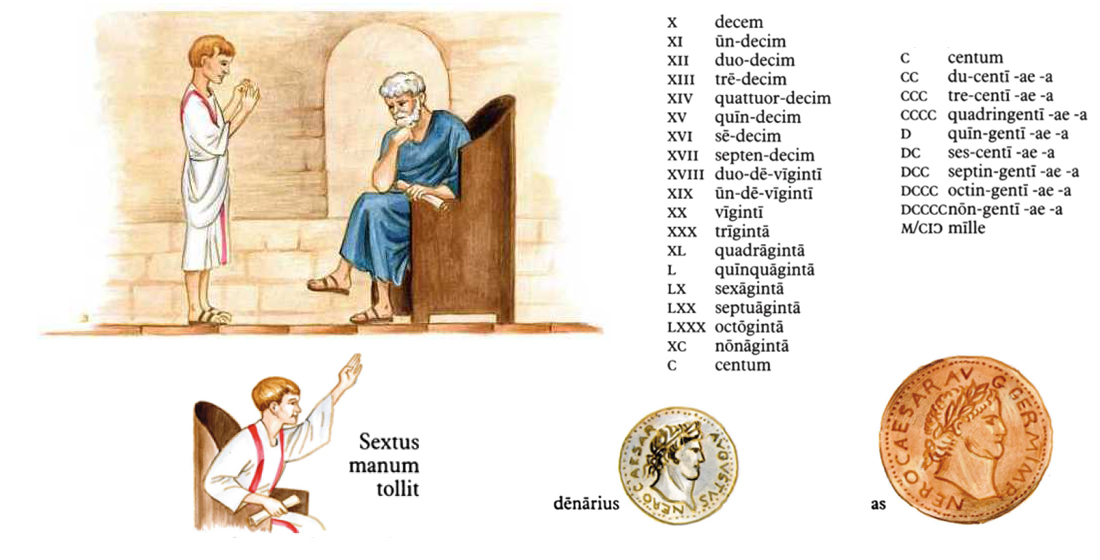
I
In ludo pueri numeros et litteras disciunt. Magister pueros numeros et litteras docet. Magister pueros multas res docere potest, nam is multas res scit quas pueri nesciunt. Magister est vir doctus. Pueri adhuc indocti sunt.
Qui paulum aut nihil discere potest, stultus esse dicitur. Qui discere non vult atque in ludo dormit, piger esse dicitur. Discipulus qui nec stultus nec piger est, sed prudens atque industrius, multas res a magistro discere potest. -
Magister Diodorus recitare desinit et pueros aspicit, qui taciti stant ante suam quisque sellam; nemo eorum dormit. Magister discipulum quemque considere iubet, primum Sextum, deinde Titum, postremo Marcum.
Magister: “Nunc tempus est numeros discere. Primum dic numeros a decem usque ad centum!”
Quisque puer manum tollit, primum Sextus, tum Titus, postremo Marcus. Magister Titum interrogat.
Titus: “Decem, undecim, duodecim, tredecim, quattuordecim, quindecim, sedecim, septendecim, duodeviginti, undeviginti, viginti, viginti unus, viginti duo...”
Hic magister eum interpellat: “Necesse non est omnes numeros dicere; a viginti dic decimum quemque numerum tantum, Tite!”
Titus: “Viginti, triginta, quadraginta, quinquaginta, sexaginta, septuaginta, octoginta, nonaginta, centum.”
Magister: “Bene numeras, Tite. Iam tu, Sexte, dic numeros a centum ad mille!”
Sextus: “Longum est tot numeros dicere!”
Magister: “At satis est decem numeros dicere, id est centesimum quemque.”
Sextus: “Centum, ducenti, trecenti, quadringenti, quingenti, sescendi, septingenti, octingenti, nongenti, mille.”
Magister: “Quot sunt triginta et decem?”
Omnes pueri simul respondent, nemo eorum manum tollit. Titus et Sextus uno ore dicunt: “Quadraginta.” Marcus vero dicit: “Quinquaginta.” Quod Marcus dicit rectum non est. Responsum Titi et Sexti rectum est: ii recte respondent. Responsum Marci est pravum: is prave respondet.
In school the boys learn numbers and letters. The teacher teacher numbers and letters to the boys. The teacher can teach many things to the boys, for he knows many things which the boys do not know. The teacher is a learned man. The boys are unlearned now.
He who can learn little or nothing is said to be stupid. He who does not want to learn and sleeps in school is said to be lazy. A student who is neither stupid nor lazy, but sensible and diligent, can learn many things from the teacher.
Odorous the teacher stops reciting and looks at the boys, who stand quietly behind each seat; none of them are sleeping. The teacher orders each student to sit down, first Sextus, then Titus, last Marcus.
Teacher: "Now it is time to learn numbers. First say the numbers from ten all the way to one hundred!"
Each boy raises his hand, first Sextus, then Titus, last Marcus. The teacher asks Titus.
Titus: "Ten, eleven, twelve, thirteen, fourteen, fifteen, sixteen, seventeen, eighteen, nineteen, twenty, twenty-one, twenty-two..."
Here the teacher interrupts him: "It is not necessary to say all the numbers; from twenty say only each tenth number Titus!"
Titus: "Twenty, thirty, forty, fifty, sixty, seventy, eighty, ninety, one hundred."
Teacher: "Good counting Titus. Now you Sextus, say the numbers from one hundred to a thousand!"
Sextus: "That is many numbers to say!"
Teacher: "But it is enough to say ten numbers, that is each hundredth."
Sextus: "One hundred, two hundred, three hundred, four hundred, five hundred, six hundred, seven hundred, eight hundred, nine hundred, a thousand."
Teacher: "How many are thirty and ten?"
All of the boys answer together, none of them raises his hand. Titus and Sextus say together: "Forty." But Marcus says: "Fifty." What Marcus says is not correct. Titus's and Sextus's answer is correct: they answer correctly. Marcus's answer is incorrect: he answers incorrectly.
II
Magister Titum et Sextum laudat: “Vos recte respondetis, Tite et Sexte. Discipuli prudentes atque industrii estis.” Deinde Marcum interrogat: “Quot sunt triginta et septem?”
Marcus: “Ad hoc recte respondere possum: triginta et septem sunt triginta septem.”
“Recte respondes, Marce” inquit magister, “Quot sunt triginta et octo?”
Marcus: “Facile est ad hoc respondere.”
Magister: “Non tam facile quam tu putas!”
Marcus: “Triginta et octo sunt triginta octo.”
Magister: “Prave dicis! Triginta et octo sunt duodequadraginta. Quot sunt triginta et novem?”
Marcus: “Triginta novem.”
Magister: “O Marce! Id quoque pravum est. Triginta et novem sunt undequadraginta. Cur non cogitas antequam respondes?”
Marcus: “Semper cogito antequam respondeo.”
Magister: “Ergo puer stultus es, Marce! Cogitare non potes! Nam stulte et prave respondes!” Magister Marcum non laudat, sed reprehendit.
Marcus: “Cur ego semper a te reprehendor, numquam laudor? Titus et Sextus semper laudantur, numquam reprehenduntur.”
Magister: “Tu a me non laudaris, Marce, quia numquam recte respondes. Semper prave respondes, ergo reprehenderis!”
Marcus: “At id quod ego interrogor nimis difficile est. Atque ego semper interrogor!”
Magister: “Tu non semper interrogaris, Marce. Titus et Sextus saepe interrogantur.”
Marcus: “Non tam saepe quam ego.”
Titus: “Nos quoque saepe interrogamur, nec vero prave respondemus. Itaque nos a magistro laudamur, non reprehendimur.”
Marcus: “Et cur vos semper laudamini? Quia id quod vos interrogamini facile est - ego quoque ad id recte respondere possum. Praeterea magister amicus est patribus vestris, patri meo inimicus. Itaque vos numquam reprehendimini, quamquam saepe prave respondetis; ego vero numquam laudor, quamquam saepe recte respondeo!”
Sextus: “At frater tuus saepe laudatur, Marce.”
Magister: “Recte dicis, Sexte: Quintus bonus discipulus est, et industrius et prudens.” Quintus a magistro laudatur, quamquam abest.
The teacher praises Titus and Sextus: "You answer correctly Titus and Sextus. You are sensible and diligent students." Then he asks Marcus: "How many are thirty and seven?"
Marcus: "I can give a correct answer to this: thirty and seven are thirty-seven."
"You answer correctly Marcus," the teacher says, "How many are thirty and eight?"
Marcus: "It is easy to answer this."
Teacher: "Not as easy as you think!"
Marcus: "Thirty and eight are thirty eight"
Teacher: "You speak incorrectly! Thirty and eight are thirty-eight. How many are thirty and nine?"
Marcus: "Thirty nine."
Teacher: "O Marcus! That is also incorrect. Thirty and nine are thirty-nine. Why do you not think before you answer?"
Marcus: "I always think before I answer."
Teacher: "Therefore you are a stupid boy Marcus! You cannot think! For you answer stupidly and incorrectly!" The teacher does not praise but rebukes Marcus.
Marcus: "Why am I always rebuked by you, never praised? Titus and Sextus are always praised, never rebuked."
Teacher: "You are not praised by me Marcus, because you answer incorrectly. You always answer incorrectly, therefore you are rebuked!"
Marcus: "But that which I am asked is more difficult. And I am always asked!"
Teacher: "You are not always asked Marcus. Titus and Sextus are often asked."
Marcus: "Not as often as I am."
Titus: "We are also often asked, but we do not respond incorrectly. Therefore we are praised by the teacher, not rebuked."
Marcus: "And why are you always praised? Because that which you are asked is easy - I can also give a correct answer to that. Besides the teacher is a friend to your fathers, but and enemy to my father. Therefore you are never rebuked, although you often answer incorrectly; but I am never praised, although I often answer correctly!"
Sextus: "But your brother is often praised Marcus."
Teacher: "You speak correctly Sextus: Quintus is a good student, and diligent and sensible." Quintus is praised by the teacher, although he is absent."
III
Sextus: “Nonne tu laetaris, Marce, quod frater tuus etiam absens a magistro laudatur?”
Marcus: “Ego non laetor cum frater meus laudatur! Et cur ille laudatur hodie? Quia discipulum absentem reprehendere non convenit!”
Magister iratus virgam tollens “Tacete, pueri!” inquit, “Nonne virgam meam veremini?”
Marcus: “Nos nec te nec virgam tuam veremur!”
Magister, qui verba Marci non audit, ex sacculo suo duos nummos promit, assem et denarium, et “Ecce” inquit nummos ostendens “as et denarius. Ut scitis, unus sestertius est quattuor asses et unus denarius quattuor sestertii. Quot asses sunt quattuor sestertii, Tite?”
Titus digitis computat: “...quattuor...octo...duodecim...sedecim: quattuor sestertii sunt sedecim asses.”
Magister: “et decem denarii quot sestertii sunt?”
Titus: “Quadraginta.”
Magister: “Quot denarii sunt duodequinquaginta sestertii?”
Titus magistro interroganti nihil respondet.
Magister: “Responsum tuum opperior, Tite. Cur mihi non respondes?”
Titus: “Nondum tibi respondeo, quod primum cogitare oportet. Duodequinquaginta est numerus difficilis!”
Sextus manum tollens “Ego responsum scio” inquit.
Magister: “Audi, Tite: Sextus dicit 'se responsum scire.' Sed exspecta, Sexte! Non oportet respondere antequam interrogaris.”
Titus: “Duodequinquaginta sestertii sunt denarii... quattuordecim? an quindecim? Non certus sum!” Titus non certus, sed incertus est, et responsum incertum dat magistro.
Magister: “Responsum certum magistro dare oportet. Responsum incerum nullum responsum est. Nunc tibi licet respondere, Sexte.”
Quamquam difficili est numerus, Sextus statim recte respondet: “Duodequinquaginta sestertii sunt duo-decim denarii.”
Magister iterum Sextum laudat: “Bene computas, Sexte! Semper recte respondes. Ecce tibi assem do.” Diodorus assem dat Sexto, et denarium in sacculo reponit.
Marcus: “Discipulo tam industrio denarium dare oportet. Largus non es, magister. Pecuniam tuam non largiris.”
Diodorus: “Non oportet pecuniam largiri discipulis.”
Marcus: “Quare igitur tot numeros difficiles discimus?”
Magister: “Quia necesse est computare scire, ut multis exemplis tibi demonstrare possum. Si tria mala uno asse constant et tu decem asses habes, quot mala emere potes?”
Marcus: “Tot asses non habeo - non tam largus est pater meus; nec mihi licet tot mala emere.”
Magister: “Id non dico. Ecce aliud exemplum: Si tu sex asses cum fratre tuo partiris, quot sunt tibi?”
Marcus: “Quinque!”
Magister: “In aequas partes pecuniam partiri oportet. Si vos sex asses aeque partimini, quot tibi sunt?”
Marcus: “Pecuniam meam exiguam non largior nec partior cum aliis!”
Postremo magister “O Marce!” inquit, “hoc modo nihil te docere possum! Tam stultus ac tam piger es quam asinus!”
Sextus: "Surely you are happy Marcus that your brother is praised by the teacher even absent aren't you?"
Marcus: "I am not happy when my brother is praised! And why is he praised today? Because it is not right for an absent student to be rebuked!"
The angry teacher raises his rod "Be silent boys!" he says, "Do you not fear my rod?"
Marcus: "We neither fear you nor your rod!"
The teacher who does not hear Marcus's words, takes out two coins from his bag, a penny and a denarius, and showing the coins says, "Behold a penny and denarius. You know, one sesterce is four pennies and one denarius is four sesterces. How many pennies are four sesterces Titus?"
Titus counts his fingers: "...four...eight...twelve...sixteen: four sesterces are sixteen pennies."
Teacher: "and ten denariis are how many sesterces?"
Titus: "Forty."
Teacher: "How many denariis are forty-eight sesterces?"
Titus does answers nothing to the teacher's question.
Teacher: "I am waiting for your answer Titus. Why are you not answering me?"
Titus: "I have not yet answered you because it is necessary to think first. Forty-eight is a difficult number!"
Sextus raises his hand saying, "I know the answer."
Teacher: "Listen Titus: Sextus says 'he knows the answer.' But wait Sextus! It is not fitting to answer before being asked."
Titus: "Forty-eight sesterces are ... fourteen denariis? Or fifteen? I am not certain!" Titus is not certain, but is uncertain, and gives an uncertain answer to the teacher.
Teacher: "It is fitting to give a certain answer to the teacher. An uncertain answer is no answer. Now it is fitting for you to answer Sextus."
Although it is a difficult number, Sextus answers correctly immediately: "Forty-eight sersterces are twelve denariis."
The teacher again praises Sextus: "Good calculating" Sextus! You always answer correctly. Behold I give a penny to you." Diodorus gives a penny to Sextus, and returns the denarius to his bag.
Marcus: "It is fitting to five such a diligent student a denarius. You are not generous teacher. You are not giving your money bountifully."
Diodorus: "It is not fitting to give money bountifully to students."
Marcus: "Why therefore do we learn all the difficult numbers?"
Teacher: "Because it is necessary to know to calculate, I can show examples to you. If three apples cost one penny and you have then pennies, how many apples can you buy?"
Marcus: "I do not have any pennies - for my father is not so generous; nor is it allowed to buy so many apples."
Teacher: "That is not what I am saying. Here is another example: if you share six pennies with your brother, how many are yours?"
Marcus: "Five!"
Teacher: "It is fitting to share money in equal parts. If you share six pennies equally, how many are yours?"
Marcus: "I do not give my small amount of money nor do I share with others!"
Finally the teacher says, "O Marcus in this way I can teach you nothing! You are as stupid and lazy as a donkey!"
GRAMMATICA LATINA
Personae verbi passivi
Ego a magistro laudor = magister me laudat.
Tu a magistro laudaris = magister te laudat.
Nos a magistro laudamur = magister nos laudat.
Vos a magistro laudamini = magister vos laudat.
| Singularis | Pluralis | |
| Persona prima | laud|or | lauda|mur |
| Persona secunda | lauda|ris | lauda|mini |
| Persona tertia | lauda|tur | lauda|ntur |
Exempla: [1] iact|or iacta|mur; [2] vide|or vide|mur; [3] merg|or merg|imur; [4] audi|or audi|mur.
Nauta, qui fluctibus iactitur ac mergitur: "Fluctibus iactor ac mergor! Serva me, Neptune, qui prope ades, quamquam nec videris nec audiris ab hominibus." Neptunus: "Fluctibus iactaris, nauta, nec vero mergeris! Nam ego adsum, quamquam nec videor nec audior." Deus ab hominibus nec videtur nec auditur.
Nautae, qui fluctibus iactantur ac merguntur: "Fluctibus iactimur ac mergimur! Servate nos, o dei boni, qui prope adestis, quamquam nec videmini nec audimini ab hominibus." Dei: "Fluctibus iactamini, nautae, nec vero mergimini! Nam nos adsumus, quamquam nec videmur nec audimur." Dei ab hominibus nec videntur nec audiuntur.
[1] Ut 'laudor laudamur' declinantur verba passiva et deponentia quorum infinitivus desinit in -ari.
[2] Ut 'videor videmur' declinantur verba passiva et deponentia quorum infinitivus desinit in -eri.
[3] Ut 'mergor mergimur' declinantur verba passiva et deponentia quorum infinitivus desinit in -i (praeter ea quae -i- habent ante -or et -untur, ut 'capior capiuntur', 'egredior egrediuntur').
[4] Ut 'audior audimur' declinantur verba passiva et deponentia quorum infinitivus desinit in -iri (sed 'oriri oritur').
Exempla verborum deponentium: [1] laet|or laeta|mur; [2] vere|or vere|mur; [3] sequ|or sequ|imur; [4] parti|or parti|mur.
Lydia: "Ego Neptunum non vereor. Tune eum vereris, nauta?" Nauta: "Omnes nautae deum maris veremur." Lydia: "Cur Neptunum veremini?"
Nautae Neptunum verentur, Lydia eum non veretur.
LATIN GRAMMAR
The persons of the passive verb
I am praised by the teacher = the teacher praises me.
You are praised by the teacher = the teacher praises you.
We are praised by the teacher = the teacher praises us.
You
are praised by the teacher = the teaches praises you.
| Singular | Plural | |
| First person | I am praised | we are praised |
| Second person | you are praised | you (pl) are praised |
| Third person | he is praised | they are praised |
Examples: [1] I am tossed about, we are tossed about; [2] I am seen, we are seen; [3] I am submerged, we are submerged; [4] I am heard, we are heard.
The sailor, who is tossed about and submerged by the waves: "I am tossed about and submerged by the waves! Save me Neptune, you who are near, although you are neither seen nor heard by men." Neptune: ''You are tossed about by the waves sailor but not submerged! For I am near, although neither seen nor heard." The god is neither seen nor heard by men.
The sailors, who are tossed about and submerged by the waves: "We are tossed about and submerged by the waves! Save us, o good gods, you who are near, although neither seen nor heard by men." Gods: "You sailors are tossed about by waves, but not submerged! For we are near you, although we are neither seen nor heard." The gods are neither seen nor heard by men.
[1] Passive and deponent verbs in which the infinitive ends in -ari are declined like 'laudor laudamur'.
[2] Passive and deponent verbs in which the infinitive ends in -eri are declined like 'videor videmur'.
[3] Passive and deponent verbs in which the infinitive ends in -i are declined like 'mergor mergimur' (except that which has an -i- before -or and -untur, like 'capior capiuntur', 'egredior egrediuntur').
[4] Passive and deponent verbs in which the infinitive ends in -iri are declined like 'audior audimur' (but 'oriri oritur').
Examples of deponent verbs: [1] I rejoice, we rejoice; [2] i am afraid, we are afraid; [3]I follow, we follow; [4] I share, we share.
Lydia: "I do not fear Neptune. Do you fear him sailor?" Sailor: "All of us sailors fear the god of the sea." Lydia: "Why do you fear Neptune?"
Sailors fear Neptune, Lydia does not fear him.
VOCABVLA
responsum, i n.
as, assis m.
denarius, i m.
doctus, a, um
indoctus, a, um
piger, pigra, pigrum
prudens, prudentis
industrius, a, um
rectus, a, um
pravus, a, um
facilis, facile
difficilis, difficile
absens, absentis
certus, a, um
incertus, a, um
largus, a, um
centesimus, a, um
tredecim
quattuordecim
quindecim
sedecim
septendecim
duodeviginti
undeviginti
quadraginta
quinquaginta
septuaginta
quadringenti
quingenti
sescenti
septingenti
octingenti
nongenti
disco, discere, didici
doceo, docere, docui, doctus
scio, scire, scivi, scitus
nescio, nescire, nescivi, nescitum
tollo, tollere, sustuli, sublatum
interpello, -are, -avi, -atum
laudo, -are, -avi, -atum
cogito, -are, -avi, -atum
reprehendo, -ere, -i, reprehensum
promo, promere, prompsi,
oporteo, oportere, oportui,
computo, -are, -avi, -atum
repono, reponere, reposui,
largio, -ire, -ivi, -itum
demonstro, -are, -avi, -atum
partio, -ire, -ivi, -itum
quisque
tot
postremo
recte
prave
aeque
usque
numquam
saepe
quamquam
quare
VOCABULARY
answer, response
penny, copper coin
silver coin
learned, wise
unlearned, ignorant
lazy, slow
skilled, sensible
diligent
right, correct
wrong, crooked, bad
easy
difficult
absent, missing
firm, certain
uncertain, unsure
lavish, generous
100th
13
14
15
16
17
18
19
40
50
70
400
500
600
700
800
900
to learn
to teach
to know
to not know
to lift, to raise
to interrupt
to praise
to think
to blame
to bring forth
to require, to order
to compute
to put back
to give bountifully
to point out, to show
to share
each
so many, as many
at last, finally
right, correctly
wrong, incorrectly
equally
up to
never
often
although
why? how?