CAPITVLVM VICESIMVM SEPTIMVMTWENTY-SEVENTH CHAPTER
RES RVSTICAECOUNTRY MATTERS
I
Quid agit pater familias post meridiem? Primum quiescit, tum ambulat, denique lavatur. Iulius igitur, postquam paulum quievit, ambulatum exit. Iam desiit imber, aves rursus in horto canunt. Dominus huc illuc in horto suo amoeno ambulat, deinde exit in agros, qui hortum cingunt.
In agris frumentum crescit vere et aestate. Mense Augusto frumentum metitur et ex agris vehitur. Deinde agri arantur et novum frumentum seritur. Qui agros arant ac frumentum serunt et metunt, agricolae appellantur. Agricola est vir cuius negotium est agros colere.
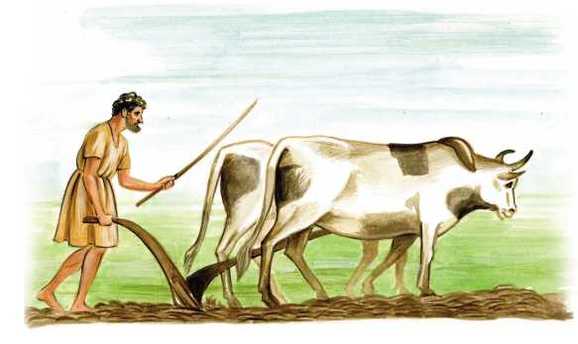
Agricola arans post aratrum ambulat. Aratrum est instrumentum quo agri arantur. Arator duos validos boves qui aratrum trahunt prae se agit. Quomodo frumentum seritur? Agricola semen manu spargit. Ex parvis seminibus quae in agros sparsa sunt frumentum crescit. Mense Augusto frumentum maturum est. Quomodo metitur frumentum? Falce metitur. Falx est instrumentum quo agricola metit. Quo instrumento serit agricola? Qui serit nullo instrumento utitur praeter manum. Qui arat aratro utitur; qui metit falce utitur; qui serit manu sua utitur.
What does the family's father do after noon? First he rests, then walks, finally he bathes. Julius therefore, after a short rest, goes out for a walk. Now the rain has stopped, birds are again singing in the garden. The master walks here and there in his beautiful garden, then he goes out into the fields which are around the garden.
In the fields grain grows in Spring and Summer. In the month of August grain is harvested and carried out of the fields. Then the fields are plowed and new grain is sown. Thos who plow the fields and sow and reap grain, are called farmers. A farmer is a man whose duty is to tend to fields.
The plowing farmer walks behind a plow. A plow is a tool that plows the fields. The plowman drives two strong oxen who drag the plow behind. How is grain sown? The farmer spreads the seed with his hand. From small seeds which are spread in the fields grain grows. In the month of August grain is ripe. How is grain reaped. It is reaped with a sickle. A sickle is the tool by which the farmer reaps. With what tool does the farmer sow? He who sows uses no tool besides his hand. He who plows uses a plow; he who reaps uses a sickle; he who sows uses his own hand.
Deus agricolarum est Saturnus, qui olim rex caeli fuit, sed a filio suo Iove e caelo pulsus in Italiam venit, ubi eam regionem quae Latium appellatur optime rexit Latinosque, homines ut tunc erant rudes ac barbaros, agros colere docuit. In foro Romano est templum Saturni.
Ager qui multum frumenti aliasve fruges ferre potest fertilis esse dicitur. Italia est terra ferilis, sed multa loca Italiae non arantur nec ullas fruges ferunt praeter herbam. Iis locis oves, porci, boves pascuntur, nam herba est pecoris pabulum, et facilius est pecus pascere quam agros colere. Praeterea lana ovium utuntur homines, nam e lana vestes efficiuntur. Itaque pecus maioris pretii est quam frumentum, et qui pecus pascit plus pecuniae facit quam qui agros colit.
The god of farmers is Saturn, who was once king of the sky, but knocked from the sky by his son Jove he came into Italy, where he ruled greatly that region which is called Latium and taught the Latins, men that then were rude and barbaric, to cultivate the fields. In the Roman forum there is a temple to Saturn.
A field that can bear much grain or other crops is said to be fertile. Italy is a fertile land, but many places in Italy are not plowed nor do they bear any crops besides grass. Those places feed sheep, pigs, and oxen, for grass is the food of cattle, and it is easier to feed cattle than to cultivate fields. Besides the wool of sheep is used by men, for from wool clothes are made. Therefore cattle is more valuable than grain, and he who feeds cattle makes more money than he who cultivates fields.
Frumentum minoris pretii est, quia magna copia frumenti ex Africa in Italia, invehitur. Solum Africae fertile est, nisi aqua caret, sed multis locis Africae parum aqua est. Ergo necesse est agros aqua fluminum rigare. Agricolae qui agros prope Nilum flumen colunt bis terve in anno metere possunt, Aegyptus enim terra fertilissima est, quia solum eius aqua Nili rigatur.
Agri Iulii, qui sub monte Albano siti sunt, non solum frumentum, sed etiam vites ferunt. Ii agri in quibus vites crescunt vineae dicuntur. Fruges vinearum sunt uvae, quae mense Septembri maturae sunt. Ex uvis maturis vinum efficitur.
Grain is less valuable because large crops of grain are carried out of Africa into Italy. African soil is fertile, unless it lacks water, but many places in Africa lack water. Therefore it is necessary to irrigate the fields with river water. Farmers who cultivate fields near the Nile river can reap twice or three times in a year, for Egypt is very fertile land, because its soil is irrigated from water of the Nile.
Julius's fields, which sit beneath mount Alban, bear not only grain but also vines. The fields in which vines grow are called vinyards. The crops of vinyards are grapes, which are ripe in the month of September. From mature grapes wine is made.
II
Iulius, qui nuper ex urbe in praedium suum Albanum venit, circa agros et vineas suas ambulat. Supra eum est mons Albanus, post montem lacus Albanus, qui villis magnificis cingitur. Nulla in parte Italiae tot et tantae villae sitae sunt quam in Latio et maxime circa lacum illum amoenum. Ne in Campania quidem plures villae sunt, quamquam multi Romani in ora maritima eius regionis villas possident; nam plurimi Romani sub urbe Roma habitare volunt in villis suburbanis.
Iulius aspicit agricolas qui in agris et in vineis opus faciunt, gaudens quod ipsi, ut domino diviti, non necesse est in agris laborare. Quamquam nullo modo laborem agricolarum sordidum indignumve esse existimat, tamen se prae agricolis beatum esse censet. Neque enim laborat dominus, sed quiescit, cum in praedio suo est. Rus quietum amoenum eum delectat. In urbe Iulius semper in negotio est, sed ruri in otio cogitat de negotiis urbanis. Itaque Iulius, qui otium ruris valde amat, cum primum confecta sunt negotia urbana, in praedium suum suburbanum proficiscitur.
Agri Iulii non a domino ipso coluntur, sed a colonis. Colonus est agricola qui non suos, sed alienos agros pro domino absenti colit et mercedem domino solvit pro frugibus agrorum.
Coloni Iulii sunt agricolae validi qui industrie laborant omnesque mercedem ad diem solvere solent. At hoc anno quidam colonus mercedem nondum solvit. Iulius eum colonum in agro conspicit et “Huc accede, colone!” inquit. Dominus imperat ut colonus accedat, tum interrogat: “Cur nondum solvisti mercedem quam ter quaterve iam abs te poposci? Octingentos sestertios mihi debes. Solve eos!” Iulius colono imperat ut mercedem solvat.
Julius, who recently came from the city into his estate, walks around his fields and vinyards. Above him is Mount Albans, behind the mountain lake Alban, which is surrounded by magnificent villas. In no other part of all of Italy are so many and such great villas are situated as in Latium and most of all around that beautiful lake. Not even in Campania are there more villas, even though many Romans possess villas on that maritime sea coast region; for many Romans want to live below the city of Rome in suburban villas.
Julius looks at the farmers who are working in the fields and vinyards, happy because he, as a wealthy master, it is not necessary to work in the fields. Although he in no way believes the work of farmers to be dirty or unworthy, he nevertheless considers himself to be happier than farmers. For the master does not work, but rests, when he is at his estate. The beauty of the quiet country pleases him. In the city Julius is always working, but in the country he thinks in leisure of city business. Therefore Julius, who loves very much the leisure of the country, when the cities affairs are first ended, sets out to his suburban estate.
Julius's fields are not cultivated by the master himself, but by a tenant farmer. A tenant farmer is a farmer who cultivates not his own but other fields for an absent master and pays a wage to the master for the crops of the fields.
Julius's tenant farmers are strong farmers who work diligently and are accustomed to pay all their wages daily. But this year a certain tenant farmer had not yet paid. Julius seeing the farmer in the field says to him, "Come here farmer!" The master commands that the tenant farmer come, then asks, "Why have you not yet paid the wages which I have asked from you three or four times? You owe me eighty sestertii. Pay them!" Julius commands that the tenant farmer pay the wage.
Colonus pallidus prae metu loqui non potest.
Iulius: “Audisne? Impero tibi ut mercedem solvas. Quin respondes?”
Colonus: “Nulla est mihi pecunia. Ne assem quidem habeo.”
Iulius: “Nisi hic et nunc solvis mercedem debitam, servis meis imperabo ut te agris meis pellant. Iam tres menses exspecto ut ea pecunia mihi solvatur. Etsi vir patiens sum, hic finis est patientiae meae!”
Colonus ad pedes domini se proicit eumque orat ut patientiam habeat: “Patientiam habe, domine! Noli a me postulare ut tantum pecuniae statim solvam! Intra duos tresve menses omnia accipies. Noli me e domo mea rapere! Octo liberi mihi sunt, quos ipse curare debeo. Cura infantium multum temporis magnamque patientiam postulat, itaque parum temporis habeo ad opus rusticum.”
Iulius: “Quid? Num uxor abs te postulat ut tu pro matre infantes cures? Itane infantes suos neglegit? Matris officium est infantes curare. Tu vero cura ut agri bene colantur et merces ad diem solvatur!”
Colonus: “Uxor mea officium suum non neglegit nec postulat ut ego infantes curem; sed nunc nec infantes curare nec quidquam aliud agere potest, quia aegrotat: intra paucos dies novum infantem exspectat. Noli me ab uxore gravida rapere! Per omnes deos te oro!”
His precibus dominus severus tandem movetur. Colono imperat ut taceat atque surgat, tum “Quoniam” inquit “uxor tua gravida es, abi domum! Primum cura ut uxor et liberi valeant, tum vero labora ut pecuniam omnem solvas intra finem huius mensis, id est intra tricesimum diem!”
The tenant farmer white from fear cannot speak.
Julius: "Do you hear? I command you to pay the wage. Why don't you answer?"
Tenant farmer: "I have no money. I do not even have a penny."
Julius: "Unless you pay the wage I am owed here and now, I will order my slaves to drive you from my fields. Now I have waited three months that the money owed is paid to me. I am a patient man, my patience ends here!"
The tenant farmer falls at the feet of the master and begs that he have patience: "Have patience master! Do not demand from me that I pay so much money immediately! You will receive everything within two or three months. Do not tear me away from my home! I have eight children, whom I take care of myself. Caring for an infant demands much time and great patiences, therefore I don't have time for farm work."
Julius: "What? Surely your wife does not demand that you care for an infant like a mother? Does she neglect her infant? It is the mothers duty to care for infants. But you take care that the fields are cultivated well and that payment is paid daily!"
Tenant farmer: "My wife does not neglect her duty nor does she ask that I care for the infant; but now she cannot care for infants nor do other things, because she is sick: she expects a new baby within a few days. Do not tear me away from my pregnant wife! I beg you through all the gods!"
By these words the strict master is moved very much. He orders the farmer to be silent and stand up then says, "Since your wife is pregnant, go home! First take care that your wife and children are well, but then work to pay all the money within the end of this month, that is within thirty days!"
III
Colono dimisso, Iulius alium agricolam vocat eumque de rebus rusticis rogitat, ac primum de vineis: “Quomodo vineae se habent hoc anno?”
“Optime” inquit agricola, “Aspice hanc vitem: tot et tantae uvae magnam vini copiam promittunt, ac vinum bonum futurum esse existimo, nam sol duos iam menses prope cotidie lucet usque a mane ad vesperum. Nihil enim vineis magis prodest quam sol et calor, nec quidquam iis magis nocet quam imber et frigus.”
Iulius: “Calor solis non ipse per se efficit ut vinum bonum sit. Vites probe curare oportet. Itaque vos moneo ut industrie in vineis laboretis. Sed satis de vineis. Frumentum quale erit?”
“Non ita bonum” inquit alter agricola, “Solum nimis siccum est nec rigari possunt agri quod procul absunt a rivo. Imber brevis quem hodie habuimus frumento profuit quidem, sed parum fuit. Item sicca est herba, pecus parum pabuli invenit. Sed scisne ovem heri paene raptam esse a lupo?”
With the tenant farmer dismissed, Julius calls another farmer and asks him of farm matters, and first of the vines: "How are the vines this year?"
"Excellent" says the farmer, "Look at these vines: so many so great grapes promise a great supply of wine. and I think the wine will be good, for the Sun shines from morning to evening nearly every day for two months now. For nothing produces more wine than Sun and heat, and nothing harms wine more than rain and cold."
Julius: "The heat of the Sun itself will not make it so that the wine is good. The vines should be well cultivated. Therefore I advise you that you work diligently in the vinyards. But enough of the vinyards. How much crop will there be?"
"Not as good," said the other farmer, "the soil is too dry and the fields cannot be irrigated because they are farm from the river. We had a short rain today that produced grain, but it was lacking. Likewise the grass is dry, the cattle find a lack of food. But do you know that yesterday a sheep was nearly carried off by a wolf?"
Iulius: “Quid? Lupusne ovem e grege rapuit?”
Agricola: “Ovis ipsa e grege aberraverat. Nec vero lupus ovi nocuit, nam pastor eam in silva repperit atque e dentibus lupi servavit!”
Iulius: “O, pastorem pigerrimum, qui officium suum ita neglexit! Pastoris officium est curare ne oves aberrent neve silvam petant. Ego vero curabo ne ille pastor posthac officium neglegat!”
Agricola: “Noli nimis severus esse! Non censeo illum pastorem prae ceteris pigrum esse.”
Iulius: “Recte dicis: nam pigri ac neglegentes sunt omnes! At ego faciam ut industrii sint!”
Agricola: “Certe pastores minus laborant quam agricolae. Nobis nullum est otium, nec opus est nos monere ut industrii simus neve quiescamus.”
Iulius: “Noli censere opus pastorum facilius esse. Cura pecoris magnum est negotium, non otium, ut pastores nequam in molli herba dormientes putant. Ego vero curabo ne ille pastor neglegens sit neve dormiat! Faciam ut tergum ei doleat! Arcesse eum!”
Sed eo ipso tempore pastor gregem prae se agens e campis revertitur. Cum primum is prope venit, “Optime advenis” inquit dominus iratus baculum prae se tenens, “nam verbera meruisti!”
Pastor humi se proiciens dominum orat ne se verberet: “Noli me verberare, ere! Nihil feci!”
Julius: "What? Did a wolf carry off a sheep from the flock?"
Farmer: "A sheep wandered off from the flock. But the wolf did not harm the sheep, for the shepherd found it in the forest and saved it from the wolf's teeth!"
Julius: "O, lazy shepherd, who thus neglects his duty! It is the shepherds job to take care lest th sheep wander away or seek the forest. But I will take care lest that shepherd neglects his duty after this!"
Farmer: "Do not be too strict! I do not think that shepherd to be lazier than others."
Julius: "You speak correctly: for they are all lazy and neglectful! But I will do it to be industrious!"
Farmer: "Certainly shepherds work less than farmers. There is no leisure for us, there is no need to warn us to be industrious and not quiet."
Julius: "Do not think the work of shepherds to be easy. It is a big task to care for cattle, not leisure, that they think worthless shepherds sleep in soft grass. But I will take care lest that shepherd be neglectful or sleep! I will make it so that his back side hurts! Fetch him!"
But at that time the shepherd driving the flock before him, returned from the plains. When he first comes near, the angry master holding his staff before him says, "You come at the best time for you deserve a beating!"
The shepherd throwing himself to the ground begs the master not to beat him, "Do not beat me! I have done nothing!"
“At propter hoc ipsum” inquit Iulius “te verberabo, homo nequam, quod nihil fecisti! Officium tuum est curare ne oves aberrent neve a lupo rapiantur. Preces tibi non prosunt. Prehendite eum, agricolae, et tenete!” Iulius duobus agricolis imperat ut pastorem prehendant et teneant.
Tum vero, dum pastor territus verbera exspectat, oves sine pastore relictae de via in agros aberrant ac frumentum immaturum carpere incipiunt. Agricolae hoc videntes clamant: “Prohibe oves tuas ab agris nostris, pastor!” - tum pastorem mittunt atque celeriter oves in agris sparsas persequuntur.
Pastor solus cum domino relictus “Modo dixisti” inquit “meum officium esse cavere ne oves aberrent. Noli me officio meo prohibere!”
Iulius: “Ego te non prohibebo officium facere. Fac ut oves ex agris agantuur! Age, curre, pastor!”
Vix haec dixerat Iulius, cum pastor quam celerrime potest ad oves suas currit. Dominus ridens eum currentem aspicit, tum ad villam revertitur. Etsi dominus severus existimatur, tamen inhumanus non est.
"But it is because of this that I will beat you worthless man," Julius says, "because you have done nothing! Your job is to take care lest the shep wander off or are carried off by a wolf. Prayers don't work for you. Grab and hold him farmers!" Julius commands the two farmers to grab and hold the shepherd.
But then, while the terrified shepherd waited for the beating, the sheep without the shepherd wander off the road into the fields and begin to eat the unripened grain. The farmers seeing this shout: "Keep your sheep from our fields shepherd!" - then they send the shepherd and swiftly chase the sheep scattered in the fields.
The shepherd left alone with the master says, "You said that it was my job to take care lest the sheep wander off. Do not prevent me from my job!"
Julius: "I will not prevent you from doing your job. Drive the sheep from the fields. Go, run shepherd!"
Julisu had barely said these things, when the shepherd ran as swift as he could to his sheep. The master laughing seeing him run, then returns to his villa. Even though the master is thought to be strict, but he is nevertheless not inhuman.
GRAMMATICA LATINA
Coniunctivus
Tempus prasens
[A] Activum
Dominus: "Intra, serve! Claude forem! Tace et audi!" Dominus servo imperat ut intret, forem claudat, taceat et audiat. Servus intrat, forem claudit, tacet et audit.
'Intrat', 'tacet', 'claudit', 'audit' est indicativus. 'Intret', 'taceat', 'claudat', 'audiat' coniunctivus est. Coniunctivus praesentis (pers. III sing.) [1] -et, [2, 3, 4] -at.
Exempla: [1] cogita|re: cogit|et; [2] responde|re: responde|at; [3] scrib|ere: scrib|at; [4] audi|re: audi|at.
LATIN GRAMMAR
Subjunctive
Present time
[A] Active
Master: "Enter slave! Close the door! Be silent and listen!" The master commands the slave to enter, close the door, be silent and listen. The slave enters, closes the door, is silent and listens.
'Intrat', 'tacet', 'claudit', 'audit' is indicative. 'Intret', 'taceat', 'claudat', 'audiat' is subjunctive. Subjunctive present (3rd pers. sing.) [1] -et, [2,3,4] -at.
Examples: [1] cogita|re: cogit|et; [2] responde|re: responde|at; [3] scrib|ere: scrib|at; [4] audi|re: audi|at.
VOCABVLA
ager, agri m.
frumentum, frumenti n.
agricola, agricolae m.
negotium, negoti n.
aratrum, aratri n.
instrumentum, instrumenti n.
semen, seminis n.
falx, falcis f.
regio, regionis f.
frux, frugis f.
pecus, pecoris n.
pabulum, pabuli n.
lana, lanae f.
copia, copiae f.
vitis, vitis f.
vinea, vineae f.
uva, uvae f.
vinum, vini n.
praedium, praedi n.
labor, laboris m.
rus, ruris n.
otium, oti n.
colonus, coloni m.
patientia, patientiae f.
cura, curae f.
preces, precis f.
calor, carloris m.
frigus, frigoris n.
grex, gregis n.
amoenus, a, um
maturus, a, um
rudis, rude
fertilis, fertile
suburbanus, a, um
urbanus, a, um
patiens, patientis
rusticus, a, um
gravidus, a, um
siccus, a, um
neglegens, neglegentis
nequam
immaturus, a, ump
inhumanus, a, um
tricesimus, a, um
quiesco, -ere, quievi, quietum
cingo, cingere, cinxi, cinctum
cresco, crescere, crevi, cretum
meto, metere, messui, messum
aro, arare, aravi, aratum
sero, serere, sevi, satum
colo, colere, colui, cultum
spargo, -gere, sparsi, sparsum
uti
pasco, pascere, pavi, pastum
inveho, -here, invexi, invectum
rigo, rigare, rigavi, rigatum
laboro, -are, -avi, laboratum
existimo, -are, -avi, existimatum
censeo, censere, censui, censum
proicio, -icere, -jeci, projectum
oro, orare, oravi, oratum
rapio, rapere, rapui, raptum
neglego, -legere, -lexi, -lectum
prosum, -desse, -fui, profuturum
noceo, nocere, nocui, nocitum
prohibeo,-ere, -hibui, prohibitum
quidam
parum
tantum
denique
circa
prae
praedium, praedi n.
pro
abs
-ve
ne
patientia, patientiae f.
cura, curae f.
coniunctivus, coniunctivi m.
VOCABULARY
field, land
grain, crops
farmer
job, work
plow
tool(s), equipment
seed
sickle, scythe
area, region
crops (pl)
herd, flock
fodder
wool, fleece
plenty, abundance
vine, grape vine
vineyard vines, vine
grape
wine
farm, estate
effort, labor
country, farm
free time, leisure
farmer, cultivator
patience, tolerance
concern, attention
request, prayer
heat, warmth
cold, cold weather
flock, herd, crowd
beautiful, attractive
mature, ripe, early
undeveloped, wild
fertile, fruitful
near the city
of the city, urbane
patient, tolerating
country, plain
pregnant
dry
heedless, neglectful
wicked, depraved
unripe, immature
discourteous,
30th
to rest, to be calm
to surround, to
to increase, to grow
to reap, to cut off
to reap, to cultivate
to sow, to plant
to tend, to inhabit
to scatter, to sprinkle
in order that, as
to feed on, to graze
to import, to carry in
to moisten, to wet
to labor, to produce
to value, to consider
to assess, to consider
to throw out, abandon
to ask for, to plead
to hurry, to snatch
to neglect, to
to be useful, to
to injure, to harm
to hinder, to restrain
certain, a certain
not enough
so much, hardly, only
finally, to sum up
around, concerning
before, in front of
farm, estate
on behalf of, before
by, from, after
or
not, indeed, lest
patience, tolerance
concern, attention
conjunctive/subjunctive