CAPITVLVM QVINTVM DECIMVMFIFTEENTH CHAPTER
MAGISTER ET DISCIPVLITEACHER AND STUDENTS
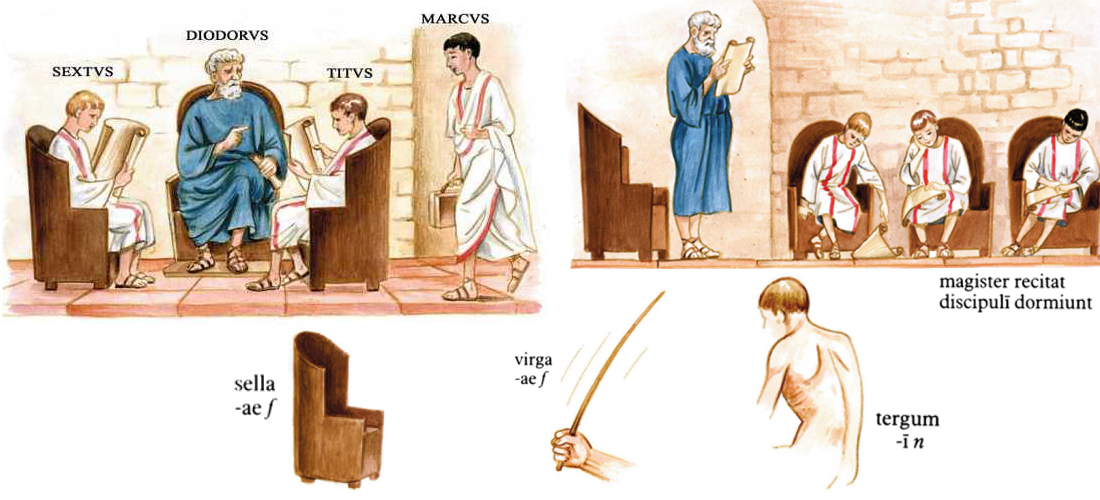
I
Marcus librum et tabulam et ceteras res ferens Tusculum ambulat. Illic est ludus puerorum. Multi pueri mane in ludum eunt.
Magister ludi est vir Graecus, cui nomen est Diodorus. Marcus magistrum metuit, Diodorus enim magister severus est, qui discipulos suos virga verberat; eo modo magister severus discipulos improbos punire solet. Discipuli sunt pueri qui in ludum eunt. Marcus et Quintus sunt duo discipuli. Alii discipuli sunt Titus et Sextus.
Sextus qui ante Marcum et Titum ad ludum advenit, primus ludum intrat. Sextus solus est, nam ceteri discipuli nondum adsunt.
Magister intrans Sextum solum in sella sedentem videt. Sextus de sella surgens magistrum salutat: “Salve, magister!”
Magister: “Salve, Sexte! Conside!”
Sextus in sella considit. Discipulus tacitus ante magistrum sedet.
Magister interrogat: “Cur tu solus es, Secte?”
“Ego solus sum, quod ceteri discipuli omnes absunt” respondet Sextus.
Exclamat magister: “O, discipulos improbos...!”
Sextus: “Num ego discipulos improbus sum?”
Magister: “Immo tu probus es discipulus, Sexte, at Marcus et Quintus et Titus improbi sunt!”
Hic Titus ad ludum advenit et ianuam pulsat antequam intrat: discipulus non statim intrat, sed primum ianuam pulsat; tum ludum intrat et magistrum salutat: “Salve, magister!”
Magister: “O Tite! Sextus iam adest...”
Titus: “At Marcus et Quintus nondum adsunt!”
Magister: “Tace, puer! Claude ianuam et conside! Aperite libros, pueri!”
Sextus statim librum suum aperit, sed Titus, qui librum non habet, “Ego” inquit “librum non habeo.”
Magister: “Quid? Sextus librum suum habet, tu librum tuum non habes? Cur librum non habes?”
Titus: “Librum non habeo, quod Marcus meum librum habet.”
Marcus walks to Tusculum carrying his book, tablet and other things. That is the boys' school. Many boys go to school in the morning.
The school's teacher is a Greek man, whose name is Diodorus. Marcus fears the teacher, for Diodorus is a strict teacher, who beats his students with a rod; he is not only strict he is accustomed to punish bad students. Students are boys who go to school. Marcus and Quintus are two students. Other students are Titus and Sextus.
Sextus who arrives to school before Marcus and Titus, enters the school first. Sextus is alone, for the other students have not arrived yet.
The teacher enters seeing Sextus sitting alone in his seat. Sextus gets up from his seat and greets the teacher: "Hail teacher!"
Teacher: "Hail Sextus! Sit down!"
Sextus sits in his seat. The student sits quietly in front of the teacher.
The teacher asks: "Why are you alone Sextus?"
Sextus answers, "I am alone, because all the other students are absent."
The teacher shouting: "O bad students...!"
Sextus: "Surely I am not a bad student am I?"
Teacher: "On the contrary you are a good student Sextus, but Marcus, Quintus and Titus are bad!"
Now Titus arrives at school and knocks on the door before entering: students do not immediately enter, but first knock on the door; then enter the school and greet the teacher: "Hail teacher!"
Teacher: "O Titus! Sextus is here already..."
Titus: "But Marcus and Quintus are not here yet!"
Teacher: "Be silent boy! Close the door and sit down! Open your books boys!"
Sextus immediately opens his book, but Titus, who does not have a book says, "I do not have a book."
Teacher: "What? Sextus has his book, you not have your book? Why don't you have your book?"
Titus: "I don't have my book, because Marcus has my book."
II
Post Titum Marcus ad ludum advenit, neque is ianuam pulsat antequam intrat. Marcus statim intrat, nec magistrum salutat.
“O Marce!” inquit Diodorus, “Cur tu ianuam non pulsas cum ad ludum venis, nec me salutas cum me vides?”
At Marcus “Ego” inquit “ianuam non pulso cum ad ludum venio, nec te saluto cum te video, quia nec Sextus nec Titus id facit.”
Sextus et Titus: “Quid?”
Marcus (ad Sextum et Titum): “Vos ianuam non pulsatis cum ad ludum venitis, nec magistrum salutatis cum eum videtis. Auditisne id quod dico?”
Tum Sextus et Titus “Id quod dicis” inquiunt “verum non est: nos ianuam pulsamus cum ad ludum venimus, et magistrum salutamus cum eum videmus. Nonne verum dicimus, magister?”
Magister: “Vos verum dicitis. Quod Marcus dicit non est verum. Discipulus improbus es, Marce! Necesse est te punire. Statim ad me veni!”
Diodorus, magister severus, tergum pueri virga verberat. (Tergum est posterior pars corporis.) Tergum dolet Marco, neque ille lacrimat, nam lacrimare puero Romano non convenit.
Marcus clamat: “Ei! Iam satis est! Desine, magister!”
Magister puerum verberare desinit et “Ad sellam tuam redi” inquit, “Atque conside!”
Marcus ad sellam suam redit, neque considit, sed tacitus ante sellam stat.
“Audisne, Marce? Ego te considere iubeo. Cur non considis?” interrogat magister.
Marcus: “Non consido, quod sedere non possum.”
Diodorus: “Cur sedere non potes?”
Marcus: “Sedere non possum, quod mihi dolet... pars tergi inferior in qua sedere soleo.”
Haec verba audientes Titus et Sextus rident.
Diodorus: “Quid ridetis, Tite et Sexte?”
Titus: “Ridemus, quod Marco dolet...”
Diodorus: “Tacete! Eam corporis partem nominare non convenit! - Sed ubi est frater tuus, Marce?”
Marcus: “Is domi est apud matrem suam. Quintus dicit 'se aegrum esse'.”
Diodorus: “Si aeger est, in ludum ire non potest. At vos bene valetis. Iam aperite libros!”
Titus: “Marcus meum librum habet.”
Diodorus: “Quid tu librum Titi habes, Marce?”
Marcus: “Ego eius librum habeo, quod is meum malum habet. Redde mihi malum meum, Tite!”
Titus ridens “Malum” inquit “tibi reddere non possum, id enim iam in ventre meo est!”
Marcus iratus Titum pulsare incipit, sed magister “Desine, Marce!” inquit, “Titus tibi malum dare non potest, at ego tibi malum dare possum, nisi hic et nunc Tito librum reddis!”
Marcus Tito librum reddit.
After Titus Marcus arrives at the school, he does not knock on the door before entering. Marcus enters immediately, he does not greet the teacher.
"O Marcus!" says Diodorus, "Why do you not knock on the door when you come to school, nor do you greet me when you see me?"
But Marcus says, "I do not knock when I come to school, nor greet you when I see you, because neither Sextus nor Titus do that."
Sextus and Titus: "What?"
Marcus (to Sextus and Titus): "You do not knock on the door when you come to school, nor do you greet the teacher when you see him. Do you hear that which I am saying?"
Then Sextus and Titus say, "That which you say is not the truth: we knock on the door when we come to school and we greet the teacher when we see him. Surely we speak the truth don't we teacher?"
Teacher: "You speak the truth. What Marcus says is not the truth. You are a bad student Marcus! It is necessary to punish you. Come to me immediately!"
Diodorus, a strict teacher, beats the rear of the boy with a rod. (The rear is the back part of the body.) The rear of Marcus is hurting, he does not cry, for it is not fitting for a Roman boy to cry.
Marcus shouts: "Ow! It is enough now! Stop teacher!"
The teacher stops beating the boy and says, "Return to your seat and sit!"
Marcus returns to his seat, he does not sit, but stands silently in front of his seat.
Do you hear Marcus? I ordered you to sit. Why are you not sitting?" asks the teacher.
Marcus: "I am not sitting down, because I cannot sit."
Diodorus: "Why can't you sit?"
Marcus: "I cannot sit, because the lower part of my rear in which I am accustomed to sit is hurting me."
Hearing these words Titus and Sextus laugh.
Diodorus: "Why are you laughing Titus and Sextus?"
Titus: "We are laughing because Marcus's ... is hurting"
Diodorus: "Be silent! It is not fitting to name that part of the body! - But where is your brother Marcus?"
Marcus: "He is at home with his mother. Quintus says that he is sick."
Diodorus: "If he is sick, he cannot go to school. But you are well. Now open your books!"
Titus: "Marcus has my book."
Diodorus: "Why do you have Titus's book Marcus?"
Marcus: "I have his book because he has my apple. Return my apple to me Titus!"
Titus laughing says, "I cannot return the apple to you, for that is now in my stomach!"
Marcus angry begins to hit Titus, but the teacher says, "Stop Marcus! Titus cannot give the apple to you, but I can give an apple to you, but not unless you return the book to Titus now!"
Marcus returns the book to Titus.
III
Discipuli libros aperiunt. Item librum suum aperit magister ac recitare incipit. Pueri autem priorem libri partem tantum audiunt, nam antequam magister partem libri posteriorem recitare incipit, omnes pueri dormiunt!
Magister recitare desint et exclamat: “O improbi discipuli! Dormitis! Quod recito non auditis!”
Marcus magistro irato “Ego” inquit “non dormio. Immo vigilo et te audio, magister.”
Item Sextus et Titus “Neque nos dormimus” inquiunt, “Vigilamus et omnia verba tua audimus. Bene recitas, Diodore! Bonus es magister!”
Magister laetus “Verum est quod dicitis” inquit, “ego bene recito ac bonus sum magister - at vos male recitatis ac mali discipuli estis!”
Discipuli: “Immo boni discipuli sumus! Bene recitamus!”
Diodorus: “Tacete! Ubi estis, pueri?”
Discipuli: “In ludo sumus.”
Diodorus: “Verum dicitis: in ludo estis - non domi in lectulis! In lectulo dormire licet, hic in ludo non licet dormire!”
Magister iratus discipulos virga verberat.
Discipuli: “Ei, ei! Quid nos verberas, magister?”
Diodorus: “Vos verbero, quod alio modo vos excitare non possum. Ad sellas vestras redite atque considite!”
Discipuli ad sellas suas redeunt, neque considunt.
Magister: “Quid non considitis?”
Discipuli: “Non considimus, quod sedere non possumus.”
Diodorus: “Quid? Sedere non potestis? Ergo vos horam totam taciti state, dum ego sedens partem libri posteriorem recito! Nec enim stantes dormire potestis!”
The students open their books. The teacher also opens his book and begins to recite. But the boys only hear the first part of the book, for before the teacher begins to recite the last part of the book, all of the boys are sleeping!
The teacher stops reciting and shouts: "O bad students! You are sleeping! You are not hearing what I recite!"
Marcus says to the angry teacher, "I am not sleeping. On the contrary I am awake and listening to you teacher."
Likewise Sextus and Titus say, "Nor are we sleeping, we are awake and we hear all of your words. You recite well Diodorus! You are a good teacher!"
The teacher smiling says, "That which you speak is the truth, I recite well and I am a good teacher - but you recite poorly and you are bad students!"
Students: "On the contrary we are good students! We recite well!"
Diodorus: "Be silent! Where are you boys?"
Students: "We are in school."
Diodorus: "You speak the truth: you are in school - not at home in bed! It is fitting to sleep in bed, it is not fitting to sleep here in school!"
The angry teacher beats the students with a rod.
Students: "Ow, ow! Why are you beating us teacher?"
Diodorus: "I am beating you, because I cannot wake you any other way. Return to your seats and sit down!"
The students return to their seats, the do not sit down.
Teacher: "Why are you not sitting?"
Students: "We are not sitting because we cannot sit down."
Diodorus: "What? You cannot sit down? Therefore you will stand the entire hour silently, while I sit reciting the last part of the book! For you cannot sleep standing up!"
GRAMMATICA LATINA
Personae verbi
Pueri rident. Puella non ridet.
Pueri: “Cur tu non rides, cum nos ridemus?”
Puella: “Ego non rideo, quia vos me ridetis!”
“Rideo ridemus” dicitur persona prima, “rides ridetis” persona secunda, “ridet rident” persona tertia.
| Singularis | Pluralis | |
| Persona prima | ride|o | ride|mus |
| Persona secunda | ride|s | ride|tis |
| Persona tertia | ride|t | ride|nt |
Exempla: [1] clam|o clama|mus; [2] ride|o ride|mus; [3]dic|o dic|imus; faci|o faci|mus; [4] audi|o audi|mus.
Malus discipulus in ludo clamat et ridet. Qui id non facit, et omnia verba magistri audit, bonus est discipulus.
Bonus discipulus malo dicit: “Ego bonus discipulus sum: in ludo nec clamo nec rideo, et omnia verba magistri audio. At tu malus discipulus es: in ludo clamas et rides nec verba magistri audis! Verum dico! Nonne hoc facis?” Malus discipulus: “Quod dicis verum non est: ego hoc non facio!”
Mali discipuli in ludo clamant et rident. Qui id non faciunt, et omnia verba magistri audiunt, boni sunt discipuli.
Boni discipuli malis dicunt: “Nos boni discipuli sumus: in ludo nec clamamus nec ridemus, et omnia verba magistri audimus. At vos mali discipuli estis: in ludo clamatis et ridetis nec verba magistri auditis! Verum dicimus! Nonne hoc facitis?” Mali discipuli: “Quod dicitis verum non est: nos hoc non facimus!”
[1] Ut “clamo clamamus” declinantur verba quorum infinitivus desinit in -are.
[2] Ut “rideo ridemus” declinantur verba quorum infinitivus desinit in -ere.
[3] Ut “dico dicimus” declinantur verba quorum infinitivus desinit in -ere, praeter ea quae -i - habent ante -o et -unt, ut “facio faciunt”: accipere, aspicere, capere, facere, fugere, iacere, incipere, parere, cet.
[4] Ut “audio audimus” declinantur verba quorum infinitivus desinit in -ire, praeter verbum ire (pers. I sing. eo, pers. III plur. eunt), item ab-ire, ad-ire, ex-ire, red-ire, cet.
Ut “sum sumus” declinantur verba quorum infinitivus desinit in -esse, ut ab-esse, ad-esse, in-esse, cet., et posse (pers. I pos-sum pos-sumus, II pot-es pot-estis, III pot-est pos-sunt).
LATIN GRAMMAR
Persons of a verb
The boys are laughing. The girl is not laughing.
Boys: "Why are you not laughing, when we are laughing?"
Girl: "I am not laughing, because you are laughing at me!"
"Rideo ridemus" are said to be first person, "rides ridetis" second person, "ridet rident" third person.
| Singular | Plural | |
| First person | I laugh | We laugh |
| Second person | You laugh | You (pl) laugh |
| Third person | he/she/it laughs | they laugh |
Examples: [1] I shout we shout; [2] I laugh We laugh; [3] I say we say; I do we do; [4] I hear We hear.
A bad student shouts and laughs in school. He who does not do this, and listens to all the teacher's words, is a good student.
A good student says to the bad: "I am a good student: I neither shout nor laugh in school, and I listen to all the teacher's words. But you are a bad student: you shout and laugh in school and do not listen to the teacher's words! I say the truth! You do this don't you?" Bad student: "What you say is not true: I do not do this!"
Bad students shout and sleep in school. They who do not do this, and listen to all the words of the teacher, are good students.
Good students to the bad: "We are good students: we neither shout nor sleep in school, and we listen to all the teacher's words. But you are bad students, you shout and laugh in school and do not listen to the teacher's words. We say the truth! You do this don't you?" Bad students: "What you say is not true: we do not do this!"
[1] Words which the infinitive ends in -are are declined like "clamo clamamus"
[2] Words which the infinitive ends in -ere are declined like "rideo ridemus"
[3] Words which the infinitive ends in -ere are declined like "dico dimimus" except that which has -i before -o and -unt, like "facio faciunt": receive, look, take, make, flee, lie down, begin, obey, etc.
[4] Words which the infinitive ends in -ire are declined like "audio audimus" except the word go (1 pers. sing. I go, 3 pers. plur. they go), likewise go from, go to, go out, go back, etc.
Words which the infinitive ends in -esse are declined like "sum sumus", like be away, be present, be in, etc., and posse (1 pers. I can we can, 2 you can you can, 3 he can they can).
VOCABVLA
ludus, i m.
magister, magistri n
discipulus, i m.
virga, ae f.
sella, ae f.
ianua, ae f.
verum, i n.
tergum, i n.
malus, a, um
lectulus, i m.
severus, a, um
tacitus, a, um
verus, a, um
posterior
inferior
prior
punio, -ire, -ivi, -itum
consido, -ere, -considi, consessum
exclamo, -are, -avi, -atum
desino, -are, -avi, -atum
redeo, redire, redivi, reditum
reddo, reddere, reddidi, redditum
recito, -are, -avi, -atum
licet
sum
es
sumus
estis
ego
tu
nos
vos
nondum
statim
tum
quid?
domi
antequam
at
si
nisi
VOCABULARY
game, school
teacher, master
student
twig, switch, rod
seat, chair
door, entrance
truth, in truth, yes
back, rear
bad, evil
bed, couch
severe, stern, strict
quiet, silent
true, real
next, latter
below, benaeth
ahead, in front, leading
to punish
sit down
to shout, to exclaim
to stop, to end, to finish
to return, to go back
to return, hand over
to read aloud, recite
it is permitted; one may
I am
you are
we are
you all are
I
you
we
you (plural)
not yet
at once, immediately
then
what?
at home
before
but
if
if not, unless