CAPITVLVM QVARTVM DECIMVMFOURTEENTH CHAPTER
NOVVS DIESNEW DAY
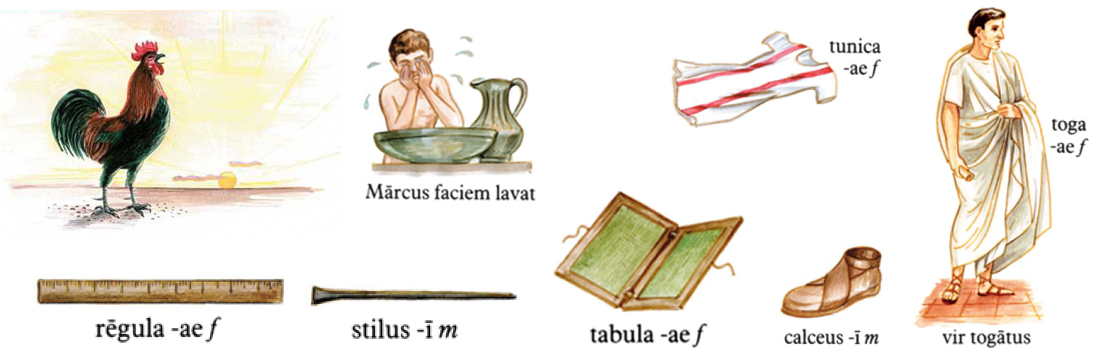
I
Nox est. Familia dormit. Villa Iulii obscura et quieta est. Marcus quietus in lecto suo cubat; is bene dormit. Quintus dormire non potest, quod et caput et pes ei dolet. Bracchium quoque dolet Quinto; itaque is non dormit, sed vigilat.
Cubiculum in quo Quintus cubat non magnum est, nec magnum est cubiculum Marco. Utrumque cubiculum parvum est. Uterque puer cubat in cubiculo parvo, neuter in cubiculo magno. Neutrum cubiculum magnum est. Uterque puer quietus est, neuter puer se movet. Alter puer dormit, alter vigilat. Alter e duobus pueris valet, alter aegrotat. Uter puer aegrotat, Marcusne an Quintus? Quintus aegrotat, Marcus valet.
Aer frigidus cubiculum Marci intrat, fenestra enim aperta est. Marcus fenestra aperta dormit. Fenestra Quinti aperta non est. Altera e duabus fenestris est aperta, altera clausa. Utra fenestra clausa est? Fenestra Quinti. Is fenestra clausa dormit, quia aeger est.
Ecce gallus canit: “Cucurru! Cucurru!” Gallus canens novum diem salutat.
Marcus oculos non aperit neque se movet. Quintus, qui oculis apertis iacet, super lectum se vertit. Puer dormiens gallum canentem non audit. Puer vigilans gallum audit, et Davum vocat.
Davus cubiculum intrans interrogat: “Quomodo se habet pes tuus hodie?”
Quintus respondet: “Pes male se habet, nec pes tantum, sed etiam caput et bracchium dolet. O, quam longa nox est! Sed iam mane est, nam gallus canit. Da mihi aquam, Dave!”
Davus Quinto aquam in poculo dat. Puer aquam bibit. Servus puerum bibentem aspicit.
It is night. The family sleeps. Julius's villa is dark and quiet. Marcus lies quiet in his bed; he is sleeping well. Quintus cannot sleep, because both his head and foot are hurting. Quintus's arm is also hurting; therefore he is not sleeping, but awake.
The room in which Quintus lies is not large, nor is Marcus's room large. Each room is small. Each boy lies in a little room, neither in a large room. Neither room is large. Each boy is quiet, neither boy moves himself. One boy sleeps, another is awake. One of the two boys is well, the other is sick. Which boy is sick, Marcus or Quintus? Quintus is sick, Marcus is well.
Cold air enters Marcus's room, for the window is open. Marcus sleeps with the window open. Quintus's window is not open. One of the two windows is open, the other closed. Which window is closed? Quintus's window. He sleeps with a closed window, because he is sick.
Behold the rooster sings: "Cucurru! Cucurru!" The rooster sings greeting the new day.
Marcus does not open his eyes nor move himself. Quintus, who lies with open eyes, turns himself on this bed. The sleeping boy does not hear the rooster singing. The awake boy hears the rooster and calls Davus.
Davus entering the room asks: "How is your foot today?"
Quintus answers: "My foot is bad, not only my foot, but also my head and arm hurt. O, what a long night! But now it is morning, for the rooster sings. Give water to me Davus!"
Davus gives water in a cup to Quintus. The boy drinks the water. The slave sees the boy drinking.
II
Davus Quintum in lecto iacentem relinquit et cubiculum Marci intrat. Marcus adhuc dormit. Davus ad puerum dormientem adit eumque excitat. Quomodo servus puerum excitat? In aureum pueri dormientis magna voce clamat: “Marce! Mane est!” Eo modo excitatur Marcus, et oculos aperiens servum apud lectum stantem videt. Iam neuter e duobus pueris dormit.
“Hora prima est” inquit Davus, “Surge e lecto!”
Marcus e lecto surgit. Iam non cubat in lecto, sed ante lectum stat. Marcus Davum aquam afferre iubet: “Affer mihi aquam ad manus!”
Servus Marco aquam affert et “Ecce aqua” inquit, “Lava faciem et manus! Manus tuae sordidae sunt.”
Marcus primum manus lavat, deinde faciem.
Davus: “Aures quoque lava!”
“Sed aures” inquit Marcus “in facie non sunt!”
Davus: “Tace, puer! Non modo faciem, sed totum caput lava! Merge caput in aquam!”
Marcus caput totum in aquam mergit atque etiam aures et capillum lavat. Iam totum caput eius purum est. Aqua non est pura, sed sordida.
Aqua qua Marcus lavatur frigida est; itaque puer manus et caput solum lavat, non totum corpus. Mane Romani faciem et manus aqua frigida lavant; post meridiem totum corpus lavant aqua calida.
Marcus caput et manus tergens Davum interrogat: “Cur frater meus tam quietus est?”
Davus respondet: “Quintus adhuc in lecto est.”
Marcus: “In lecto? Quintus, qui ante me surgere solet adhuc dormit! Excita eum!”
“Non dormit” inquit Davus, “Frater tuus vigilat, nec surgere potest, quod pes et caput ei dolet.”
Marcus: “Mihi quoque caput dolet!
Davus: “Tibi nec caput nec pes dolet! Caput valens non dolet nec membra valentia.”
Per fenestram apertam intrat aer frigidus. Marcus friget, quod corpus eius nudum est (id est sine vestimentis); itaque Marcus vestimenta sua a servo poscit: “Da mihi tunicam et togam! Vesti me!” Davus puero frigenti tunicam et togam dat, neque eum vestit: necesse est puerum ipsum se vestire. Marcus primum tunicam induit, deinde togam. Puer iam nudus non est.
Davus leaves Quintus lying in his bed and enters Marcus's room. Marcus sleeps now. Davus goes to the sleeping boy and wakes him. How does the slave wake the boy? He shouts in the sleeping boy's ear with a loud voice: "Marcus! It is morning!" Just that wakes Marcus and opening his eyes he sees the slave standing among the bed. Now neither of the two boys are sleeping.
"It is the first hour" says Davus, "Get up from bed!"
Marcus gets up from the bed. Now he is not lying in bed, but standing in front of the bed. Marcus orders Davus to bring water: "Bring water to me to my hand!"
The slave brings ware to Marcus and says, "Here is the water. Wash your face and hands! Your hands are dirty."
Marcus first washes his hands, then his face.
Davus: "Wash your ears also!"
"But ears" Marcus said, "are not on the face!"
Davus: "Be silent boy! Not only your face, but wash your whole head! Submerge your head in the water!"
Marcus submerges his entire head in the water and also washes his hears and hair. Now his entire head is clean. The water is not clean but dirty.
The water which Marcus washes is cold; therefore the boy washes his hands and head alone, not his entire body. In the morning Romans wash their face and hands with cold water; after noon they wash their entire body with hot water.
Marcus wiping his head and hands asks Davus: "Why is my brother so quiet?"
Davus answers: "Quintus is lying in his bed now."
Marcus: "In bed? Quintus who is accustomed to get up before me! Wake him!"
"He is not sleeping" Davus says, "your brother is awake, he cannot get up, because his foot and head hurt him."
Marcus: "My head is also hurting me!"
Davus: "Neither your head nor your foot is hurting you! Your head is well not hurting nor your arm which is well."
Cold air enters through the open window. Marcus is cold because his body is nude (that is it is without clothes); therefore Marcus calls for his clothes from the slave: "Give me my tunic and toga! Dress me!" Davus gives the tunic and toga to the cold boy, he does not dress him: it is necessary that the boy dress himself. Marcus puts on the tunic first then the toga. Now the boy is not nude.
III
(Toga est vestimentum album, quod viri et pueri Romani gerunt. Graeci et barbari togam non gerunt. Multis barbaris magna corporis pars nuda est. Viro togato nulla pars corporis est nuda praeter bracchium alterum. Utrum bracchium viro togato nudum est, dextrumne an sinistrum? Bracchium dextrum est nudum, bracchium sinistrum toga operitur. Milites togam non gerunt, nemo enim togatus gladio et scuto pugnare potest. Utra manu miles gladium gerit? Manu dextra gladium gerit, scutum gerit manu sinistra.)
Marcus, qui pedibus nudis ante lectum stat, calceos poscit: “Da mihi calceos! Pedes frigent mihi.” Davus ei calceos dat, et eum secum venire iubet: “Veni mecum! Dominus et domina te exspectant.”
Marcus cum servo atrium intrat, ubi parentes sedent liberos exspectantes. Ante eos in parva mensa panis et mala sunt. Parentes a filio intrante salutantur: “Salvete, pater et mater!” et ipsi filium intrantem salutant: “Salve, Marce!”
Mater alterum filium non videns Davum interrogat: “Quintus quomodo se habet hodie?”
Davus: “Quintus dicit 'non modo pedem, sed etiam caput dolere'.”
(A toga is white clothing, which is worn by Roman men and boys. Greeks and barbarians do not wear a toga. Many barbarians are naked on large parts of their bodies. A man with a toga is naked on no part of his body besides one arm. Which arm of a man with a toga is naked, the right or the left? The right arm is nude, the left arm is covered by the toga. Soldiers do not wear a toga, for no one wearing a toga can fight with sword and shield. With which hand does a soldier carry a sword? He carries the sword with his right hand, he carries the shield with his left hand.)
Marcus, who stands with bare feet in front of the bed, calls for shoes: "Give my shoes to me! My feet are cold." Davus gives shoes to him, and commands him to come with him: "Come with me! The master and mistress are waiting for you."
Marcus enters the atrium with the slave, where his parents sit waiting for the children. Behind them on a little table is bread and apples. The parents are greeted by their son entering: "Hail father and mother!" and they greet their son entering: "Hail Marcus!"
The mother not seeing her other son asks Davus: "How is Quintus doing today?"
Davus: "Quintus says, 'not only his foot, but also his head is hurting'."
Aemilia surgit et ad filium aegrotantem abit. Mater filio suo aegrotanti panem et malum dat, sed ille, qui multum esse solet, hodie nec panem nec malum est. Puer aegrotans nihil esse potest.
Marcus autem magnum malum a patre poscit: “Da mihi illud malum, pater! Venter vacuus est mihi.”
Iulius Marco panem dans “Primum es panem” inquit, “deinde malum!”
Marcus panem suum est. Deinde pater ei in utrumque manum malum dat, et “Alterum malum nunc es” inquit, “alterum tecum fer!”
Davus Marco librum et tabulam et stilum et regulam affert.
Iulius: “Ecce Davus tibi librum et ceteras res tuas affert. Sume res tuas atque abi!”
“Sed cur non venit Medus?” inquit Marcus, qui Medum adhuc in familia esse putat. Is servus cum pueris ire solet omnes res eorum portans. Marcus ipse nullam rem portare solet praeter malum.
Iulius: “Medus tecum ire non potest. Hodie necesse est te solum ambulare.”
Marcus: “...atque me ipsum omnes res meas portare? Cur ille servus mecum venire non potest ut solet? Etiamne Medo caput dolet?”
Iulius: “Immo bene valet Medus, sed hodie alias res agit.”
Marcus: “Quae sunt illae res?”
Iulius nihil ad hoc respondet et “Iam” inquit “tempus est discedere, Marce.”
Marcus malum, librum, tabulam, stilum regulamque secum ferens e villa abit. Filius a patre discedens “Vale, pater!” inquit.
“Vale, Marce!” respondet pater, “Bene ambula!”
Quo it Marcus cum rebus suis? Vide capitulum quintum decimum!
Emilia gets up and goes to her sick son. The mother gives bread and an apple to her sick son, but he, who is accustomed to eating an apple, eats neither the bread nor the apple. The sick boy can eat nothing.
But Marcus demands a large apple from father: "Give that apple to me father! My stomach is empty."
Julius giving bread to Marcus says, "Eat bread first then an apple!"
Marcus eats his bread. Then father gives an apple to him in each hand, and says, "Eat one apple now and carry the other with you!"
Davus brings a book, tablet, pencil, and ruler to Marcus.
Julius: "Behold Davus brings your book and other things to you. Pick up your things and go!"
"But why is Medus not coming?" Marcus says, who thinks Medus to still be among the family. That slave is accustomed to go with the boys carrying all of their things. Marcus himself is accustomed to carry nothing besides his apple.
Julius: "Medus cannot go with you. Today it is necessary for you to walk alone."
Marcus: "...and to carry all of my things myself? Why can that slave not come with me like he is accustomed to? Is Medus's head hurting?"
Julius: "On the contrary Medus is very well, but today he is doing other things."
Marcus: "What are those things?"
Julius answers nothing to this and says, "Now it is time to leave Marcus."
Marcus goes out of the villa carrying an apple, book, tablet, pencil and ruler with him. The son departing from his father says, "Be well father!"
"Be well Marcus!" father responds, "Walk well!"
Where is Marcus going with this things? See chapter fifteen!
GRAMMATICA LATINA
Participium
Puer vigilans in lecto iacens gallum canentem audit. Gallus canens non auditur a puero dormiente. Puer dormiens servum claamantem audit, nec a gallo canente, sed a servo clamante excitatur. Non vox galli canentis, sed vox servi clamantis puerum dormientem excitat.
Pueri vigilantes gallos canentes audiunt. Galli canentes a pueris dormientibus non audiuntur. Pueri dormientes servos clamantes audiunt, nec a gallis canentibus, sed a servis clamantibus excitantur. Non voces gallorum canentium, sed voces servorum clamantium pueros dormientes excitant.
Caput valens non dolet nec membra valentia. Canis animal volans non est; animalia volantiía sunt aves. Milites inter pila volantia pugnant.
"Vigilans", "iacens, "canens", "dormiens" participia sunt. Participium est adiectivum declinationis III: gen. sing. -ant|is, -ent|is (abl. sing. -e vel -i).
LATIN GRAMMAR
Participle
The awake boy lying in bed hears the rooster crowing. The singing rooster is not heard by the sleeping boy. The sleeping boy hears the slave shouting, he is woken up not the rooster crowing, but by the slave shouting. Not the voice of the crowing rooster, but the voice of the shouting slave wakes the sleeping boy.
The awake boys hear the crowing roosters. The crowing roosters are not heard by the sleeping boys. The sleeping boys hear the slaves shouting, they are woken up not by the roosters crowing, but by the slaves shouting. Not the voices of the singing roosters, but the voices of the shouting slaves wakes up the sleeping boys.
A head that is well does not hurt nor do limbs that are well. The dog is not a flying animal; birds are flying animals. Soldiers fight between flying javelins.
"Waking", "lying down", "singing", "sleeping" are participles. A participle is an adjective of the third declension: gen. sing. -ant|is, -ent|is (abl. sing. -e or -i).
VOCABVLA
gallus, i m.
vestimentum, i n.
tunica, ae f.
toga, ae f.
calceus, i m.
parens, parentis c.
tabula, ae f.
stilus, i m.
regula, ae f.
res, rei f.
aperio, aperire, aperui, apertum
claudo, claudere, clausi, clausus
sordidus, a, um
purus, a, um
nudus, a, um
togatus, a, um
dexter, dextra, dextrum
sinister, sinistra, sinstrum
omnis, omnis, omne
cubo, cubare, cubui, cubitus
vigilo, -are, -avi, -atus
valeo, valere, valui, valitus
excito, -are, -avi, -atus
surgo, surgere, surrexi, surrectus
affero, afferre, attuli, allatus
lavo, lavare, lavi, lautus
mergo, mergere, mersi, mersus
soleo, solere, solitus sum
frigeo, frigere
dexter, dextra, dextrum
vestio, vestire, vestivi, vestitus
induo, induere, indui, indutus
gero, gerere, gessi, gestus
inquit
uterque
neuter, neutra, neutrum
alter, altera, alterum
uter, utra, utrum?
mihi
tibi
mecum
tecum
secum
nihil
quomodo
hodie
adhuc
primum (adv)
deinde
praeter
an
vale
participium
VOCABULARY
rooster
clothing
tunic, shirt
toga, outer clothes
shoe
parent
writing tablet
stylus, pencil
ruler
thing
to open
to close
dirty
pure, clean
bare, nude
wearing a toga
right, right hand
left, left hand
each, all, every one
to lie down, recline
to remain awake
to be strong
to rouse, to wake
to rise, to lift
to bring to
to wash, to soak
to dip, plunge, sink
to be in the habit of
to be cold
to ask, to demand
to clothe
to put on, to clothe
to bear, to carry
he, she, or it says
which (of two)
neither
one (of two)
which (of two)
to me
to you
with me
with you
with him, her, it
nothing
how, in what way
today
thus far, yet, still
at first
then, next
besides, except
or
goodbye, be strong
participle