CAPITVLVM UNDECIMVMELEVENTH CHAPTER
CORPVS HVMANVMTHE HUMAN BODY
I
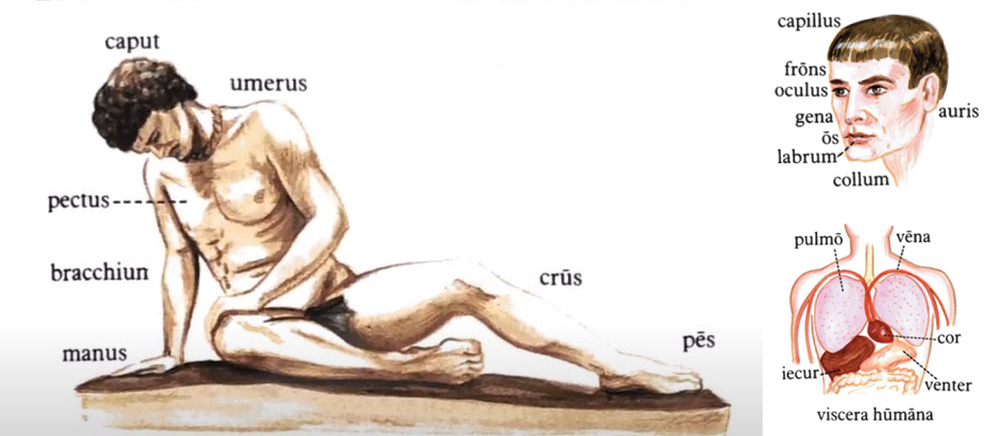
Corpus humanum quattuor membra habet: duo bracchia et duo crura. Bracchium membrum est et crus membrum est. In bracchio est manus, in crure pes. Duae manus et duo pedes in corpore humano sunt.
In corpore unum caput est, non duo capita. In capite sunt oculi et aures, nasus et os. Super caput capillus est. Capillus virorum non tam longus est quam feminarum. Supra oculos frons est. Infra oculos genae sunt. Post frontem est cerebrum. Qui cerebrum parvum habet stultus est. Os est inter duo labra. In ore lingua et dentes insunt. Dentes sunt albi ut margaritae. Lingua et labra rubra sunt ut rosae.
Homines oculis vident et auribus audiunt. Homo qui oculos bonos habet bene videt, qui oculos malos habet male videt. Qui aures bonas habet bene audit, qui aures malas habet mala audit. Syra male audit, ea enim aures malas habet.
Caput est super collum. Sub collo est pectus. In pectore cor et pulmones sunt. In corde est sanguis, qui per venas ad cor fluit. Color sanguinis est ruber. Infra pulmones est iecur et venter. In ventre cibus est. Cor, pulmones, iecur, venter sunt viscera humana.
Homo qui ventrem malum habet cibum sumere non potest, neque is sanus, sed aeger est. Homo sanus ventrem bonum, pulmones bonos, cor bonum habet.
Medicus ad hominem aegrum venit eumque sanum facit. Medicus est vir qui homines aegros sanat, sed multi aegri a medico sanari non possunt.
Estne sanus Quintus? Non est: pes eius aeger est. Puer super lectum iacet. Aemilia et Syra apud puerum aegrum sunt. Mater apud eum sedet manumque eius tenet. Syra non sedet, sed apud lectum stat. Quintus iacet. Aemilia sedet. Syra stat.
Aemilia: “Ecce malum, Quinte.”
Aemilia puero aegro malum rubrum dat, neque is malum esse potest. Mater ei poculum aquae dat.
Aemilia: “Bibe aquam modo!”
Mater caput Quinti sustinet, dum puer aquam bibit.
Aemilia: “Iam dormi, Quinte! Dormi bene!”
Mater manum ponit in fronte filii: frontem eius tangit. Quintus oculos claudit atque dormit.
The human body has four limbs: two arms and two legs. The arm is a limb and the leg is a limb. On the arm is the hand, on the leg the foot. There are two hands and two feet on the human body.
On the body there is one head, not two heads. On the head there are eyes and ears, a nose and mouth. Above the head is hair. The hair of men is not as long as that of women. Above the eyes is the forehead. Below the eyes are cheeks. Behind the forehead is the brain. He who has a little brain is stupid. The mouth is between two lips. In the mouth there is a tongue and teeth. Teeth are white like pearls. The tongue and lips are red like roses.
Men see with eyes and hear with ears. A man who has good eyes sees well, he who has bad eyes sees poorly. He who has good ears hears well, he who has bad ears hears poorly. Syra hears poorly, for she has bad ears.
The head is above the neck. Bellow the neck is the chest. On the chest there is the heart and lungs. In the heart there is blood, that flows through veins to the heart. The color of blood is red. Below the lungs there is the liver and stomach. In the stomach there is food. The heart, lungs, liver, stomach are human organs.
A man who has a bad stomach cannot take food, nor is he healthy but sick. A healthy man has a good stomach, good lungs, a good heart.
A doctor comes to sick men and makes them well. A doctor is a man who cures sick men, but many of the sick cannot be cured by a doctor.
Is Quintus healthy? He is not: his foot is injured. The boy lies on top of the bed. Emelia and Syra are with the sick boy. The mother holds his hand and sits with him. Syra is not sitting, but standing near the bed. Quintus is lying. Emelia is sitting. Syra is standing.
Emilia: "Here is an apple Quintus."
Emilia gives an apple to the sick boy, nor can he eat the apple. The mother gives a cup of water to him.
Emilia: "Just drink water!"
The mother holds Quintus's head, while the boys drinks the water.
Emelia: "Now sleep Quintus! Sleep well!"
The mother places her hand on her sons forehead: she touches his forehead. Quintus closes his eyes and sleeps.
II
Iulius, qui cum Syro servo in atrio est, imperat: “I ad oppidum, Syre, atque medicum arcesse!”
Medicus Tusculi habitat. Iulius servum suum Tusculum ire iubet atque medicum arcessere. Syrus equum ascendit, ad oppidum it, medicum arcessit. Servus cum medico ad villam revenit.
Medicus interrogat: “Quis aegrotat?”
Iulius: “Meus Quintus filius aegrotat; ambulare non potest.”
Medicus: “Cur ambulare non potest?”
Iulius: “Quia pes eius aeger est. Puer stultus est, medice: nidum in arbore reperit, arborem ascendit, de arbore cadit! Itaque pedem aegrum habet nec ambulare potest. Nec modo pede, sed etiam capite aeger est.”
Iulius medicum ad cubiculum Quinti ducit. Medicus cubiculum intrat, ad lectum adit atque puerum aspicit. Quintus quietus super lectum iacet nec oculos aperit. Medicus puerum dormire videt.
Medicus dicit: “Puer dormit.”
Syra, quae male audit, id quod medicus dicit audire non potest; itaque interrogat: “Quid dicit medicus?”
Aemilia (in aurem Syrae): “Medicus 'puerum dormire' dicit.”
Quintus oculos aperit atque medicum adesse videt. Puer, qui medicum timet, nullum verbum facere audet.
Medicus: “Os aperi, puer! Linguam ostende!”
Syra: “Quid dicit medicus?”
Aemilia: “Medicus Quintum os aperire atque linguam ostendere iubet.”
Quintus os aperit atque medico linguam ostendit. Medicus linguam eius rubram esse videt.
Medicus: “Lingua eius rubra est.”
Syra: “Quid dicit?”
Aemilia: “Dicit 'linguam eius rubram esse'.”
Medicus etiam dentes Quinti spectat et inter dentes albos unum nigrum videt. Non sanus est dens qui colorem nigrum habet.
Medicus: “Puer dentem aegrum habet.”
Quintus: “Sed dens non dolet; ergo dens aeger non est. Pes dolet - et caput.”
Syra: Quid dicunt?”
Aemilia: “Medicus dicit 'Quintum dentem aegrum habere', et Quintus dicit 'pedem et caput dolere, non dentem'.”
Iulius: “Non dentem, sed pedem modo sana, medice!”
Medicus pedem Quinti spectat atque digitum ad pedem apponit: medicus pedem eius tangit. Puer digitum medici in pede suo sentit.
Quintus: “Ei, ei! Pes dolet!”
Julius, who is with the slave Syrus in the atrium, commands : "Go to the town and fetch the doctor!"
The doctor lives in Tusculum. Julius commands his slave to go to Tusculum and fetch the doctor. Syrus mounts a horse, goes to town, and fetches the doctor. The slave returns to the villa with the doctor.
The Doctor asks: "Who is sick?"
Julius: "My son Quintus is sick; he cannot walk."
Doctor: "Why can't he walk?"
Julius: "Because his foot is hurt. The boy is stupid doctor: he found a nest in the tree, climbed the tree, and fell from the tree! Therefore he has a hurt foot and cannot walk. Not only his foot, but his head is hurt also."
Julius leads the doctor to Quintus's room. The doctor enters the room, goes to the bed and looks at the boy. Quintus lies quietly on the bed but does not open his eyes. The doctor sees the boy sleeping.
The doctor says: "The boy is sleeping."
Syra who hears poorly, cannot hear what the doctor says; therefore she asks: "What is the doctor saying?"
Emilia (in Syra's ear): "The doctor says 'the boy is sleeping."
Quintus opens his eyes and see the doctor present. The boy, who fears the doctor, dares not to make a word.
Doctor: "Open your mouth boy! Show your tongue!"
Syra: "What is the doctor saying?"
Emilia: "The doctor orders Quintus to open his mouth and show his tongue."
Quintus opens his mouth and shows his tongue. The doctor sees his tongue is red.
Doctor: "His tongue is red."
Syra: "What is he saying?"
Emilia: "He says 'his tongue is red.'"
The doctor also looks at Quintus's teeth and sees a black one among the white teeth. A tooth is not healthy that has a black color.
Doctor: "The boy has a sick tooth."
Quintus: "But the tooth does not hurt; therefore the tooth is not sick. My foot and head hurt."
Syra: "What are they saying?"
Emilia: "The doctor says 'Quintus has a sick tooth.' and Quintus says 'his foot and heat are hurting not his tooth'"
Julius: "Doctor don't cure his tooth, but only his foot!"
The doctor looks at Quintus's foot and places his finger to his foot: the doctor touches his foot. The boy feels the doctor's finger on his foot.
Quintus: "Ow, ow! My foot is hurting!"
III
Medicus (ad Iulium): “Tene bracchium pueri!” (ad Aemiliam): “Tene poculum sub bracchio!” (ad Quintum): “Claude oculos, puer!” Medicus Quintum oculos claudere iubet, quod puer cultrum medici timet.
Ecce medicus cultrum ad bracchium pueri apponit. Perterritus Quintus cultrum medici sentit in bracchio, nec oculos aperire audet. Capilli horrent. Cor palpitat. Medicus venam aperit. Ruber sanguis de bracchio in poculum fluit. Quintus sanguinem de bracchio fluere sentit atque horret. Frons et genae albae sunt ut lilia...
Medicus puerum oculos aperire iubet: “Aperi oculos, puer!” neque Quintus oculos aperit. Puer quietus super lectum iacet ut mortuus.
Syra: “Cur Quintus oculos non aperit? - O dei boni! Puer mortuus est!”
Quintus autem spirat, ergo mortuus non est. Sed Syra eum mortuum esse putat, quod eum spirare non audit. Iulius et Aemilia filium suum quietum spectant - atque tacent.
Medicus manum super pectus pueri imponit eumque spirare et cor eius palpitare sentit.
Medicus: “Puer spirat et cor eius palpitat.”
Aemilia gaudet quod filius vivit.
Syra: “Quid dicit medicus?”
Aemilia: “Medicus dicit 'Quintum spirare et cor eius palpitare.' Ergo Quintus vivit.”
Syra Quintum vivere gaudet.
Aemilia sanguinem de bracchio filii deterget. Iam puer oculos aperit.
Quintus: “Ei! Dolet bracchium!”
Mater filium vivum esse videt et audit.
Aemilia imperat: “Aquam arcesse, Syra!” neque ancilla verba dominae audit.
Iulius: “Domina te aquam arcessere iubet, Syra!”
Syra abit, atque revenit cum alio poculo aquae pleno. Aemilia poculum tenet, dum Quintus bibit.
Medicus: “Iam necesse est puerum dormire.”
Exit medicus. Quintus, qui medicum horret, eum abesse gaudet.
Iulius: “Iam filius noster non modo pede, sed etiam bracchio aeger est.”
Aemilia: “Ille medicus crassus filium nostrum sanare non potest.” Aemilia non putat medicum puerum aegrum sanare posse.
Syra: “Stultus est medicus! Neque cor reque cerebrum habet!”
Syra 'medicum stultum esse' dicit. Iulius et Aemilia eum stultum esse putant, non dicunt.
Doctor (to Julius): "Hold the boy's arm!" (to Emilia): "Hold the cup below his arm!" (to Quintus): "Close your eyes boy!" The doctor orders Quintus to close his eyes, because the boy fears the doctor's knife.
Behold the doctor places the knife to the boy's arm. Terrified Quintus feels the doctor's knife on his arm, he does not dare open his eyes. His hairs stand on end. His heart is beating. He doctor opens his vein. Red blood flows from his arm into the cup. Quintus feels the blood flow from his arm and shudders. His forehead and cheeks are white like lilies...
The doctor commands the boy to open his eyes: "Open your eyes boy!" but Quintus does not open his eyes. The boy silent lays on the bed like he is dead.
Syra: "Why is Quintus not opening his eyes? O good gods! The boy is dead!"
But Quintus is breathing, therefore he is not dead. But Syra thinks him to be dead, because she does not hear him breathing. Julius and Emilia look at their quiet son and they remain silent.
The doctors places his hand on the boy's chest and feels him breathing and his heart beating.
Doctor: "The boy is breathing and his heart is beating."
Emilia rejoices because her son is alive.
Syra: "What is the doctor saying?"
Emilia: "The doctor says 'Quintus is breathing and his heart is beating.' Therefore Quintus is alive."
Syra rejoices Quintus is alive.
Emilia wipes the blood from his sons arm. Now the boy opens his eyes.
Quintus: "Ow! My arm is hurting!"
The mother sees and hears her son is alive.
Emilia commands: "Send for water Syra!" the handmaid does not hear the mistress's words.
Julius: "The mistress ordered you to bring water Syra!"
Syra goes away and returns with another cup full of water. Emilia holds the cup while Quintus drinks.
Doctor: "Now it is necessary for the boy to sleep."
The doctor leaves. Quintus who shudders at the doctor, rejoices with him away.
Julius: "Now not only our son's foot, but also his arm is injured."
Emilia: "That fat doctor cannot heal our son." Emilia does not think the doctor can heal her sick son.
Syra: "The doctor is stupid! He has neither heart nor a brain!"
Syra says 'the doctor is stupid.' Julius and Emilia think him to be stupid, they do not say it.
GRAMMATICA LATINA
Declinatio tertia
[A/B] Masculinum et femininum.
Vocabula masculina: pastor, mercator, clamor, timor, color, sol, aer, venter, leo, pulmo, homo, pes, sanguis; panis, collis, piscis, mons, dens, cet.
Vocabula feminina: ovis, vallis, avis, auris, nubes, frons, arbor, vox, praepositio, declinatio, cet.
[C] Neutrum.
Vocabula neutra: flumen, os, crus, corpus, pectus, iecur,
caput, cor; viscera (pl); mare, animal, cet.
Pluralis: -a. Accusativus = nominativus.
'Corpus' et 'flumen' declinantur hoc modo:
| Sing. | Plur. | Sing. | Plur. | |
| Nom. | corpus | corpor|a | flumen | flumin|a |
| Acc. | corpus | corpor|a | flumen | flumin|a |
| Gen. | corpor|is | corpor|um | fluem|is | flumin|um |
| Dat. | corpor|i | corpor|ibus | fluem|i | flumin|ibus |
| Abl. | corpor|e | corpor|ibus | flumen|e | flumin|ibus |
Ut 'corpus' declinantur: pectus -or|is, os or|is, crus crur|is, iecur -or|is (cor cord|is, caput -it|is); pluralis: viscer|a -um.
'Mare' et 'animal' hoc modo deeclinantur:
| Sing. | Plur. | Sing. | Plur. | |
| Nom. | mar|e | mar|ia | animal | animal|ia |
| Acc. | mar|e | mar|ia | animal | animal|ia |
| Gen. | mar|is | mar|ium | animal|is | animal|ium |
| Dat. | mar|i | mar|ibus | animal|i | animal|ibus |
| Abl. | mar|i | mar|ibus | animal|i | animal|ibus |
Accusativus cum infinitivo
Iulia dormit. Syra Iuliam dormire videt.
Syra: 'Iulia dormit.' Syra 'Iuliam dormire' dicit.
'Iuliam dormire' est accusativus cum infinitivo. Accusativus cum infinitivo ponitur apud multa verba:
[1] videre, audire, sentire: Puer medicum adesse videt. Pueri
Iuliam canere audiunt. Medicus puerum spirare sentit.
[2] iubere: Dominus servum discedere iubet.
[3] dicere: Quintus 'pedem dolere' dicit.
[4] putare: Syra Quintum mortuum esse putat.
[5] gaudere: Aemilia filium vivere gaudet.
[6] necesse esse: Puerum dormire necesse est.
LATIN GRAMMAR
Third declension
[A/B] Masculine and feminine
Masculine words: shepherd, merchant, shout, fear, color, sun, air, stomach, lion, lung, man, foot, blood, bread, hill, fish, mountain, tooth, etc.
Feminine words: sheep, valley, bird, ear, cloud, forehead, tree, voice, preposition, declension, etc.
[C] Neuter.
Neuter words: river, mouth, leg, body, chest, liver, head, heart, organs (pl), sea, animal, etc.
Plural -a. Accusative = nominative.
'Body' and 'river' are declined this way:
| Sing. | Plur. | Sing. | Plur. | |
| Nom. | body | bodies | river | rivers |
| Acc. | body | bodies | river | rivers |
| Gen. | body's | bodies' | river's | rivers' |
| Dat. | to a body | to the bodies | to a river | to the rivers |
| Abl. | with a body | with the bodies | with a river | with the rivers |
Chest, mouth, leg, liver, (heart, head): are declined like 'body.' Plural: organs.
'Sea' and 'animal' are declined this way:
| Sing. | Plur. | Sing. | Plur. | |
| Nom. | sea | seas | animal | animals |
| Acc. | sea | seas | animal | animals |
| Gen. | sea's | seas' | animal's | animals' |
| Dat. | to the sea | to the seas | to the animal | to the animals |
| Abl. | with the sea | with the seas | with the animal | with the animals |
Accusative with the infinitive
Julia is sleeping. Syra sees Julia sleeping.
Syra: 'Julia is sleeping.' Syra says 'Julia is sleeping.'
'Iuliam dormire' is the accusative with the infinitive. The accusative with the infinitive is placed with many verbs:
[1] see, hear, feel: The boy sees the doctor is here. The boys hear Julia singing. The doctor feels the boy breathing.
[2] command: The master commands the slave to leave.
[3] say: Quintus says 'his foot is hurting.'
[4] think: Syra thinks Quintus is dead.
[5] rejoice: Emilia is pleased her son lives
[6] necessary: It is necessary for the boy to sleep.
VOCABVLA
corpus, corporis n.
membrum, i n.
bracchium, i n.
crus, cruris n.
manus, us f.
caput, capitis n.
auris, auris f.
os, oris n.
capillus, i m.
frons, frontis m.
gena, ae f.
cerebrum, i n.
labrum, i n.
lingua, ae f.
pectus, pectoris n.
cor, cordis n.
sanquis, sanguinis m.
vena, ae f.
color, coloris m.
iecur, iecoris n.
venter, ventris m.
viscera, ae f.
medicus, i m.
poculum, i n.
culter, cultri m.
humanus, a, um
stultus, a, um
ruber, -ra, -rum
sanus, a, um
aeger, aegra, aegrum
noster, nostra, nostrum
bene
male
fluere
sanare
sedere
stare
tangere
arcessere
iubere
revenire
aegrotare
dicere
spectare
dolere
apponere
sentire
horrere
palpitare
putare
gaudere
detergere
posse
modo
super
infra
de
atque
nec
VOCABULARY
body
member, limb
arm
leg
hand
head
ear
mouth
hair
forehead, brow
cheeks
brain
lip
tongue
chest
heart
blood
vein
color
liver
stomach
vitals, internal organs
doctor
cup, bowl
knife
human
foolish
red
healthy
sick
our
well
badly
to flow
to heal
to sit
to stand
to touch
to send for, to summon
to order, to command
to come back, to return
to be sick
to say
to look at
to hurt
to place (on)
to feel, to perceive
to dread
to throb
to think
to rejoice, to be glad
to wipe clean
to be able
just, only
above
below
from
and
nor; and not, not